
Birka’s Viking dog weekend opens a better question about animals in Norse life because dogs were never just friendly scenery around Viking Age people. On August 8–9, 2026, Birka, the Viking City in Lake Mälaren, will host “The Dog – The Viking’s Best Friend!” in collaboration with the Swedish Icelandic Sheepdog Club and Kennel Sangilak. The official program includes herding demonstrations, dog parades, a petting corner, quiz walks for visitors and dogs, guided tours, and lectures about dogs in archaeological context. Together, those activities turn a family event into a useful public-history prompt. For oldnorsenews.org readers, the topic matters because animals can reveal work, status, burial practice, household life, and belief in the Norse past without relying on the usual warrior-and-ship frame. (Birka Viking dog weekend)
Why Birka Is The Right Place To Ask About Viking Dogs
Birka gives the dog weekend more historical weight than a generic Viking-themed program could. The site sits on Björkö Island in Lake Mälaren, west of Stockholm, and forms a UNESCO World Heritage Site with Hovgården on nearby Adelsö. UNESCO describes Birka and Hovgården as an archaeological complex that illustrates Viking-Age trading networks and their influence on Scandinavia’s later history. Its listing also notes that Birka held Sweden’s first Christian congregation, founded in 831 by St Ansgar.
That setting matters because Birka was not a modern stage built for reenactment. A town rose on Björkö in the mid-700s, according to Birka’s official history page, and merchants brought goods from Europe and beyond, including Arabic silver, Eastern European beads, ceramics, glass, and exclusive fabrics. The same source says the town may have held about 700 to 1,000 people during its two centuries of activity.
A dog weekend at such a site can do more than entertain visitors. Instead, it can remind them that animals shaped daily life in a trading town. Dogs may have guarded homes, accompanied people, helped with herding, joined hunting activities, or carried symbolic meaning in death. Livestock supplied food, wool, leather, bone, horn, and movement, while horses could mark elite status and transport. Birds, fish, cattle, sheep, goats, pigs, and dogs all belonged to the practical world behind Norse settlement and trade.
This topic also connects naturally with Old Norse News coverage of daily life during the Viking Age, where households, farms, labor, and material evidence matter more than simple warrior imagery.
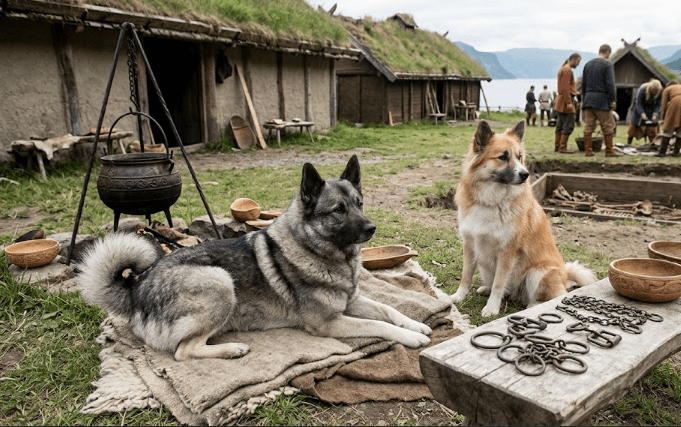
How Modern Dog Culture Can Mislead Viking Interpretation
Modern visitors often approach Viking dogs through affection. They may imagine loyalty, companionship, protection, and familiar pet behavior. Those ideas can overlap with the archaeological record in some cases, yet they cannot explain every dog find. A modern pet-owner lens makes the past feel close, but it can also hide cultural differences.
Birka’s 2026 program includes lectures about dogs in archaeological context, which gives the event a needed corrective. Archaeological context asks different questions from modern feeling. Where did the dog appear? Did the remains come from a grave, settlement layer, waste deposit, workshop area, or ritual setting? Did archaeologists find the whole skeleton or butchered remains? Was the animal placed with a human burial, with other animals, or alone? Bone evidence may also show age, disease, injury, workload, or selective breeding.
These questions protect the subject from easy claims. Dogs in Norse life may have served as companions, hunters, herders, guards, status markers, ritual offerings, or afterlife attendants. In some cases, one animal may have filled several roles during its lifetime. Other dogs may have entered the archaeological record through burial customs that tell researchers more about human belief than daily dog care.
The Swedish Icelandic Sheepdog Club’s involvement at Birka adds another useful layer. Herding demonstrations help visitors imagine work between humans and dogs, and the Icelandic sheepdog has modern roots in northern herding traditions. Still, a demonstration in 2026 does not prove that Viking Age Birka used identical dogs in identical ways. The safer interpretation is broader: dogs could belong to systems of work, movement, and animal management that mattered across rural and urban Norse life.
What Dog Burials Reveal About Status And Memory
Dog remains in Viking Age graves show that animals could hold meaning after death. Christopher Nichols’ open-access study in the European Journal of Archaeology, published online in November 2023, examined three dogs from Late Iron Age boat graves at Gamla Uppsala Prästgården in Sweden. The abstract states that excavations there produced six Viking Age boat burials, several with domestic dog remains. Nichols found that two examined dogs were large, slender sight hounds, while the third was smaller and of uncertain type.
From there, the study places dogs inside a wider burial pattern in Late Iron Age Scandinavia. Nichols notes that the domestic dog is the most common animal species represented in such graves and appears across different burial forms, social statuses, ages, and sexes. He also contrasts animals butchered for feasting with animals such as dogs, horses, and raptors that more often appear intact. That distinction helps readers avoid one simple answer. Animals in graves could mark food, wealth, sacrifice, companionship, symbolic protection, or social display, depending on species and context.
High-status graves at Gamla Uppsala, Vendel, and Valsgärde make the question sharper. Large sight hounds in elite boat burials suggest that some dogs carried social meaning beyond practical farm work. They may have signaled hunting skill, prestige, companionship, or a funerary tradition shared among elite communities in the Mälaren region. Even so, the evidence does not mean every Viking Age dog held elite status. It shows that some people chose to place dogs in death settings where status, memory, and ritual already mattered.
Birka’s dog weekend can make that evidence easier for the public to approach, provided the interpretation stays careful. A dog parade may create interest. Archaeology then has to explain why some dogs entered graves and others did not.
Why The Senja Boat Grave Adds A Norwegian Comparison
Norway offers a recent comparison that makes the Birka event even more relevant for Old Norse News readers. In June 2025, UiT The Arctic University of Norway reported a Viking Age boat grave from Sand on the island of Senja in Northern Norway. Two metal detectorists first found 1,000-year-old Viking Age jewelry in 2023, and archaeologists from the Arctic University Museum of Norway later uncovered a burial boat containing a woman and a small dog. (Senja woman and dog boat grave)
The Senja grave dates the brooches to about AD 900–950. UiT says the boat measured around 5.4 meters and likely served coastal fishing, transport, and travel before burial. The woman’s grave goods included oval brooches, an iron sickle, a slate whetstone, a possible spindle whorl, a possible weaving sword made from whale bone, and other objects. These items point toward farming, textile work, household authority, and regional status rather than a simple warrior narrative.
At the woman’s feet, archaeologists found the dog placed with care. Anja Roth Niemi, project leader for the excavation, told UiT that dogs and horses appear most commonly among animals in Late Iron Age graves. She also noted that dogs usually appear as whole animals, which suggests a close and valued relationship between humans and dogs more than a thousand years ago. The Senja dog may have been a companion, hunting dog, guard dog, or symbolic attendant in the afterlife, but the exact role remains open.
That uncertainty is useful, not frustrating. A dog buried with a woman in Senja does not prove that all Viking Age dogs had the same role. It shows that, in at least one northern Norwegian burial, mourners placed a small dog carefully beside a woman whose grave goods already carried social meaning. Birka’s event can help readers see how local examples from Sweden and Norway belong to a wider Scandinavian question.
How Animals Expand The Story Beyond Warriors And Ships
Animals force Viking history to widen. A warrior-centered story can focus on weapons, raids, elite graves, and ships. Animal evidence shifts attention toward food, labor, travel, textile production, hunting, herding, ritual, and household management. Dogs sit at the intersection of many of those systems.
At Birka, animals would have mattered in an urban trading environment. Dogs may have lived near workshops, homes, docks, and paths. Livestock products moved through trade and domestic labor. Bone and horn became raw materials. Skins and furs counted among goods that Birka’s official history page names as part of the exchange economy. As a result, animals shaped the town even when they do not appear as the headline attraction.
This matters for Norse identity as well. Modern Viking imagery often favors the ship, helmet, axe, and warrior body. Animal evidence points instead toward dependency. People needed animals for warmth, food, craft materials, transport, protection, status display, and symbolic language. A dog in a grave or a horse beside an elite burial does not simply decorate the dead; it can reveal how people imagined relationships between life, death, power, and the non-human world.
The dog weekend format gives museums and heritage sites a practical teaching tool. Families may come for herding demonstrations or dog parades, then leave with a better question: what can animal bones tell archaeologists that written sources do not? That is the kind of public history oldnorsenews.org can use well. It begins with a current event and moves the reader toward evidence.
Why Museums Should Separate Evidence From Affection
Dogs make the Viking Age feel emotionally close, so museums need extra care. A dog curled at a person’s feet in a grave invites a powerful reaction. It is easy to say “beloved pet” and stop there. The evidence may support affection in some cases, but archaeology should keep other possibilities visible.
Responsible interpretation separates what researchers found from what modern readers feel. Whole dog skeletons in graves can suggest companionship or afterlife service. Their placement may indicate care, status, or ritual. Size and body form can suggest hunting or elite preference. Pathology can reveal age, injury, or working life. Isotopes and DNA may help trace mobility and breeding. Each method adds evidence, yet none gives a complete biography of the animal.
Birka’s official event page promises lectures about dogs in archaeological context alongside lighter programming. That balance is useful because heritage sites need accessible entry points, and dogs provide one. The risk comes when accessibility becomes sentiment without source clarity. Viking Age animals deserve better than modern projection.
A stronger museum story can show visitors several layers at once: dogs as working animals, dogs as companions, dogs as grave participants, dogs as status markers, and dogs as archaeological subjects. Those layers do not cancel each other. Instead, they remind readers that Norse society was full of human-animal relationships that changed by place, period, class, and context.
What Readers Should Ask When They See Viking Animals
Readers should treat Viking animal stories as evidence questions, not just charming details. Where did archaeologists find the animal? What date fits the context? Did the animal appear whole, burned, butchered, disarticulated, or carefully placed? Did it accompany a human burial, a boat grave, a household layer, or a refuse deposit? Can researchers identify species, size, sex, age, health, injuries, diet, or origin?
Those questions make Birka’s Viking dog weekend more than a seasonal attraction. The August 2026 event can introduce visitors to the living presence of dogs, but the deeper value lies in what the archaeological record asks afterward. At Birka, dogs belong to a wider heritage landscape of trade, burial grounds, museum interpretation, and Viking Age settlement. Across Scandinavia, dog remains from sites such as Gamla Uppsala and Senja show that animals could take part in status display, ritual care, household identity, and memory.
For oldnorsenews.org, this topic works because it avoids the easiest Viking stereotypes. Dogs bring readers into farms, towns, boats, graves, herding fields, hunting worlds, and family spaces. They also make the limits of evidence clear. The record supports saying that some Viking Age people buried dogs with care. Researchers can also say that dogs appear often enough in Late Iron Age graves to deserve serious study. At the same time, every dog should not become a modern pet story, and every grave should not become a sentimental scene.
Birka’s dog weekend matters because it opens that richer question. Animals were not marginal to Norse life. They helped people work, travel, hunt, eat, dress, guard, trade, mourn, and imagine the afterlife. A good Viking museum event should make that visible without pretending the evidence says more than it does.
