
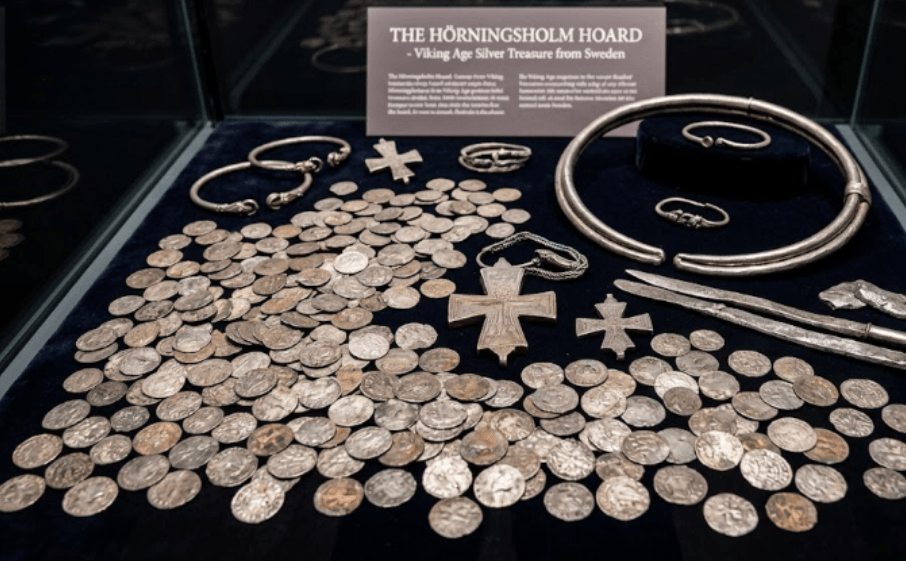
The Hörningsholm Hoard makes Sweden’s Viking silver story a legal story too because its importance does not stop at the coins. On May 21, 2026, Sweden’s National Heritage Board, Riksantikvarieämbetet, decided to redeem the hoard found at Hörningsholm 2:7 in Mörkö parish, Södertälje Municipality, for 4 million Swedish kronor. The hoard, discovered in August 2025, consists of about 24,100 silver coins and 144 other objects from the Viking Age and early medieval period. Riksantikvarieämbetet describes it as the largest coin hoard yet found in Sweden and says it has very high cultural-historical value because it can reveal new knowledge about early economy, long-distance contacts, and social structure in a period with limited written sources. (Riksantikvarieämbetet Hörningsholm decision)
Why The Hörningsholm Hoard Matters
The Hörningsholm Hoard matters because it sits at the boundary between treasure story, silver economy, and heritage law. A find of more than 24,000 coins naturally attracts attention as a spectacular discovery. Yet the 2026 redemption decision shows that Sweden treats such finds as public knowledge, not only as private luck.
The hoard includes mostly silver, along with gilded objects and a few gold objects. Riksantikvarieämbetet reports that the material is generally in good condition. The find also contains an unusually large number of rare bishop’s coins, which makes it especially valuable for studying early medieval coinage and authority.
For oldnorsenews.org readers, the careful wording matters. The hoard belongs to the Viking Age and early medieval transition, not to a simple “Viking treasure” category. It contains objects from a period when Scandinavia was moving from weight-based silver exchange toward more organized coin economies, royal minting, church authority, and legal systems that later shaped how such finds are handled today.
How The Discovery Began
Stockholm County Administrative Board first reported the find publicly on September 18, 2025. A private person found the unusually large and well-preserved silver hoard in the Stockholm area while digging for fishing worms near a summer cottage. The finder reported the discovery to the County Administrative Board, and archaeologists then began examining both the findspot and the coins, beads, rings, pendants, and other objects.
At that first stage, the hoard was described as weighing about six kilograms. It consisted largely of silver coins, together with silver rings, pendants, and beads deposited in a copper cauldron. Sofia Andersson, antiquarian at Stockholm County Administrative Board, described it as probably one of Sweden’s largest silver hoards from the beginning of the Middle Ages.
The later National Heritage Board decision refined the public numbers. Instead of the early estimate of up to 20,000 coins, the final count became about 24,100 silver coins and 144 other objects. That difference shows why early archaeology reporting needs caution. First announcements can be accurate in broad outline while later documentation improves the detail.
Why The Legal Response Is Part Of The Find
The legal response is not a side note. It is part of the find’s historical value. Riksantikvarieämbetet states that the finder reported the discovery to the County Administrative Board as soon as possible and thereby fulfilled her legal obligations. That quick report allowed authorities to document, study, preserve, and eventually redeem the hoard.
Swedish law treats many ancient finds differently from ordinary lost property. Riksantikvarieämbetet explains that finds from prehistoric or older times, generally before 1850, must be reported when they lack an owner and meet certain conditions. If a find consists wholly or partly of gold, silver, bronze, or another copper alloy, the finder must offer it to the state for redemption. The same applies when two or more objects appear to have been deliberately deposited together as a hoard.
That framework explains why the Hörningsholm Hoard became a legal case. It was silver. It was a deposited group. It had no modern owner. Its value depended on archaeology, not only metal.
Why Four Million Kronor Matters
The 4 million SEK redemption amount matters because it shows the balance Sweden tries to strike between rewarding responsible reporting and discouraging looting. Riksantikvarieämbetet’s 2026 decision explains that compensation must be reasonable. It should not disadvantage the finder, but it also should not rise so high that it encourages treasure plundering.
That point makes the hoard a legal and ethical story. Public heritage systems need cooperation from finders, landowners, museums, county authorities, and national agencies. If people believe reporting finds only brings trouble, archaeological evidence may vanish into private collections or illegal markets. If rewards become speculative jackpots, metal detecting and site disturbance can increase.
The Hörningsholm decision therefore sits in the middle. It recognizes the hoard’s exceptional cultural value while keeping the public purpose of the law visible. The state did not buy a luxury object. It redeemed evidence.
That distinction matters for every Viking and medieval silver hoard story.
Why Sweden’s Silver Story Needs Law
Sweden’s silver story needs law because silver hoards are vulnerable. Coins, rings, pendants, and hacksilver are portable, valuable, and easy to remove from context. Once separated from their findspot, they lose much of their archaeological meaning.
Riksantikvarieämbetet warns that cultural heritage crime deprives society of part of its history. It also states that metal detectors may not be used without permission and that finds of precious metal believed to be older than 1850 must be reported to the County Administrative Board. The agency also notes that it works with police and customs to monitor and combat illegal trade in ancient finds.
This matters for Hörningsholm because the hoard’s value comes from more than the silver itself. Its location at Mörkö, its container, its coin types, its object mix, and its relationship to early medieval society all depend on documentation.
A looted hoard becomes a pile of objects. A reported hoard becomes historical evidence.
Why The Hoard Is Not Just “Viking Treasure”
The title of this article uses “Viking silver story,” but the evidence requires precision. Stockholm County Administrative Board described the hoard as early medieval and said the silver coins date mainly to the 1100s. Some coins carry the text KANUTUS, the Latin form of Knut, and belong to the reign of King Knut Eriksson in Sweden in the late 1100s.
Riksantikvarieämbetet’s later decision says the hoard contains objects from the Viking Age and early medieval period. That means the find helps explain a transition rather than a single era. It carries Viking Age silver traditions forward into a world of kings, bishops, coinage, and changing institutions.
That transitional character is the best reason to cover it on oldnorsenews.org. The Viking Age did not simply end overnight. Silver habits, trade routes, stored wealth, precious-metal objects, and old deposition practices continued to shape early medieval Scandinavia.
The Hörningsholm Hoard therefore complicates period labels. It asks readers to think across the Viking-to-medieval boundary.
Why Bishop’s Coins Change The Story
The bishop’s coins are one of the most important details. Stockholm County Administrative Board reported that several coins were unusual bishop’s coins, meaning coins made for a bishop. Some show a bishop holding a crozier in the right hand. Riksantikvarieämbetet later emphasized that the hoard contains an unusually large number of rare bishop’s coins.
That matters because bishop’s coins bring church authority into the silver story. Viking Age silver hoards often make readers think of raids, trade, Islamic dirhams, English pennies, and weighed hacksilver. Bishop’s coins point toward a later institutional world, where church power, royal power, minting rights, and local economies were becoming more formal.
The hoard therefore does not only show wealth. It shows authority stamped into metal. Coins can carry names, titles, symbols, buildings, bishops, kings, and regional identities.
A silver hoard with many bishop’s coins becomes a source for political and religious history, not only economic history.
How The Hoard Connects To Viking-Age Silver Habits
The Hörningsholm Hoard also matters because it invites comparison with Viking Age silver habits. The Swedish History Museum explains that Viking Age payment often worked through weighed silver. Silver could appear as coins, jewelry, rods, pieces, and other objects. Value depended on weight and purity rather than fixed coin denominations. (Viking Age payment forms)
That system helps readers understand why coins and objects often appear together. A coin was not always treated as a modern coin. It could be bullion, ornament, pendant, payment, or raw material. People could cut silver to adjust weight, test purity, or melt it for new objects.
The Hörningsholm Hoard belongs later than many classic Viking Age hoards, but its mixture of coins and objects echoes older silver practices. It also shows what changed. By the 1100s, coins connected more strongly to named rulers, bishops, and institutions.
The hoard therefore shows continuity and transformation in one deposit.
Why The Copper Cauldron Matters
The copper cauldron matters because it gave the hoard a container and deposition context. Stockholm County Administrative Board reported that the silver coins, rings, pendants, and beads had been placed in a copper cauldron. The objects were mostly well preserved, although the cauldron itself was in poorer condition.
A container changes how archaeologists read a hoard. Loose objects scattered in soil tell a different story from objects deliberately placed in a vessel. A cauldron implies collection, storage, concealment, and perhaps a single act of deposition.
The container also strengthens the legal and archaeological case. The hoard was not merely a group of stray coins. It was a deposited assemblage. Swedish law specifically treats grouped finds, or depot finds, as reportable when two or more objects appear to have been deliberately placed together.
The copper cauldron therefore connects everyday material, legal definition, and historical interpretation.
Why Mörkö Adds Geography To The Silver Story
Mörkö adds geography to the silver story. The National Heritage Board identifies the property as Hörningsholm 2:7 in Mörkö parish, within Södertälje Municipality. That places the hoard in the Stockholm region, not on Gotland or at a famous Viking trading center.
This matters because Swedish silver history often highlights Gotland’s hoards, Sigtuna’s coinage, Birka’s trade, and major museum finds. Hörningsholm reminds readers that large hoards can also emerge from landscapes that do not dominate popular Viking maps.
Mörkö’s position near waterways and the wider Mälaren region gives the hoard a plausible connection to movement, exchange, and regional wealth. However, the source material does not yet allow a detailed reconstruction of the depositor’s identity, route, or reason for burial.
The safest interpretation is geographic but cautious. The hoard places a major silver deposit in the Stockholm region and adds new evidence for early medieval economy there.
Why The Findspot Was Initially Withheld
Stockholm County Administrative Board initially avoided naming the exact findspot while archaeologists examined the site. That caution should be understood as heritage protection, not secrecy for its own sake.
Precise locations can attract unauthorized digging, metal detecting, and disturbance. A hoard site may contain more evidence than the visible objects first found. It may preserve soil stains, container remains, scattered coins, traces of digging, nearby features, or other archaeological context.
The County Administrative Board’s decision to withhold the location during investigation fits the same legal logic that later shaped the redemption decision. Finds are not only things. They are part of protected contexts.
Readers should take this as a practical lesson. Responsible heritage reporting sometimes means delaying public detail so archaeologists can protect the evidence.
Why The Hoard Changes The “Largest” Question
The word “largest” needs careful handling. Riksantikvarieämbetet calls Hörningsholm the largest coin hoard yet found in Sweden. That does not necessarily mean the largest silver hoard by weight, largest Viking Age hoard, or largest treasure by market value. It means the largest coin hoard by the agency’s current assessment.
This distinction matters because hoards can be ranked in different ways: number of coins, weight of silver, number of objects, cultural value, chronological span, rarity of types, or research potential. Hörningsholm’s importance comes especially from coin count, object mix, preservation, rare bishop’s coins, and legal handling.
The Swedish History Museum’s pages on Viking hoards also show how different hoards can matter for different reasons. Gotlandic hoards, imported coins, hacksilver, pendants, and bullion all tell different parts of the silver story.
Hörningsholm does not replace those stories. It adds a new legal and early medieval chapter to them.
Why This Connects To Old Norse Silver Trade
The Hörningsholm Hoard also connects with the wider Old Norse silver trade because Scandinavian silver moved through several systems over time. Earlier Viking Age networks brought silver from Islamic, Byzantine, English, German, and other sources into northern Europe. Later Scandinavian coinage and church-linked coins added new authorities to the metal economy.
Old Norse News has covered how Viking Age trade and expansion depended on ships, markets, routes, commodities, and silver. Hörningsholm adds a later question: what happens when older silver traditions meet stronger royal and ecclesiastical institutions?
That question is more useful than calling the hoard simply “Viking treasure.” The hoard’s importance lies in transition. It shows silver at the point where weight, coinage, hoarding, church authority, royal naming, and legal heritage all intersect.
The silver story becomes bigger when law enters it.
Why The Finder’s Role Should Be Treated Carefully
The finder’s role should be treated carefully because responsible reporting protected the hoard’s knowledge value. Riksantikvarieämbetet says the finder reported the find as soon as possible and fulfilled what the law required. Stockholm County Administrative Board also praised the finder’s correct action in contacting authorities.
That does not mean every article should turn the finder into the main character. The finder acted responsibly, and the compensation decision recognized the legal process. Yet the hoard belongs to a wider public story involving archaeologists, county officials, national heritage staff, legal rules, conservation, documentation, and future research.
This balance matters. Public praise for responsible reporting can encourage good behavior. At the same time, heritage coverage should not romanticize treasure hunting, unauthorized detecting, or accidental disturbance.
The best lesson is simple: report finds quickly, leave context intact when possible, and let specialists document what the objects cannot explain alone.
Why The Hoard Does Not Prove Too Much
The Hörningsholm Hoard does not prove who buried it. It does not identify a named bishop, trader, landowner, king, or church institution as the depositor. It does not yet explain why the hoard entered the ground. It also does not prove one single crisis, raid, tax event, or family emergency.
The evidence supports more careful claims. The hoard was found in August 2025 at Hörningsholm 2:7 in Mörkö parish. It contains about 24,100 silver coins and 144 other objects from the Viking Age and early medieval period. Many coins date mainly to the 1100s, including Knut Eriksson-period examples and rare bishop’s coins. The state redeemed it in 2026 for 4 million SEK.
Those facts are strong enough. The hoard does not need a dramatic invented motive. Its real value lies in what it can reveal after full documentation and specialist study.
A responsible article should leave room for future analysis.
Why Future Research Matters
Future research matters because a hoard of this size can produce many different kinds of knowledge. Numismatists can identify coin types, mints, rulers, bishops, die links, circulation patterns, and chronological limits. Archaeologists can study deposition, container remains, object arrangement, and site context. Conservators can examine wear, corrosion, gilding, and traces of use.
The rare bishop’s coins may be especially important. If researchers can identify where and when they were struck, the hoard may clarify church-linked minting, ecclesiastical authority, and regional circulation in early medieval Sweden and Europe.
The object mix also matters. Rings, pendants, beads, gilded objects, and gold items can show how silver wealth coexisted with ornament, display, and stored value. Some objects may have long biographies before deposition.
The hoard is therefore not finished as a news story. It is beginning as a research archive.
Why This Is A Legal Story Too
The Hörningsholm Hoard makes Sweden’s Viking silver story a legal story because every stage depended on rules. The finder reported the discovery. The County Administrative Board investigated and protected the site. Riksantikvarieämbetet assessed the find and decided on redemption. Swedish heritage law defined why the hoard had to be offered to the state and how compensation could work.
That legal chain is not separate from history. It is what allowed the history to survive.
Without reporting, the hoard could have become anonymous silver. Without documentation, the copper cauldron, object mix, and find context could have lost meaning. Without compensation rules, responsible finders might feel punished. Without anti-looting concerns, high rewards could create new risks for buried archaeology.
The Hörningsholm Hoard therefore teaches two lessons at once. It reveals early economy, long-distance contacts, bishop’s coins, and changing silver use. It also shows why law, ethics, and public responsibility shape what modern readers can learn from the Viking and early medieval past.
