
Nonnebakken makes Odense’s hidden Viking fortress a modern city story because the monument does not stand in open countryside. Streets, buildings, pavements, school grounds, and daily urban movement now sit above much of the fortress in central Odense. VisitOdense lists the current “Odense’s Viking Fortress” exhibition at Museum TID, Møntestræde 1, 5000 Odense C, with August 2026 dates and daily opening times from 10:00 to 17:00. The exhibition invites visitors to discover Nonnebakken and understand Viking Age power structures through finds, stories, and UNESCO context. That public framing matters because Nonnebakken is not only a Viking monument. It also tests how a modern city explains archaeology that most people cannot fully see above ground. (Odense’s Viking Fortress Exhibition)
Why Nonnebakken Matters Now
Nonnebakken matters now because Odense is turning a mostly hidden Viking fortress into a visible part of the city’s identity. VisitOdense’s exhibition listing says visitors can learn why Nonnebakken, together with four other Danish ring fortresses, entered the UNESCO World Heritage List in 2023. The same listing says the exhibition brings visitors closer to the Viking Age through unique finds and stories that raise a modern question: how can a structure more than 1,000 years old still matter today?
That question makes the topic timely. Nonnebakken does not work like Trelleborg, Fyrkat, or Aggersborg, where visitors can read parts of the monument more easily in the landscape. UNESCO notes that modern urban fabric now covers Nonnebakken, even though archaeological deposits survive below ground.
For oldnorsenews.org readers, the strongest angle is not simply “a fortress under a city.” A better frame asks how urban archaeology changes public understanding. Nonnebakken asks Odense to make an invisible monument readable.
What Nonnebakken Was
Nonnebakken formed part of the Danish Viking Age ring-fortress network associated with King Harald Bluetooth. VisitDenmark states that Harald built at least five known ring castles around AD 980, including Aggersborg, Fyrkat, Trelleborg, Borgring, and Nonnebakken. The National Museum of Denmark gives the broader construction range as AD 970–980 and presents the fortresses as evidence of Harald Bluetooth’s power, unification ambitions, and response to pressure from the German-Roman Emperor Otto II.
This matters because Nonnebakken was not a local defensive oddity. It belonged to a coordinated royal building program. The ring fortresses shared strict circular geometry, planned internal organization, and strategic locations near important land and sea routes.
Nonnebakken’s special feature is its city setting. VisitOdense’s 2023 UNESCO announcement says the fortress had an outer diameter of 180 meters and stood in central Odense. It also says Nonnebakken was the only one of the five Danish ring fortresses built next to a town during the Viking Age.
Why Harald Bluetooth’s Network Changes The Story
Harald Bluetooth’s ring-fortress network changes the story because it turns Nonnebakken into evidence for state formation. UNESCO describes the Viking-Age Ring Fortresses as monuments that illustrate the centralisation of power by the Danish Jelling Dynasty and the consolidation of the kingdom under Harald. UNESCO also says the fortresses show a strong royal authority able to command resources, military operations, alliance building, and control over territorial waters, land traffic, and trade.
That wider context matters for Odense. Nonnebakken was not only a military structure. It formed part of a royal system designed to organize power across a large territory. A ring fortress beside a town suggests control over movement, people, supplies, and urban growth.
The fortress therefore belongs to both Viking military history and early urban history. Odense’s later importance as Funen’s main town and episcopal seat gives the site extra weight. VisitOdense argues that Nonnebakken’s establishment helped Odense develop further into Funen’s main town.
That does not mean Nonnebakken alone caused Odense’s later history. It means the fortress stands at a crucial early layer of that history.
Why A Hidden Fortress Is Hard To Explain
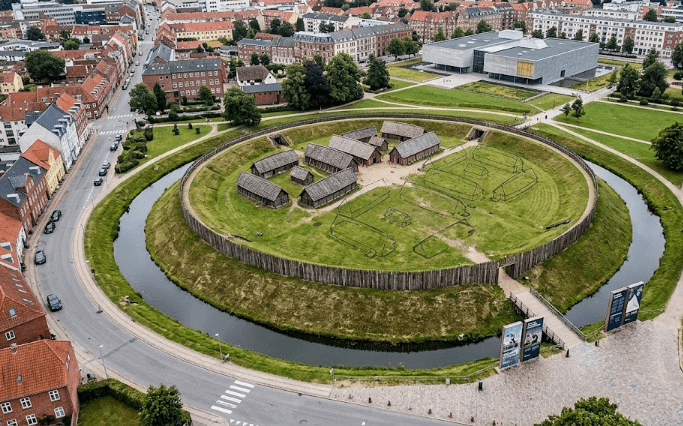
A hidden fortress is hard to explain because visitors cannot simply walk along complete ramparts and understand the structure. VisitDenmark says visitors can still notice the now-smoothed castle mound, where the Odd Fellow Lodge stands today, along with some other traces in the terrain. Other parts of the fortress survive well but remain hidden under the modern city.
This creates a public-history challenge. A famous monument that sits mostly underground needs careful interpretation. Information boards, exhibitions, urban markers, maps, light installations, and walking routes must help people imagine the fortress without inventing more than the evidence supports.
Modern city life can easily swallow archaeological meaning. Roads, buildings, pavements, schoolyards, and lodges make the old ring hard to perceive. Yet that difficulty also makes Nonnebakken unique. It shows how Viking heritage can survive beneath urban life rather than outside it.
Odense’s task is not to remove the city from the monument. The city has to make the monument understandable inside the city.
Why The Fortress Was Not Really Lost
Nonnebakken was hidden, but it was not simply lost. VisitDenmark notes that recent archaeological excavations have uncovered new and groundbreaking knowledge. Contrary to earlier views, large parts of the Viking castle appear well preserved under the modern pavements.
This point is important because the phrase “hidden fortress” can sound like a romantic mystery. The better story is archaeological. Scholars have known Nonnebakken from historical maps, earlier investigations, and modern excavations. Recent work has changed how well researchers understand its preservation.
Museum TID’s Nonnebakken exhibition page states that the fortress had an outer diameter of 180 meters, a 9-meter-wide moat, and an approximately 15-meter-wide rampart that may have stood up to 5 meters high, with wooden cladding on the front and back. Much of the structure now lies hidden beneath central Odense, but archaeologists have excavated parts of it.
Those dimensions help make the invisible visible. A hidden ring can still be measured, mapped, and explained.
Why Urban Archaeology Makes Nonnebakken Different
Urban archaeology makes Nonnebakken different because every interpretation must deal with modern use. UNESCO says urban fabric covers Nonnebakken entirely. VisitOdense calls it the only one of Harald Bluetooth’s five ring fortresses located in the center of a vibrant city, with part of the surrounding earthworks still visible but much of the fortress preserved underground.
That urban setting changes what preservation means. At rural ring fortresses, visitors may expect open views, reconstructed lines, or visible earthworks. At Nonnebakken, preservation often means keeping archaeological layers safe beneath later structures.
This makes Nonnebakken a modern planning story as well as a Viking story. Cities need schools, roads, cultural buildings, utilities, and public spaces. Ancient monuments need protection, research, and interpretation. Nonnebakken sits where those needs overlap.
The site therefore asks a practical question: how can Odense grow as a modern city while respecting one of its oldest power structures?
Why UNESCO Recognition Matters
UNESCO recognition matters because it gives Nonnebakken a global heritage frame. The World Heritage listing includes Aggersborg, Fyrkat, Nonnebakken, Trelleborg, and Borgring as a serial property. UNESCO’s decision states that the fortresses occupied strategic positions near important land and sea routes, used a uniform and precise geometric design, and connected directly with Harald Bluetooth’s state-building ambitions.
This recognition changes how Odense can present Nonnebakken. A local hidden monument becomes part of an international argument about Viking Age military architecture, royal power, state formation, and late tenth-century transformation.
Yet UNESCO status also raises responsibility. The listing does not make Nonnebakken easier to see. It makes interpretation more urgent. The city must explain why something mostly underfoot belongs to world heritage.
That is why the 2026 exhibition matters. It gives the public a current place to learn the fortress story before walking the modern streets above it.
How The Exhibition Turns A Buried Site Into A Visitor Experience
The “Odense’s Viking Fortress” exhibition turns a buried site into a visitor experience by moving from invisible archaeology to objects, narrative, and city interpretation. VisitOdense says visitors will gain insight into Viking Age power structures and see why Nonnebakken remains relevant today. The listing also says the exhibition gives visitors facts and stories that can help them continue their own journey to the places where the fortresses once stood.
That wording matters because a museum cannot replace the site. It can prepare people to read it. A visitor may start at Museum TID, learn the fortress dimensions, understand Harald’s network, see finds and interpretation, then walk toward the hidden ring in central Odense with better eyes.
This is the strongest modern city angle. Nonnebakken is not only preserved underground. Museum space, signage, routes, and urban memory now translate it for modern visitors.
A fortress that cannot fully rise again can still become visible through interpretation.
Why Odense’s Viking Story Is Bigger Than One Fortress
Odense’s Viking story is bigger than one fortress. VisitOdense’s “Life in the City” exhibition page says its story of the city begins in the Viking Age, where visitors learn how Harald Bluetooth built Nonnebakken by the Odense River and where Cnut the Holy, Denmark’s last Viking king, was killed in St. Alban’s Church.
This matters because Nonnebakken sits inside a wider urban transformation. The fortress belongs to Harald Bluetooth’s late tenth-century power network. Cnut the Holy’s death in 1086 belongs to a later moment when Odense had become part of Christian royal and ecclesiastical history. The city’s medieval development adds still more layers.
A good article should not collapse those layers into one “Viking city” scene. Instead, Nonnebakken should be treated as an early monument within a longer urban story. Odense’s development continued through royal, religious, commercial, and civic changes.
That is why the fortress works as a modern city story. It marks a beginning, not the whole history.
Why Nonnebakken Connects Power And Trade
Nonnebakken connects power and trade because ring fortresses controlled movement. UNESCO emphasizes their strategic positions near major land and sea routes. VisitDenmark says the ring castles helped dominate the interior and defend against external opponents. In Odense, the fortress stood near the Odense River and beside a settlement that later grew in importance.
This makes Nonnebakken relevant beyond military architecture. A fortress beside a town could monitor traffic, signal royal authority, organize resources, and shape access to people and goods. Harald Bluetooth’s network was about more than walls. It was about controlling a kingdom in motion.
Old Norse News has explored how Viking Age trade and expansion depended on routes, markets, silver, ships, and power. Nonnebakken adds a strong Danish example of how royal infrastructure could intersect with movement and urban development.
The fortress makes trade feel political.
Why The Finds Matter
The finds matter because they help make Nonnebakken more than a plan on a map. UNESCO’s gallery identifies a circular filigree brooch, 6.2 centimeters in diameter, found at Nonnebakken as part of a hoard with hacksilver and coins.
That object does not explain the whole fortress. However, it reminds visitors that archaeological sites contain personal and portable histories as well as architecture. A fortress required earth, timber, geometry, and labor. Its human story also appears through brooches, coins, silver, tools, waste, postholes, and other traces.
Museum interpretation needs both levels. The large ring shows royal ambition. The smaller finds show people, wealth, use, loss, and deposition. Together, they make the hidden fortress easier to imagine.
Nonnebakken’s modern city story works best when visitors understand both the monumental and the human scale.
Why The Ring Form Still Matters
The ring form still matters because it shows controlled design. UNESCO says the ring fortresses used a uniform, precise, geometric, scalable design. The structures included circular ramparts, four gateways close to the cardinal points, ditches, axial streets, ring streets, and rows of longhouses arranged in quadrants in most cases.
This design was not accidental. It signaled order. A ruler who could command such geometry across several places could also command surveyors, builders, timber, labor, food supplies, and military organization.
At Nonnebakken, that order is harder to see today because the modern city covers the ring. Yet the form remains central to its meaning. Once visitors understand the circle, the moat, the rampart, and the planned interior, Odense’s streets become layered with an older geometry.
The ring is hidden, but it still organizes the story.
Why Nonnebakken Should Not Be Oversimplified
Nonnebakken should not be oversimplified as a simple “Viking castle.” That phrase helps visitors quickly understand the site, but it can hide complexity. Ring fortresses were not medieval stone castles. They were late tenth-century fortified royal structures with timber, earthworks, ditches, controlled entrances, and planned interiors.
Their exact day-to-day function also remains partly inferred. UNESCO says scholars can only infer the function of the fortresses, even though the network clearly testifies to state formation, military organization, and socio-political transformation. That caution is important.
A fortress can suggest soldiers, storage, control, administration, royal presence, defensive planning, or short-term mobilization. The evidence does not always reveal every activity that happened inside the walls.
Nonnebakken therefore needs interpretation that is confident about what is known and careful about what remains uncertain. That balance protects the site from fantasy.
Why The Modern City Is Part Of The Evidence
The modern city is part of the evidence because it explains why Nonnebakken looks the way it does today. UNESCO notes that above-ground elements of the fortresses have suffered decay, while urban fabric covers Nonnebakken. VisitDenmark says the mound has been smoothed out and that parts are hidden under modern pavements.
These modern changes do not erase the fortress’s importance. They define its public challenge. The site’s visibility problem is itself historical evidence of urban continuity, rebuilding, reuse, and changing priorities.
Odense did not freeze around Nonnebakken. It grew over it. That growth makes the fortress harder to see, but also more meaningful. The city’s oldest royal infrastructure now sits beneath a living urban center.
For readers, this changes the emotional response. Nonnebakken is not a ruin outside town. It is a buried layer inside everyday Odense.
Why Public Marking Matters
Public marking matters because invisible heritage needs signals. VisitOdense’s 2023 UNESCO announcement says Odense Municipality and Museum Odense marked the designation with a light installation titled “What was and what is.” The installation used 230 reflective flags to draw attention to what lies hidden beneath the ground.
That project name captures the whole Nonnebakken problem. “What was” is the tenth-century ring fortress. “What is” is the modern city. Public interpretation must hold both together.
Markers, museum displays, walking routes, and temporary or permanent installations cannot replace excavation. They can help residents and visitors sense the scale and location of a monument they might otherwise pass without noticing.
This is why Nonnebakken’s story is modern. The challenge is not only to preserve the past. It is to make the buried past legible in present-day public space.
Why Visitors Should Verify Before Making Big Claims
Visitors should verify several points before making big claims about Nonnebakken. First, the fortress belongs to Harald Bluetooth’s late tenth-century ring-fortress network, usually dated around AD 970–980. Second, it is part of a UNESCO serial property with Aggersborg, Fyrkat, Trelleborg, and Borgring.
Third, Nonnebakken is largely hidden under central Odense, even though parts remain visible or marked and archaeological deposits are preserved below ground. Fourth, visitors should not describe the site as a fully visible reconstructed fortress. Its modern interpretation depends on museum displays, urban markers, and archaeological evidence.
Finally, the fortress’s function should be discussed carefully. It clearly relates to royal power, state formation, military architecture, and route control, but the exact use of every internal space cannot be treated as certain.
Those limits make the site stronger, not weaker. They make it a serious archaeological story.
Why Nonnebakken Makes Odense A Modern Viking City Story
Nonnebakken makes Odense a modern Viking city story because the fortress survives as a hidden layer of urban identity. Harald Bluetooth’s builders created it as part of the royal ring-fortress network around the late tenth century. The fortress stood beside a settlement and near the Odense River. Later, the city grew above and around it.
Today, its meaning depends on how Odense explains what cannot be fully seen. Museum TID’s 2026 exhibition, UNESCO recognition, VisitOdense’s public interpretation, and ongoing urban heritage work all turn Nonnebakken into more than an archaeological feature. They make it a civic question.
How does a city remember a fortress beneath its pavements? How does world heritage live under schools, lodges, streets, and walking routes? How do visitors distinguish evidence from reconstruction when the monument’s strongest remains are underground?
Those questions are why Nonnebakken matters now. Odense’s hidden Viking fortress is not only a story about Harald Bluetooth’s power. It is a story about how modern cities carry the Viking Age underfoot.
