
Sweden’s fragile runestones need conservation before new interpretation because every reading depends on a surface that weather, lichen, cleaning, repainting, visitor pressure, and older repairs can change. The Swedish National Heritage Board, Riksantikvarieämbetet, warned in its November 6, 2025 article “Runstenar – ett ömtåligt kulturarv” that runestones and runic inscriptions fascinate people, but they also require care, maintenance, and information if future readers are going to experience and understand them. The agency also gives a direct public warning: if a private person sees a runestone that needs care, they should contact the county administrative board, not try to make the runes more visible themselves. Such private “care” is not allowed under Sweden’s cultural heritage law and can damage the inscription forever. (Riksantikvarieämbetet Runestone Warning)
Why This Conservation Question Matters Now
The conservation question matters now because Swedish runes are receiving fresh public attention while their physical condition remains uneven. In March 2026, Riksantikvarieämbetet noted that Swedish runes had recently attracted international coverage from the BBC and ABC Listen, helped by the agency’s runologists Magnus Källström and Laila Kitzler Åhfeldt. The same article states that Sweden has more preserved runestones than any other country and that new finds still occur. (Swedish Runes International Coverage)
That excitement creates a useful news hook for oldnorsenews.org. New finds, 3D scanning, digital databases, and international media coverage make runestones feel newly alive. Yet the strongest interpretation still begins with preservation. A damaged inscription, a wrongly repainted rune, or an aggressively cleaned stone can mislead researchers and visitors for decades.
The central reader decision is simple: before accepting a dramatic new reading, ask how specialists documented, conserved, and checked the stone.
Why Runestones Are Not Ordinary Stones
Runestones are not ordinary stones because they are both monuments and written documents. Riksantikvarieämbetet says runestones have a special position among ancient monuments because they are the main source for the Swedish language before the Middle Ages. That means every conservation, documentation, and management choice must also respect their value as written records and as material for ongoing runological research. (Runestone Care Guidance)
This point changes the whole discussion. A runestone is not only a carved object that should look neat in a churchyard, meadow, road corridor, or museum display. It is also evidence for language, names, kinship, inheritance, memorial practice, Christianity, road building, travel, art style, and local power.
A reader may want the runes filled with bright paint so the text is easier to see. A conservator may worry about material stability. A runologist may worry that a line has been misunderstood. A county administrator may have to balance public access, law, budget, and long-term care.
Good interpretation has to respect all of those needs.
Why Sweden’s Runestone Boom Needs Caution
Sweden’s runestone boom needs caution because the stones carry more than one kind of evidence. Riksantikvarieämbetet’s educational page explains that, from the late 900s into the early 1100s, people in Sweden raised memorial stones with runic inscriptions when relatives died. The agency also stresses that these stones are usually not gravestones in the modern sense. They are better understood as memorial stones, often raised at meaningful places rather than directly over the burial.
That distinction matters because public interpretation can drift into shortcuts. A runestone near a grave field does not automatically mark a grave. A Christian cross does not erase older social customs. A name in the inscription does not prove the exact location of a person’s burial. A weathered line does not become a sensational claim just because it fits a modern story.
Old Norse News has covered why readers should be careful when separating Norse myth from Viking history. Runestones require the same discipline. The inscription is primary evidence, but only when specialists can read it responsibly.
Why Lichen And Moss Are More Than A Visibility Problem
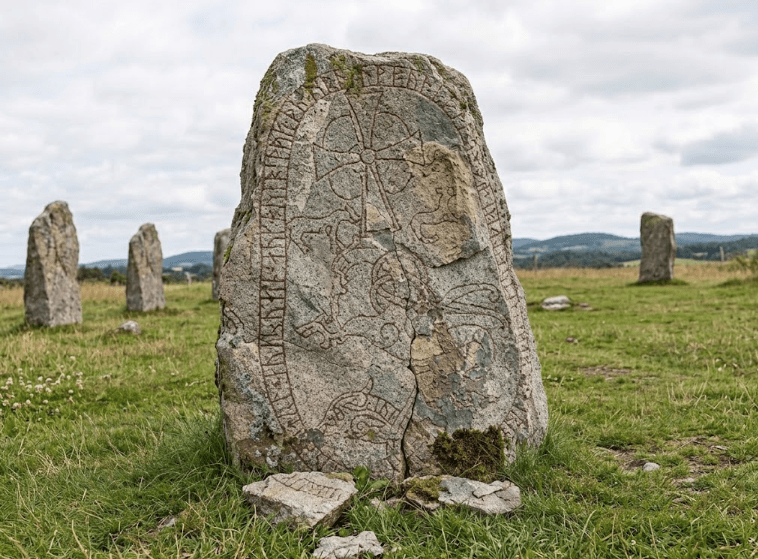
Lichen, moss, algae, and other biological growth are more than a visibility problem because cleaning can help one value while harming another. Riksantikvarieämbetet explains that algae, moss, and especially lichen can quickly cover outdoor stone surfaces and make carved lines hard to see. The agency also warns that every manager must weigh the wish to keep stones free from biological growth against the wear that cleaning can cause.
That is the conservation dilemma in one sentence. Visitors may see lichen and think neglect. Specialists may see lichen, stone type, moisture, old paint, prior repairs, surrounding vegetation, drainage, and the risk that repeated cleaning will make the surface rougher. A rougher surface can then invite more growth.
Upplandsmuseet gives a concrete regional example. Its runestone-care project in Uppsala County began with an inventory of outdoor runic inscriptions, and the museum reports that a group of stones was acutely threatened. It also says that one third of the stones were so covered with lichen and moss that motifs or runes could not be read.
The problem is not that visitors are wrong to want readable stones. The problem is that readability has to come through expert care.
Why Cleaning Can Become Damage
Cleaning can become damage when people treat stone as if it were a garden feature rather than an ancient written source. Riksantikvarieämbetet warns that many commercial products claim to keep stone free from biological growth, excess water, or graffiti, but new treatments and methods may remain untested on archaeological or culturally historic stone. The agency’s rule is blunt: never experiment on original objects.
This matters because runestones are not renewable. A scratched surface, loosened grain, damaged paint layer, widened line, or chemically affected repair can change how the inscription appears. Later readers may struggle to tell whether a mark belongs to the Viking Age carver, a medieval reuse, an antiquarian repair, a modern repainting, or recent damage.
The agency also notes that stone weathering can involve complex processes and that damage from wrong cleaning or surface treatment may become visible long after the harmful action. That delay makes amateur care especially dangerous.
A visitor who wants to help a runestone should not scrape, scrub, paint, chalk, oil, wash, or apply chemicals. The correct action is to report the concern to the county administrative board.
Why Repainting Is An Interpretation, Not Just Maintenance
Repainting is an interpretation, not just maintenance, because it decides which carved lines modern visitors notice first. Riksantikvarieämbetet says repainting unclear or ambiguous runes, ornamental bands, and other features requires knowledge of stone, paint types, iconography, and runology. The goal is to avoid unsuitable materials and prevent distortion or misinterpretation of the text.
This point is easy to overlook. Red paint can make a runestone feel clear and authoritative. Yet the paint may show a modern scholarly reading rather than a preserved Viking Age color scheme. Riksantikvarieämbetet stresses that repainting is usually not a conservation measure, because it adds modern material and because the original individual painting of most stones remains unknown.
That does not mean repainting is always wrong. The agency describes it as an aesthetic and linguistic public-adaptation measure that can make the text easier to read and can make the stone’s value more visible. The important rule is reversibility. Any added material should be possible to remove and should not block future treatment.
Interpretation begins the moment someone picks which lines to paint.
Why County Boards And Runologists Both Matter
County administrative boards and runologists both matter because runestone care combines law, conservation, and language. Riksantikvarieämbetet explains that deep cleaning, consolidation, gluing, and jointing of loose parts should be performed by people with conservation competence. The county administrative boards commission such work and act as the permitting authorities for actions on or near ancient monuments.
Runologists matter because the object is also text. When repainting or reading uncertain lines, linguistic expertise can prevent false clarity. A conservation team may stabilize the stone, but the runologist helps decide what the inscription actually says and where uncertainty remains.
This division protects both the material object and the historical message. A beautifully cleaned stone with a wrongly interpreted inscription still fails as heritage. A brilliant reading that ignores stone condition risks building scholarship on a damaged surface.
Runestone care therefore needs coordinated expertise. No single enthusiastic visitor, local group, or content creator can replace the professional chain.
Why Digital Tools Do Not Replace Conservation
Digital tools do not replace conservation, but they do make conservation-first interpretation more powerful. Riksantikvarieämbetet says 3D digitization can help specialists read damaged and weathered inscriptions better, analyze carving lines, identify rune carvers, and investigate whether different stones were made by the same person or whether parts of an inscription were added later.
In the March 2026 article, Laila Kitzler Åhfeldt discusses how 3D analysis helped connect the famous Jelling Stone in Denmark with Ravnunge-Tue, the rune carver who also appears on the Læborg stone. That research contributed to a new interpretation of Queen Thyra, Harald Bluetooth’s mother, because she appears on more runestones than anyone else in her time.
This is exactly why preservation comes first. A high-resolution scan of a carefully handled surface can reveal tool marks, carving sequence, weathering, and later intervention. A scan of a damaged or overcleaned surface may still help, but it cannot recover everything that poor care has erased.
Technology gives runologists sharper eyes. It does not give damaged stones a second original surface.
Why Neutron Tomography Strengthens The Preservation Argument
Neutron tomography strengthens the preservation argument because it shows what responsible interpretation can look like when the object is too fragile to open. On April 9, 2026, Riksantikvarieämbetet reported that Magnus Källström and Helena Berg had visited the Institut Laue-Langevin in Grenoble, France, to analyze Viking Age and medieval runic metal sheets with neutron tomography. The goal was to read hidden runes without damaging the objects.
The project involved four objects: two lead sheets, one from Binge in Alva on Gotland and one from Källa old church on Öland, plus two rolled copper sheets from Gällungs in Väskinde on Gotland. Källström explained that neutron technology can create three-dimensional digital images and, unlike ordinary X-rays, can see through lead when handled correctly.
That example concerns metal runic sheets rather than outdoor runestones, but the lesson applies widely. The best new readings increasingly depend on methods that protect the object while expanding the evidence. Interpretation should not require destruction.
Why The Runor Database Changes Public Access
The Runor database changes public access because it lets researchers and interested readers check known material without relying only on tourist signs or social media summaries. Riksantikvarieämbetet describes Runor as a digital research platform that makes about 7,000 inscriptions available through reports and images from different databases, institutions, and collections. The service requires no login and has a mobile-friendly field interface. (Runor Search Service)
This matters because better access can reduce careless interpretation. A visitor can compare a stone’s signboard with a database entry. A student can see where uncertainty exists. A writer can avoid inventing translations. A local guide can check whether a stone has been re-read.
Digital access also reveals why conservation matters. A database may preserve photographs, reports, readings, and older interpretations, but the physical stone remains the primary witness. If the stone changes through weathering, vandalism, or poor care, the database becomes a record of loss as well as knowledge.
Runor makes the material easier to study. It also reminds readers that each inscription has a location, condition, history, and management problem.
Why Visitors Should Not Treat Runestones As Props
Visitors should not treat runestones as props because public access can create damage even without bad intentions. People may lean on stones, climb on nearby structures, trace carved lines with fingers, add chalk for photographs, clear moss, place candles, or move small surrounding stones. Some actions feel harmless in the moment but can harm an ancient surface or context.
Riksantikvarieämbetet’s public advice is direct: people who see damage or care needs should contact the county administrative board. They should not perform their own intervention. That rule protects the stone from amateur repair and protects the inscription from modern distortion.
This is especially important for social media. A dramatic photo of red runes, wet stone, or a “newly revealed” carving may travel faster than the careful explanation. Visitors should ask whether the stone was documented, whether specialists handled the care, and whether the interpretation comes from a reliable runological source.
The best visitor leaves the stone more protected than they found it.
Why New Interpretations Need A Condition Check
New interpretations need a condition check because a reading can change when the stone surface changes. Weathering may soften a line. Lichen may hide part of a rune. Older paint may follow an outdated interpretation. A break may remove a grammatical ending. A nineteenth-century record may preserve something no longer visible.
That is why conservation and documentation should come before confident claims. Specialists need photographs, 3D models, older drawings, previous readings, material analysis, and a close look at the stone’s current condition. They also need to know whether cleaning, repainting, repair, or relocation has altered the surface.
Riksantikvarieämbetet’s care guidance separates several goals: preservation, investigation, and public visibility. Those goals can support each other, but they can also pull in different directions. The stone should survive first. The reading should come from evidence second. The visitor experience should follow both.
A good runestone headline should never outrun the conservation record.
Why Climate And Growth Make This A Long-Term Problem
Climate and biological growth make runestone care a long-term problem because outdoor stone never stays frozen in one condition. Riksantikvarieämbetet notes that milder winters and longer growing seasons linked to climate change may make more scientific research and method development necessary for gentle cleaning of runestones and other cultural-historic stone.
That warning matters for future interpretation. If biological growth returns faster, managers face more difficult choices. Clean too often, and the stone may suffer wear. Clean too little, and visitors and researchers may struggle to see the inscription. Use the wrong product, and damage may appear later. Ignore drainage, vegetation, and surrounding maintenance, and moisture problems may worsen.
Preventive care therefore matters as much as dramatic restoration. Riksantikvarieämbetet recommends regular attention to the stone and its surroundings, including removing organic material that holds moisture and watching how water gathers after rain.
The future of runestone interpretation will depend on ordinary maintenance, not only spectacular technology.
Why Sweden’s Runestones Need Source-Sensitive Storytelling
Sweden’s runestones need source-sensitive storytelling because they attract mythic, linguistic, religious, national, and tourist meanings all at once. A single inscription may mention a family member, a bridge, a road, an inheritance, a Christian prayer, a journey abroad, a rune carver, or a local boundary. That richness makes the stones valuable, but it also makes them vulnerable to overinterpretation.
The safest article structure begins with the object, then the condition, then the reading, then the interpretation. A story that begins with a modern agenda can turn a damaged line into fake certainty. A story that begins with conservation gives the stone a chance to speak on its own terms.
This approach also protects readers. It helps them distinguish a published runological reading from a tourist myth, a digital reconstruction from a physical surface, and a cautious interpretation from a viral claim.
Runestones should invite curiosity. They should not reward shortcuts.
What Readers Should Verify Before Accepting A New Runestone Claim
Readers should verify several points before accepting a new runestone claim. First, check whether the claim comes from a runologist, museum, county administrative board, university, or official heritage agency. Second, check whether the stone’s condition has been documented through photographs, 3D scanning, older records, or conservation reports.
Third, ask whether the runes have been cleaned, repainted, repaired, moved, or reinterpreted recently. Fourth, separate the transliteration, translation, and historical interpretation. A single uncertain rune can affect all three. Finally, ask whether the article explains its limits. Serious runestone interpretation should say when a reading is uncertain.
That checklist is not meant to slow interest. It improves interest. The more readers understand the work behind a responsible reading, the less likely they are to accept fake runic claims, exaggerated Viking narratives, or amateur “discoveries” that damage the very evidence they claim to celebrate.
Why Conservation Must Come First
Conservation must come first because runestones are finite records. Sweden has more preserved runestones than any other country, and the Runor database now makes thousands of inscriptions easier to study. New methods, including 3D analysis and neutron tomography for hidden metal inscriptions, show that runology is still developing. International media attention also proves that public interest remains strong.
Yet none of that removes the basic problem. Every inscription depends on the survival of its material surface. Lichen, moisture, weathering, old paint, visitor behavior, vandalism, poor cleaning, and hasty repainting can all change what people think they see.
That is why Sweden’s fragile runestones need conservation before new interpretation. Care does not stand in the way of discovery. It makes discovery trustworthy.
The best future for runestone research will not come from making every line brighter as quickly as possible. It will come from protecting the stones, documenting them carefully, involving runologists and conservators, and giving visitors enough information to understand both the message and the limits. Only then can new interpretations honor the people who carved the stones and the fragile evidence that still carries their words.
