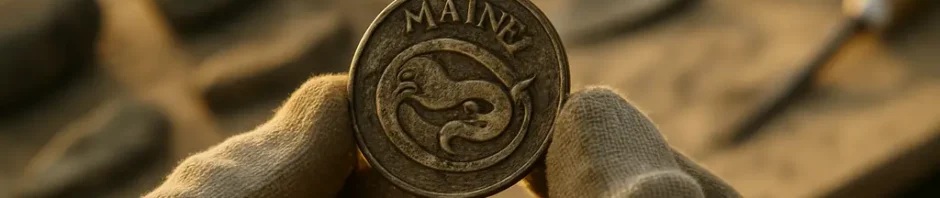
The Maine Penny debate asks a small silver coin to carry a heavy historical burden. The object, also called the Goddard coin, is identified in the research record as a Norwegian silver penny associated with the reign of King Olaf III Kyrre, who ruled from 1067 to 1093. It has been dated to about 1065–1080. The central dispute is not whether the coin is Norse. The harder question is whether it truly came from the Goddard, or Naskeag Point, site in coastal Maine, where it was claimed to have been found on August 18, 1957. If the findspot is genuine, the coin may point toward long-distance Indigenous exchange linking Maine to northern Atlantic contact zones. If the findspot is not secure, the coin tells us far less about medieval movement in North America.
Understanding The Maine Penny Debate
Why The Maine Penny Debate Starts With One Coin
The coin’s small size is part of its power. Archaeology often turns on modest objects: a bead, a nail, a textile fragment, a coin. Yet a single object can be dangerous if interpretation outruns context. The Maine Penny is treated in the research notes as an authentic Norse coin, but authenticity is only one layer of the question. A genuine medieval coin can still be misplaced, planted, collected, traded in recent centuries, or recorded poorly.
The Goddard site matters because it was a large Native American coastal settlement on the Brooklin Peninsula in Maine. The research notes place its occupation, by radiocarbon dating, at approximately 1180–1235. That date range is later than the coin’s minting date, yet still overlaps with the broader period of Norse presence in Greenland, which the notes place from the 10th to the 15th centuries. A coin minted in Norway could, in theory, have remained in circulation or exchange for many decades before reaching another shore.
The Maine Penny debate begins, then, with a gap between object and setting. The coin is Norse. The site is Native American. The time gap is possible but not self-explanatory. That is why the coin has drawn so much attention: it sits at the edge of what the evidence can safely say.
The Goddard Site As A Native Exchange Center
One of the strongest interpretive points is that the Goddard site already contained materials from far away. The research notes describe approximately 30,000 Native archaeological items recovered there, including imported or traded materials such as pottery types from Nova Scotia and New Jersey. In that setting, a foreign coin does not need to prove a Norse camp in Maine. It could instead fit a pattern of exchange among Indigenous communities.
This matters for how we read Norse movement. The old saga-haunted image of a ship landing on every shore is tempting, but archaeology asks for firmer footing. A single coin cannot create a settlement. It can suggest contact, exchange, curation, or later disturbance. The difference is not minor. It changes the whole story from direct Norse arrival in Maine to the possible movement of an object through Native networks.
Provenance And The Goddard Problem
Why Provenance Is The Hardest Question
The research notes state that the coin was claimed to have been found by amateur archaeologist Guy Mellgren on August 18, 1957, at the Goddard site. A later discussion of the find stresses the same claimed discovery context and the problem of missing modern excavation controls near the coin’s story (coin context essay). The issue is not simply whether Mellgren found objects at the site. It is whether this particular coin was recovered from undisturbed archaeological deposits with enough documentation to satisfy later scrutiny.
The lack of a strong chain of custody leaves room for doubt. The research notes also record concern that the coin may have been planted or misplaced, partly because similar Norwegian coins were circulating among collectors in 1957 and Mellgren was a coin collector with some involvement in auction houses. Those facts do not prove planting. They do explain why scholars hesitate before treating the coin as direct evidence of Norse activity on the Maine coast.
Provenance is a stern word, but it names a simple question: where was the object before anyone made a historical claim about it? In Norse studies, that question is essential. Silver traveled widely. Coins moved by trade, gift, theft, loss, heirloom keeping, and modern collecting. Without a well-recorded find context, the object’s meaning narrows.
What A Genuine Coin Still Cannot Tell Us
A genuine Norse penny cannot speak by itself. It cannot identify the last person who carried it. It cannot name the exchange route. It cannot say whether it crossed from Greenland, Newfoundland, or another northern node. It cannot tell us whether it moved quickly after minting or many decades later. It cannot prove that Norse speakers stood at Naskeag Point.
This caution does not diminish the coin. It protects it from being made into evidence it is not. The strongest reading keeps two points together: the coin is a real Norse object, and the story of its arrival in Maine remains unsettled.
Trade Networks Without Settlement
Indigenous Routes As The Stronger Explanation
Recent scholarly discussion summarized through the University of Maine in March 2026 still favored the idea that, if the coin’s findspot is genuine, it more likely reached Maine through Indigenous exchange networks than by direct Viking activity in Maine (University of Maine interview note). That interpretation fits the wider evidence from Goddard: a Native site with many local and imported objects, but no cluster of Norse material.
This reading is significant because it allows contact without colonization. Norse people in the North Atlantic could have exchanged materials that later moved from hand to hand through Indigenous communities. The coin may have been valued as metal, curiosity, ornament, token, or keepsake; the research notes do not provide enough evidence to choose one function. What matters is that movement through exchange does not require Norse buildings, Norse burials, or Norse daily life in Maine.
That pattern also aligns with a broader archaeological lesson: objects can travel farther than people. Silver in particular has a habit of crossing boundaries. Readers interested in coin evidence in a Scandinavian setting may compare this case with Norway’s Viking coin hoard evidence, where context is also central to interpretation.
Why L’Anse Aux Meadows Remains The Contrast
The research notes contrast the Maine Penny with L’Anse aux Meadows in Newfoundland, where multiple Norse structures, tools, and ecofacts have been found. That distinction is vital. L’Anse aux Meadows is not built on one stray object. It is supported by a set of material evidence that points to Norse presence at a site. Maine does not have that same pattern in the research presented here.
If the Goddard coin is genuine in context, it may expand the map of Norse-related object movement. It does not, by itself, expand the map of Norse settlement. Those are different claims, and careful history must keep them apart.
What The Maine Penny Debate Can And Cannot Prove

Evidence For Movement, Not A Maine Colony
The Maine Penny debate can support a cautious model of object circulation. It can raise serious questions about contact zones, Indigenous exchange, and the paths by which a Norse object might move well south of known Norse sites. It can also remind us that Native communities were not passive margins in an Atlantic story. They maintained their own routes, values, and exchange systems.
What the coin cannot prove is just as important. It cannot prove a Norse settlement in Maine. It cannot prove that Viking explorers visited the Goddard site. It cannot prove a direct voyage from Norway, Greenland, or Newfoundland to the Maine coast. The research notes state that as of March–April 2026, the Maine Penny remained housed in the Maine State Museum and was accepted as a Norse object, but not as definitive proof that Viking explorers visited the exact location where it was reportedly found.
For public readers, that may feel unsatisfying. Norse history is often pulled toward bold narratives: ship prows, sagas, distant shores. Yet the quieter interpretation is often the stronger one. A Norse coin at a Native site, if genuinely recovered there, may speak more powerfully about Indigenous exchange than about Norse expansion.
Public History And Careful Storytelling
The coin also shows how public history can be distorted by the desire for certainty. A headline may ask whether Vikings were in Maine. The evidence asks a narrower question: how did a Norwegian penny, if truly recovered at Goddard, reach a Native American coastal site dated centuries after its minting? That question is less dramatic, but it is more faithful to the data.
For readers moving between heritage writing and community institutions, the related site in the same network, the Stuyvesant Yacht Club, may offer broader context about affiliated projects or discussions. The distinction matters: a history article should identify which links support evidence and which links serve site context.
The Maine Penny debate therefore offers a useful lesson in source discipline. The coin’s story should be told with dates, named uncertainties, and clear separation between artifact identification and archaeological interpretation.
Maine Penny Debate And Norse Trade Networks
Why The Coin Still Matters
The Maine Penny debate matters because it opens a narrow but meaningful window onto Norse trade networks and Indigenous exchange. If the coin truly came from the Goddard site, it suggests that European metal could move through North American pathways far beyond direct Norse occupation zones. That would not make Maine a Norse site. It would make Maine part of a wider story of object movement, mediated by Native communities.
The most responsible interpretation is conditional. If the provenance is genuine, the coin may indicate indirect exchange linking the North Atlantic to coastal Maine. If the provenance is not genuine, it remains an authentic Norse coin with little power to explain medieval Maine. Both possibilities must remain open until stronger evidence appears.
That balance is why the coin endures in scholarship and public imagination. It is small enough to rest in a palm, yet large enough to test how we read contact, trade, and uncertainty. In the sagas, silver often gleams as a sign of travel and obligation. In archaeology, silver is colder and more demanding. It asks not only where it was made, but where it was found, who recorded it, and what other evidence lies beside it. The Maine Penny’s answer remains partial, and that partial answer is exactly why it should be handled with care.
