Joel Anderson’s trade-route hypothesis has shifted how many readers should frame Norse presence in Maine. In early 2026, Anderson, an associate history professor at the University of Maine, described the Native American trade-route hypothesis as the most plausible explanation for how the Maine Penny reached Maine, rather than direct Viking settlement, according to UMaine News. That distinction is small in wording but large in historical meaning. It moves attention away from a dramatic landing story and toward Indigenous exchange systems that were already capable of carrying objects across long distances.
The famous object is a silver Norse coin found in 1957 at the Goddard site in Brooklin, Maine. Live Science reports that the Goddard site was an ancient Native American trading center and that it produced more than 30,000 pre-European Native American artifacts, including stone tools and ceramics, with traded material linked to areas as far north as Newfoundland/Labrador and as far south as Long Island; the same report notes that no other Norse artifacts have been confirmed there and that there is no valid archaeological evidence of Viking visitors or settlements in Maine Live Science.
Why Norse presence in Maine Needs Caution
Norse presence in Maine And The Goddard Site
The Goddard site matters because it gives the coin a real archaeological setting, but that setting is Indigenous, not Norse. A single imported object found among thousands of Native American artifacts should not be asked to prove more than it can support. Anderson’s argument, as reported in 2026, does not deny that the coin is Norse. It asks how a Norse object could move without requiring Norse people to have reached the place where it was found.
That question is dear to those of us who study Norse literature and archaeology together. Sagas invite readers toward movement, ship travel, contact, and fame. Archaeology asks a sterner question: what was found, where was it found, and what other material surrounds it? The answer at Goddard is not a Scandinavian settlement layer. It is a Native American trade center with one Norse coin.
What One Coin Can And Cannot Show
One coin can show contact between economic worlds, but it cannot by itself map a voyage. It can show that an object made in a Norse context ended up in Maine. It cannot prove a ship landing, a camp, a trading post, or a colony. The difference is not pedantic. It protects the evidence from being stretched into a story that the site has not yielded.
The Maine Penny has often attracted public fascination because it feels like a clue from a larger drama. Yet the stronger reading is quieter and, to my mind, more interesting. It asks readers to see Native networks as active historical systems, not as a backdrop to European movement. For related discussion of the coin’s provenance and the danger of overclaiming, Old Norse News has also examined the Maine Penny debate.
What The Trade Route Hypothesis Changes About Norse presence in Maine
Indigenous Exchange As The Stronger Explanation
If Norse presence in Maine means confirmed Viking people on Maine soil, the evidence remains absent. If it means a Norse-made object entering Maine through Indigenous exchange, the Maine Penny becomes a different kind of evidence. It points toward down-the-line trade, in which an object can pass through many hands and communities before reaching its final archaeological context.
Live Science reported that experts including numismatist Svein Gullbekk and archaeologists including Andrew Beaupré support the view that the coin likely arrived through Indigenous exchange rather than by Viking voyagers landing in Maine. That interpretation fits the Goddard site’s broader pattern of traded materials. It also avoids giving Norse travelers explanatory credit for a network that the archaeological finds identify as Native American.
Wear, Perforation, And Movement
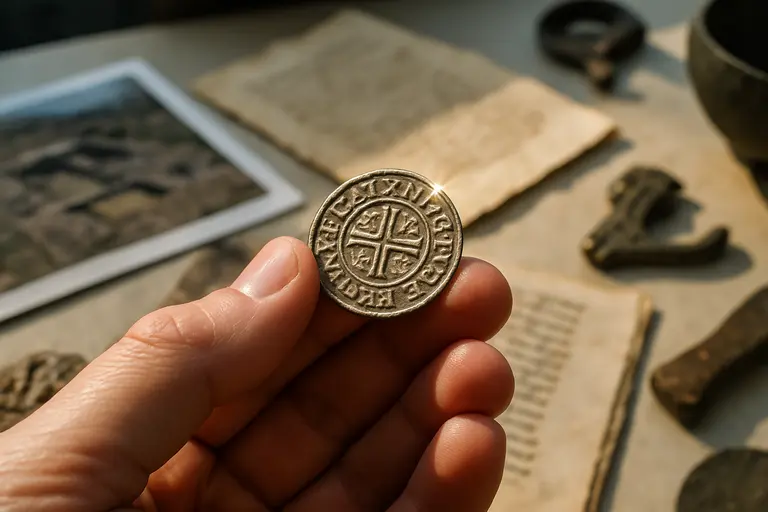
The coin’s physical condition also matters. The research notes describe wear, chipping, and a perforation, suggesting that it may have been worn as jewelry or as an ornament. That kind of use is consistent with long circulation. A coin need not remain money in every culture that handles it. It can become a pendant, a valued curiosity, a token of exchange, or a socially meaningful object whose worth is not limited to its original minting purpose.
This is where the trade-route hypothesis becomes persuasive. A worn and perforated foreign coin found in an Indigenous trading center does not behave like a clean marker of a Norse camp. It behaves more like an object that traveled, changed meaning, and entered a local system of value. That is not a lesser story. It is a better-grounded one.
Why The Maine Penny Still Matters
Authenticity Is Not The Main Dispute
One helpful part of the 2026 discussion is that the coin’s authenticity is widely accepted among scholars. The debate is not mainly whether the object is real. The debate concerns context, provenance, and route. That distinction helps keep the public conversation honest. A genuine Norse coin in Maine is exciting; it is not the same as proof of a Viking settlement in Maine.
As of August 25, 2026, Anderson’s framing reflects a cautious scholarly trend: interpret the Maine Penny as evidence for indirect Norse contact within broader Indigenous networks, not as direct evidence for Viking arrival in Maine. That view also changes the emotional center of the story. Instead of asking only, “How far did Vikings go?” we can ask, “How far did Indigenous exchange systems carry objects, meanings, and relationships?”
A Better Public Story
Public history often rewards the loudest claim. A “Vikings in Maine” headline travels faster than a discussion of provenance and trade. Yet evidence-based heritage writing has to resist the louder claim when the quieter one fits the record better. For readers interested in additional perspectives on public engagement and educational projects, you might find the approach of Talk and Play insightful. Here, the focus remains on maintaining factual integrity around the Maine Penny.
The cultural value of Anderson’s hypothesis lies in its restraint. It does not drain wonder from the past. It relocates wonder to the movement of objects through Indigenous hands, across waterways and social ties, long before modern borders shaped the map. That approach gives Native exchange systems historical force rather than treating them as a passive route for a European artifact.
Joel Anderson’s Trade-Route Hypothesis
A Cautious Shift In Narrative
Joel Anderson’s trade-route hypothesis matters because it changes the question from presence to movement. The phrase Norse presence in Maine can tempt readers toward settlement, ships, and footprints. The Maine Penny, read carefully, points instead to circulation. It is a Norse object in an Indigenous archaeological context, and the most plausible explanation reported in 2026 is that Native American trade routes carried it there.
That shift is not anti-Viking. It is good Viking Age scholarship. Norse history was connected to trade, travel, and exchange, but not every Norse object abroad marks a Norse person standing at the findspot. The Maine Penny is still remarkable. It links Maine to a wider northern world through material movement. Yet the present evidence asks us to honor Indigenous networks as the likely carriers of that connection, and to keep claims about Viking settlement out of the story until archaeology provides firmer support.
