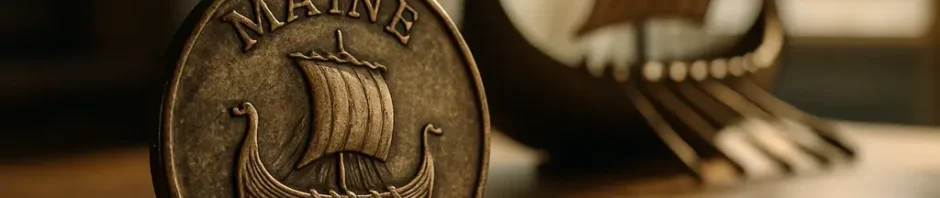
The Maine Penny, also known as the Goddard coin, has become one of the most discussed small artifacts in North American Norse heritage debates. The coin matters because specialists generally accept it as a genuine Norse silver coin from the reign of King Olaf III Kyrre of Norway, dated around 1065–1080 CE. Yet its meaning is far less settled than its manufacture. The central question is not whether the coin is Norse, but how a single Norse object came to be associated with a Native American site in Maine.
The Evidence Behind The Maine Penny
Maine Penny Date And Findspot
The reported find took place on August 18, 1957, at the Goddard archaeological site at Naskeag Point in Brooklin, Maine. According to an Atlas Obscura account, amateur archaeologists Guy Mellgren and Ed Runge found the coin at the site. That date and setting are central to the modern debate because the find was not recovered under the level of controlled excavation standards that would now be expected for an artifact with such large historical implications.
The object itself is not usually treated as a fake coin. The supplied research states that experts generally agree it is a genuine Norse silver coin minted under Olaf III Kyrre. Its physical life after minting is also significant. The coin was found with a perforation, suggesting use as a pendant or ornament rather than as normal circulating currency. That detail supports the possibility that the object had been valued, altered, and carried in ways not tied to Norwegian monetary use.
The Goddard Site Context
The Goddard site was not a Norse settlement. The research identifies it as a large Native American trade-and-habitation shell midden with material links stretching from the eastern Great Lakes to Labrador. In that setting, the coin is the only Norse artifact reported from the site. This point sets a firm limit on interpretation. A single object, however intriguing, cannot carry the weight of a settlement claim by itself.
That is why the coin has a double status in scholarship and public memory. It is striking because it appears far from Norway and far from the confirmed Norse site at L’Anse aux Meadows in Newfoundland. Yet it is also weak as stand-alone evidence for a direct Norse visit to Maine. The most cautious reading treats it as a sign of object movement, not a map of Norse colonization.
What The Coin Can And Cannot Show
Maine Penny Provenance Is The Central Question
The Maine Penny therefore sits at the boundary between numismatic certainty and archaeological uncertainty. Its Norse manufacture is widely accepted. Its archaeological path is not. The research notes several reasons for caution: similar coins were available on the collectors’ market in 1957, documentation of the coin’s in-situ recovery was weak, and the find was made by amateurs. These factors do not prove a hoax. They do mean that the chain of evidence is not as secure as historians and archaeologists would prefer.
This distinction is often lost in popular retellings. A headline may say that a Viking coin was found in Maine, then imply that Vikings reached Maine. The first statement is narrower than the second. The coin’s existence in a Maine collection can be discussed responsibly. A claim of Norse activity in Maine needs more evidence, such as additional Norse artifacts, structural remains, or a secure excavated pattern. The supplied research states that, as of 2026, no other Norse artifacts or settlements have been found in Maine.
Trade Networks Before Settlement Claims
The better-supported interpretive route is Indigenous exchange. If the coin was genuinely present at the Goddard site before recovery, it may have moved through Native trade networks rather than by a Norse traveler walking onto the coast of Maine. The Goddard site’s wider material connections, from the eastern Great Lakes to Labrador, make such movement plausible within the limits of the evidence.
Several claims should be kept separate:
- The coin was a genuine Norse silver coin from the late eleventh century.
- The Goddard site was a Native American trade-and-habitation site, not a documented Norse settlement.
- The coin alone does not prove Norse colonization or direct Norse presence in Maine.
- Indigenous exchange systems offer one cautious explanation for how a distant object could travel.
This is also why a related Old Norse News discussion of the Maine coin debate treats provenance, exchange, and settlement claims as separate questions. The distinction is not academic hairsplitting. It is the difference between using an artifact as evidence and using it as a symbol that outruns the evidence.
Heritage Narratives And Indigenous Context

Why European Firsts Can Distort The Evidence
Modern Norse heritage discussions often frame artifacts around contact, discovery, and presence. That framing can be useful when carefully defined, but it can also push Indigenous history into the background. Derek Kane O’Leary’s work on reclaiming Maine’s archive and history addresses how such narratives can affect the way the past is organized and remembered, especially where European “firsts” become more visible than Indigenous agency; see Derek Kane O’Leary’s study.
The Goddard coin is a useful test case. If the discussion begins and ends with the question “Did Vikings reach Maine?” then the Indigenous site becomes a stage for a European story. If the discussion begins with the site’s Native context, then the coin becomes one object within a much larger system of exchange, habitation, value, and movement. The second approach is more cautious and better aligned with the evidence in the supplied research.
Public Memory, Museums, And Small Objects
Small objects often gain meanings far beyond their size. A pierced coin can become a museum item, a regional talking point, a heritage symbol, or a disputed proof-text. That does not make such meanings false, but it does require careful wording. A coin may help people ask better questions about contact across the North Atlantic. It should not be made to answer questions that the evidence cannot support.
For readers interested in how collected objects and public memory shape cultural interpretation, The Sketchbook Project provides an intriguing perspective. It shows how preserved materials can gain new meanings through display, handling, and storytelling. This comparison adds a layer to our understanding of modern settings’ influence on historical objects, even though it does not serve as direct archaeological evidence for the Goddard coin.
In Norse heritage circles, the coin’s appeal is easy to understand. It is tangible, dated to the Viking Age’s aftermath, and connected to Norway. Yet its strongest modern value may be corrective rather than confirmatory. It asks readers to separate origin from provenance, contact from settlement, and popular fascination from source-based interpretation.
The Maine Penny In Modern Norse Heritage Discussions
The Maine Penny remains culturally significant because it resists a simple story. It is Norse in origin, but its reported archaeological setting was Indigenous. It may speak to long-distance exchange, but it does not prove a Norse colony in Maine. It has been used in heritage tourism and popular media, yet its scholarly value depends on restraint.
For modern Norse heritage, that restraint is not a weakness. It gives the coin its real teaching power. The artifact shows how a single object can draw attention to medieval Norway, Native exchange systems, archaeological method, and the politics of historical memory. The most responsible discussion does not use the coin to claim more than it can show. It uses the coin to ask why certain stories become attractive, why provenance matters, and why Indigenous contexts should not be treated as background to European curiosity.
That is where the Goddard coin still matters. It reminds us that Norse history in North America is not only about where Norse people went. It is also about how objects moved, how evidence is recorded, and how modern communities decide which parts of the past receive emphasis.
