
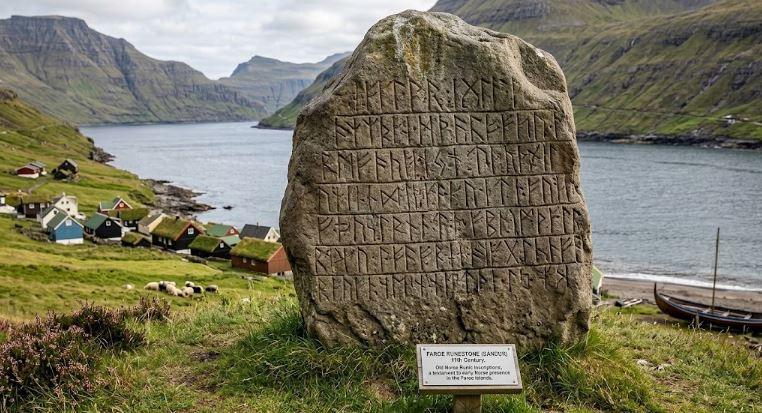
Á Sondum’s rare Faroe runestone needs careful reading before big claims because the first visible runes have appeared before specialists have finished the work that gives an inscription historical meaning. On July 22, 2026, Tjóðsavnið, the National Museum of the Faroe Islands, announced that archaeologists had found a runestone during the archaeological excavation at Á Sondum on Sandur, on the island of Sandoy. The stone lay in the floor of a building exposed during the summer excavation. Museum staff could read some runes, but Tjóðsavnið said a runologist would come to the Faroe Islands at the end of August to examine the stone more closely. That caution is the story. A rare runestone in a possible medieval prayer-house context can change how readers see writing, Christianity, and memory in the North Atlantic, but only if interpretation moves more slowly than excitement. (Tjóðsavnið Runestone Announcement)
Why The Á Sondum Find Matters Now
The Á Sondum find matters now because runestones rarely appear in the Faroe Islands. Tjóðsavnið states that finding a runestone in the Faroes is unusual, and that the newly exposed stone has become fragile now that it has come out of the ground. To protect it, the museum planned to move it from the excavation site to Tjóðsavnið for conservation and closer study.
That detail should shape every headline. The stone is not simply a dramatic object. It is a vulnerable source. Once archaeologists remove a stone from a floor layer, they must protect its surface, document its context, and avoid turning a preliminary reading into a finished historical claim.
The strongest oldnorsenews.org angle is not “a mysterious Viking message was found.” A better angle asks why a rare runic object in a possible medieval Christian building needs slow, expert reading before anyone uses it to make claims about Vikings, graves, churches, or the Faroe Islands’ religious transition.
What Tjóðsavnið Says Archaeologists Found
Tjóðsavnið says people from the museum found the runestone during the summer 2026 excavation at Sondum. The stone lay in the floor of a building that archaeologists had uncovered. Museum archaeologists believe they can read some of the runes, but they have asked a runologist to examine the inscription so they can gain as much knowledge as possible from the find.
Other finds from the same excavation also matter. Tjóðsavnið reports fragments of a small statue of the Virgin Mary with the Christ Child, and a kola, a small light or oil lamp. The museum says those objects may connect with Christian faith and religious activity at the site.
That context makes the runestone especially interesting. A runic inscription in a building floor, a Marian statue fragment, and an oil lamp do not automatically tell one story. They do, however, make the site a strong candidate for studying medieval Christian practice in the Faroes.
The evidence invites questions, not instant answers.
Why “Here Rests” Must Stay Tentative
The phrase “Here rests” must stay tentative because it comes from an early reading, not a final publication. Kringvarp Føroya reported on July 23, 2026, that archaeologist Helgi Michelsen of Tjóðsavnið said a loose preliminary assessment may read something like “Her hvílur…”, meaning “Here rests…” The same report stressed that the runes are difficult to interpret and that the stone needs closer examination.
That matters because “Here rests” sounds like a grave marker. Readers may quickly jump from those words to a tombstone, churchyard, named individual, or early Faroese Christian burial. Those possibilities are worth exploring, but the inscription has not yet carried that weight.
A runologist still needs to examine the stone’s lines, damage, carving depth, letter forms, grammar, and parallels. The stone’s position in the floor also matters. Did builders place it there as part of the original structure? Did they reuse an older memorial stone as floor material? Did later disturbance move it?
Until specialists answer those questions, the best wording remains cautious: the inscription may begin with a funerary phrase, but that reading still needs confirmation.
Why The Floor Context Changes The Question
The floor context changes the question because a runestone in a floor is not the same as a runestone standing upright in its first intended place. Tjóðsavnið says the stone lay in the floor of the building excavated during summer 2026. KVF also describes it as lying in the floor of an old building.
That placement opens several possibilities. The stone may have served as a grave marker before later builders reused it in a floor. It may have belonged to the same religious building and held a memorial function inside it. It may also have moved during rebuilding, erosion, collapse, or later disturbance.
The site’s stratigraphy will decide which interpretation works best. A runic phrase alone cannot solve the building history. Archaeologists need to understand the floor layer, associated finds, construction sequence, and relationship between the stone and surrounding deposits.
This is why big claims should wait. The inscription and the floor context must be read together.
Why The Possible Prayer House Matters
The possible prayer house matters because the building’s architecture points toward a medieval Christian setting. Tjóðsavnið reports that the exposed building runs east-west and has an entrance in the west end. The museum says those architectural features are common in medieval prayer houses and chapels. It also names Faroese examples of east-west prayer houses with west-end entrances: Bønhúsbergi in Mykines, Bønhústoft in Leirvík, and the ruin niðri á Bakka at Velbastað.
This architectural context supports careful Christian interpretation. The Marian statue fragment and oil lamp strengthen that line of inquiry. Yet the museum still uses cautious language, saying the building may be a medieval prayer house.
That word “may” matters. A building can resemble a prayer house before the final interpretation settles. Finds can suggest religious activity without proving every function of the structure. The runestone can add evidence while still needing a specialist reading.
Á Sondum therefore shows how archaeology works: architecture, objects, inscription, and site context combine gradually.
Why The Virgin Mary Fragment Adds Christian Context
The small fragment of the Virgin Mary with the Christ Child adds Christian context because it places the site inside a medieval devotional world. Tjóðsavnið reports the fragment among the summer 2026 finds. A Faroese Catholic Church article published on July 31, 2026, described the fragment as a rare testimony to Catholic religious life in the Faroe Islands before the Reformation, when the Lutheran church system entered the islands under the Danish king in the latter half of the 1530s. (Catholic Church In The Faroes Sondum Fragment)
That source adds useful religious context, but the article should still separate evidence from devotional interpretation. The fragment supports a Christian setting. It does not by itself identify the entire building, the date of every layer, or the exact use of the runestone.
The more careful claim is stronger: Á Sondum now contains a cluster of finds that may relate to medieval Christian practice. The runestone, statue fragment, oil lamp, and building orientation deserve study together.
A single object should not carry the whole interpretation.
Why Á Sondum Is Bigger Than One Stone
Á Sondum is bigger than one stone because the site has already been part of a broader investigation into early settlement and coastal erosion. On May 28, 2026, Tjóðsavnið reported that the sea threatens the archaeological remains at Sondum. Medieval and Viking Age settlement remains lie in the bank below a historic stone house, and the museum planned excavation before more material could erode into the sea.
That background matters because the runestone comes from a rescue context. The excavation is not only a search for rare objects. It responds to coastal loss, unstable protective works, and the need to document remains before the sea destroys them.
Tjóðsavnið also notes that earlier small test excavations took place in 1994 and 2006–2007. Radiocarbon dating of charred barley found beneath a Viking Age longhouse indicated that people visited the islands between AD 300–500 and AD 500–700, at least 300 years before the Norse settlement around AD 800.
This makes Á Sondum a long-term North Atlantic site, not a single runestone headline.
Why Pre-Norse Visits Complicate The Story
The evidence for pre-Norse visits complicates the story because it stretches the site’s timeline beyond the familiar Viking settlement frame. Tjóðsavnið’s May 2026 article says radiocarbon dates from charred barley beneath a Viking Age longhouse point to visits in the periods AD 300–500 and AD 500–700. That means the site may preserve traces of human presence before the Norse settlement around AD 800.
This does not mean the newly found runestone dates to those early visits. Nothing in the public museum announcement supports that claim. The runestone belongs in the context of the 2026 excavation and the possible medieval Christian building until specialists say more.
Still, the deeper chronology matters. Á Sondum sits at a place where pre-Norse visits, Viking Age settlement, medieval Christianity, coastal erosion, and modern excavation intersect. That layered timeline makes overconfident interpretation especially risky.
A runestone found in such a site does not explain the whole history. It becomes one source among several.
Why The Runestone Should Not Be Called Viking Too Quickly
The runestone should not be called Viking too quickly because its likely building context may be medieval and Christian. A runic inscription can belong to the Viking Age, but runes did not disappear when Christianity arrived. People continued using runes in medieval Scandinavia and the North Atlantic.
This distinction matters for SEO and accuracy. A headline that calls the stone “Viking” may attract clicks, but it could mislead readers if specialists later place the inscription in a medieval chapel or prayer-house context. The public evidence so far supports “rare Faroe runestone,” “runic inscription,” and “possible medieval Christian context” more safely than “Viking runestone.”
Old Norse News has covered how Norse myth and Viking history need careful separation. Á Sondum needs the same discipline. A runic script does not automatically make a find pagan, Viking, or pre-Christian.
The stone’s date, language, wording, reuse history, and archaeological layer must lead the interpretation.
Why Faroese Runestones Are Rare
Faroese runestones are rare enough that every new find changes the discussion. Tjóðsavnið says clearly that it is rare to find a runestone in the Faroe Islands. Popular attention has already compared the Á Sondum stone with other Faroese runic stones, including the well-known Sandavágur stone.
Visit Faroe Islands describes the Sandavágur runic stone as a historic landmark from about 1200, preserved inside the church for centuries. The stone entered local history in 1917, when farmer Martin á Mýruni discovered it in the area known as Eingjatoftir, between Sandar and Steig in Sandavágur.
That comparison helps readers understand rarity, but it should not collapse separate finds into one category. The Sandavágur stone has its own inscription, discovery history, and context. The Á Sondum stone still awaits specialist reading.
Rare does not mean automatically revolutionary. Rare means the evidence deserves extra care.
Why A Runologist’s Visit Matters
A runologist’s visit matters because runic reading requires more than recognizing a few marks. Tjóðsavnið states that museum archaeologists believe they can read some of the runes, but they have turned to a runologist for closer examination at the end of August. That decision shows responsible scholarship.
The specialist will need to assess whether scratches are carved runes, later marks, damage, or natural stone features. Lighting angle, surface wear, line depth, carving order, letter forms, and stone condition can all change the reading. So can language history. A sequence that looks obvious in one photograph may become less certain under close inspection.
KVF’s report notes that light from lamps can help the runes stand out. That is a reminder that reading depends on controlled observation, not casual viewing.
The public should welcome the delay. Waiting for the runologist does not weaken the story. It makes the final interpretation more trustworthy.
Why Conservation Comes Before Translation
Conservation comes before translation because a fragile surface can lose evidence if people handle it carelessly. Tjóðsavnið says the runestone became fragile after excavation and would be moved to the museum for protection. The museum also asked visitors not to enter the excavation field because the remains are fragile and can easily suffer damage.
That public warning belongs in the article. A runic stone does not become more valuable when visitors crowd it, touch it, photograph it from unsafe angles, or step into the field around it. Context and surface both matter.
This principle also applies to writing about the find. A careful article should not “clean up” the uncertainty for dramatic effect. It should tell readers that preservation, examination, and specialist reading come before firm conclusions.
The stone’s survival matters more than an instant translation. If the surface suffers damage, future readings become weaker.
Why Visitors Were Invited But Kept Back
Tjóðsavnið invited interested people from Sandur and elsewhere to visit the excavation while work continued, when conditions allowed. The museum said archaeologists would gladly explain the excavation and the remains that had appeared. At the same time, visitors were asked not to go down into the excavation field because the remains were fragile and could easily be damaged.
That balance shows good public archaeology. People should see and learn from important discoveries, especially when a local site belongs to community history. Yet public access must not endanger the evidence.
For an oldnorsenews.org audience, this detail matters because it distinguishes responsible heritage interest from intrusive curiosity. A rare runestone can belong to public memory without becoming a public handling object.
Visitors can support the site by respecting boundaries, listening to archaeologists, and waiting for the museum’s updates.
Why Aarhus University And Moesgaard Museum Matter
The excavation team matters because Á Sondum is not a casual dig. Tjóðsavnið states that it leads the excavation in cooperation with Aarhus University and Moesgaard Museum. Archaeology students from Aarhus University took part during the summer as part of their education. Tjóðsavnið also reports that Smyril Line supported the trip.
This collaboration matters for interpretation. The May 2026 background article says the project uses new natural-science methods and better dating methods available through Aarhus University’s researchers and specialized laboratories. Those methods may help clarify early settlement, site chronology, environmental evidence, and the relationship between older and newer occupation layers.
The runestone will draw the headlines, but the broader project depends on scientific dating, training, excavation technique, conservation, and comparative expertise.
A good article should therefore name the institutions. The stone’s meaning will emerge from a research team, not from one viral image.
Why “Medieval Christian” Does Not Mean Simple
“Medieval Christian” does not mean simple. The building may have Christian architecture. The statue fragment and oil lamp may relate to Christian practice. A preliminary reading may suggest a resting place. Those clues point toward a religious context, but they do not erase complexity.
A runestone in a Christian building can raise several questions. Did medieval Faroese Christians use runes in memorial contexts? Did builders reuse an older stone in a floor? Did the inscription belong to a burial, chapel, or another setting before its floor placement? How does the stone relate to the Mary-and-child fragment and the oil lamp?
The answer may involve reuse, continuity, or local practice. It may also remain partly uncertain after study.
That uncertainty should not disappoint readers. It is the reason the find matters. Á Sondum gives researchers a chance to study a place where writing, belief, building, and memory meet.
Why Big Claims Should Wait For Several Kinds Of Evidence
Big claims should wait for several kinds of evidence because the runestone needs a combined reading. The runologist must study the inscription. Conservators must protect the stone. Archaeologists must explain the floor context. Dating evidence may clarify the building sequence. Finds such as the Mary fragment and oil lamp need analysis alongside the architecture.
A single phrase, even if “Here rests” proves correct, cannot answer all questions. It may indicate a memorial. It may help identify a grave context. It may also belong to a reused stone that entered the floor after its original function ended.
The strongest interpretation will come from converging evidence. Text, context, conservation, dating, and comparison all have to support the same story.
Until then, careful wording protects the find from sensationalism.
What Readers Should Verify Before Repeating Claims
Readers should verify several points before repeating claims about the Á Sondum runestone. First, Tjóðsavnið announced the find on July 22, 2026, and the stone lay in the floor of a building at the Sondum excavation. Second, museum archaeologists could read some runes, but a runologist still needed to examine the stone at the end of August.
Third, the possible phrase “Her hvílur…” came from a preliminary assessment reported by KVF, not from a final scholarly publication. Fourth, the building may be a medieval prayer house because of its east-west orientation and west-end entrance, but the museum still presents that as a possibility. Fifth, the Mary-and-child fragment and oil lamp may connect with Christian faith and religious activity, but they do not prove every interpretation of the runestone.
Finally, the site itself is threatened by coastal erosion and has a deeper occupation history. Any claim about the stone should respect that layered context.
Why Á Sondum Needs Careful Reading Before Big Claims
Á Sondum’s rare Faroe runestone needs careful reading before big claims because the find sits at the intersection of several sensitive stories. It may speak to medieval Christian memory. It may reveal a rare Faroese runic inscription. It may belong to a prayer-house floor. It may connect with a cluster of religious finds, including a Virgin Mary and Christ Child fragment and an oil lamp. The excavation site also reaches deeper into Viking Age and pre-Norse questions about the settlement history of the Faroe Islands.
That combination makes the discovery exciting, but it also makes restraint essential. A premature “Viking tombstone” label could mislead readers. A final translation cannot come from a partial photograph. A building’s function cannot rest on one artifact. A fragile surface should not suffer because public interest moves faster than conservation.
For oldnorsenews.org, the key lesson is clear: the best Norse and North Atlantic archaeology often begins with a tempting phrase, then slows down. Á Sondum may one day give scholars a clearer inscription, a stronger building interpretation, and a sharper picture of medieval Christian life in the Faroes.
For now, the stone’s most important message is methodological. Read the runes, but read the floor too. Study the Christian objects, but date the layers. Welcome public interest, but protect the fragile remains. Let the runologist finish before the headline becomes history.
