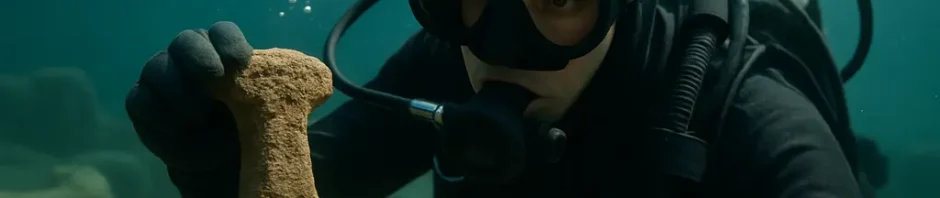
Concerns over underwater archaeological sites have sharpened since federal protection rules changed in the United States during 2025 and 2026. The Norse connection should be framed with care: the recent reporting did not identify a newly damaged Viking wreck or a named Norse artifact site. The concern is broader and still serious. If seabed-disturbing projects proceed with fewer automatic survey duties, poorly mapped shipwrecks, submerged artifact scatters, and older coastal cultural places may be harmed before archaeologists know they exist.
Why Underwater Archaeological Sites Face New Risk
Underwater Archaeological Sites And The Survey Gap
The key policy change began on March 14, 2025, when Congress passed Public Law 119-3, disapproving the Bureau of Ocean Energy Management rule called “Protection of Marine Archaeological Resources.” According to reporting on the change, the voided rule had required archaeological reports for oil and gas or other seabed-disturbing development plans on the Outer Continental Shelf; after disapproval, surveys were required only when a BOEM regional director had “reason to believe” archaeological resources might be present Washington Post report.
For heritage protection, that difference is not a minor filing change. A mandatory survey rule starts from the assumption that cultural material may be unknown, buried, scattered, or difficult to detect. A “reason to believe” standard can work when records are strong, but underwater records are often incomplete. Sites may sit beneath sediment, be known through oral traditions rather than mapped coordinates, or lie in areas surveyed for engineering rather than archaeology.
The Outer Continental Shelf was described in the same reporting as covering about 3.2 billion acres of marine territory off U.S. coasts. That scale matters. Even strong archaeological teams cannot assess such a vast area without predictable triggers, clear reporting duties, and enough time to evaluate what remote-sensing data may show.
Why Documentation Comes Before Protection
For underwater archaeological sites, this shift raises a basic problem: a resource usually has to be noticed before it can be avoided. Ship timbers, anchors, ballast piles, cargo, worked stone, ritual deposits, and submerged shorelines can all be damaged by seabed disturbance. Once broken, dispersed, or buried under new material, context may be lost. In archaeology, context is not an accessory. It is the evidence that allows a find to be dated, compared, and understood.
The issue is not only whether developers intend harm. Most modern seabed projects are designed around engineering, energy, transport, recovery, or extraction goals. Cultural material can be an unintended casualty when review systems are thin. That is why archaeologists often argue for survey before disturbance, not merely salvage after damage.
What Changed On The Outer Continental Shelf
From Uniform Reports To Conditional Review
Before March 14, 2025, the revoked BOEM rule would have made archaeological reporting a standard part of covered Outer Continental Shelf development plans. After the disapproval, the research record indicates that the reporting duty no longer applied uniformly. Instead, archaeological surveys depended on whether the agency had a prior basis to suspect cultural resources in the area.
That change creates a circular risk. If a site has never been surveyed, there may be little official evidence showing that it exists. If there is little official evidence, a survey may not be required. This is especially relevant below the waterline, where absence from a map often means absence of investigation, not absence of heritage.
A government review of underwater cultural heritage law described U.S. protections as fragmented and not fully able to cover every threat, especially where projects are already permitted, where no federal permit is needed, or where no resource has yet been identified federal UCH review. That assessment helps explain why the 2025 change drew concern from archaeologists and cultural advocates.
Related Delays And Review Changes
The research also points to other changes through mid-2026. On July 17, 2026, revisions offered by the Advisory Council on Historic Preservation to Section 106 of the National Historic Preservation Act were released. The notes indicate that many tribal nations and preservationists warned that the revisions would reduce Indigenous influence in protecting underwater cultural sites. In Lake Ontario National Marine Sanctuary regulations, a protection rule against grappling into or anchoring on shipwreck sites had its effective date delayed first to July 21, 2026, then to September 21, 2028, while mooring systems and stakeholder input were addressed.
These are not identical legal actions, but they point in a similar direction: protection may become more dependent on later review, agency discretion, or delayed infrastructure. For fragile submerged sites, delay can have material consequences. Anchors, grappling gear, dredging, construction, mining tools, and recovery equipment can affect remains directly, while sediment plumes and chemical alteration may affect preservation conditions indirectly.
Why Norse Heritage Belongs In The Discussion
A Cautious Norse Reading
Underwater archaeological sites are often discussed in global terms, but Norse and Viking Age evidence gives the issue a familiar form for readers of maritime history. Ships, ports, coastal movement, burial customs, and artifact exchange all shaped Norse-era life. Yet the current U.S. policy reporting did not document a specific Norse wreck destroyed by the 2025 or 2026 changes. That limit should be stated plainly.
The Norse relevance lies in analogy and risk, not in a claimed incident. Viking shipwrecks or submerged Norse artifacts along coasts would be vulnerable to the same general pressures as other unrecorded heritage: seabed development, mineral exploration, construction, and recovery activity. If a site is not precisely mapped or publicly known, a system that waits for prior evidence may fail to trigger review.
Old Norse News has often treated ships as evidence rather than decoration. Work on Viking ship reconstruction shows how practical maritime questions can test interpretations, while protected archaeological contexts remain the baseline. A reconstructed ship can teach handling and craft. A disturbed wreck can lose evidence that cannot be remade.
Memory, Evidence, And Unmapped Sites
Norse underwater archaeological sites, if present in threatened zones, would not always look dramatic at first contact. A scatter of rivets, ballast, worked wood, or associated objects may be less visible than an intact hull. The same is true for many non-Norse sites. A low-profile deposit can still hold evidence for trade, travel, repair, loss, ritual practice, or shoreline use.
This is why the absence of named Norse cases in the recent policy coverage does not remove the relevance for Norse history. It sets the boundary of what can be claimed. The responsible argument is that reduced survey duties heighten the risk to all poorly documented submerged heritage, including possible Norse or related maritime material where such remains exist.
Why Consultation And Documentation Matter

Indigenous Concerns And Shared Preservation Questions
The Washington Post reporting quoted Katrina Thompson-Upton of the Tolowa Dee-ni’ Nation as saying the loss of reporting requirements for cultural artifacts and sacred sites felt “very sad and violating.” That statement concerned Indigenous cultural places and should not be absorbed into a Norse story. It deserves to stand in its own right, because underwater heritage includes sacred sites, oral-history places, shrines, and ancestral evidence that may not fit older agency expectations of a shipwreck or artifact cache.
At the same time, the preservation principle is shared: cultural material below water is not empty space awaiting development. It may hold evidence for communities whose records were never written, or whose records were written by outsiders. For Norse studies, this is a useful reminder. Texts, sagas, and later memory cannot replace archaeological context. Material evidence needs protection before interpretation can begin.
- Mandatory survey rules can identify unknown sites before seabed disturbance.
- Conditional review may miss places that have not yet entered official records.
- Delayed anchoring safeguards can prolong physical pressure on known wreck sites.
- Consultation can bring forward knowledge that maps and databases do not contain.
Public Images And Public Responsibility
Public understanding of underwater heritage often depends on images: sonar scans, conservation photographs, museum displays, site drawings, and careful reconstructions. For readers comparing how visual presentation shapes public trust, the related network site Finest Image offers a valuable perspective on how images can act as carriers of evidence, highlighting the importance of visual evidence in the preservation of underwater heritage.
The danger for underwater archaeological sites is not only physical loss. It is also interpretive loss. If a site is disturbed without documentation, later viewers may see objects without positions, dates without secure associations, and narratives without a tested evidentiary base. In Norse studies, that problem is familiar. A sword, rivet, bead, or plank fragment gains meaning from where it was found and what it was found with.
Underwater Archaeological Sites And Norse Heritage Risk
What Can Be Said With Confidence
Underwater archaeological sites now face a policy environment in which some mandatory protections were reduced, some safeguards were delayed, and consultation rules were contested as of July 2026. The supported claim is not that a named Norse wreck has already been lost because of these changes. The supported claim is narrower: less automatic survey and reporting can increase the risk that uncharted submerged cultural heritage will be damaged before it is documented.
For Norse history and archaeology, that risk should be taken seriously but not exaggerated. Maritime evidence is central to how scholars understand movement, exchange, technology, settlement, and memory across the North Atlantic and nearby coasts. If comparable underwater material is disturbed without survey, the loss is not only an object. It is a lost relationship between object, seabed, shoreline, and human action.
The clearest response is evidence-first heritage practice: survey before disturbance where risk is plausible, transparent reporting when finds appear, consultation with affected communities, and caution about claims that outrun the record. Loosened protections make that work harder. They do not make it less necessary.
