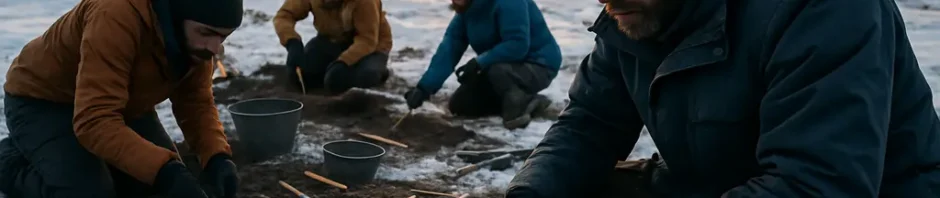
Norse Site Preservation is no longer only a question of conserving famous Viking Age monuments. As of September 10, 2026, the debate also concerns thawing soils, eroding coasts, legal buffers, development pressure, tourism value, and the hard choice of which places receive scarce conservation attention first. For Norse history, this is especially sensitive because many surviving traces are physical rather than textual: farms, burials, ship settings, trading places, fortresses, and small objects whose meaning depends on their context.
Norse Site Preservation And The Preservation Choice
Norse Site Preservation Under Climate Pressure
The clearest pressure comes from climate change in northern environments. A May 2026 study reported rapid, climate-driven damage at the 17th-century whalers’ graveyard at Likneset in Svalbard. The site is not a Norse site, and it should not be presented as one. Yet the research matters for the same conservation debate because it compares excavations from the 1980s with those from the 2010s and records greater coastal erosion at gravesites in a cold-region setting, according to the EurekAlert report.
For Norse Site Preservation, the difficulty is that cold and frozen ground once helped preserve fragile remains. When those conditions change, organic materials can decay, exposed surfaces can erode, and sites that seemed stable can become urgent. This changes the old conservation habit of waiting until a site is threatened by a road, building, or excavation permit. Climate pressure can make inaction a decision in itself.
What The Greenland Evidence Can And Cannot Say
Greenland is central because it contains Norse and Inuit archaeological remains, and those categories must be kept distinct. A projection discussed by Smithsonian Magazine warned that up to 70 percent of Arctic archaeological remains could vanish in the next 80 years as warming harms preservation, especially organic materials, in both Norse and Inuit contexts; the estimate appears in a Smithsonian report. That is not a site-by-site prediction for every Norse farm. It is a warning about scale.
The research notes also refer to microbial degradation under rising soil temperatures affecting Norse Viking Age settlements in Greenland’s relatively dry continental interiors. This point is important because public discussion often imagines climate risk mainly as dramatic coastal loss or collapsing ice. Soil biology is less visible, but it can still alter what survives for archaeologists and local communities. The cautious reading is that preservation risk varies by site, material, moisture, exposure, and temperature. A single policy cannot treat every ruin, midden, grave, or building trace as if it faces the same clock.
Legal Protection Is Necessary But Not Enough
Norway’s Automatic Protection Model
Law gives heritage managers a first line of defense, but law alone does not stop erosion, thaw, or decay. Norway’s Cultural Heritage Act of 1978 automatically protects archaeological and historical sites and monuments older than AD 1537, including known and unknown sites. The research notes specify that this protection includes standing structures, road-tracks, burials, cult sites, and a 5-meter buffer zone around known boundaries.
That model matters for Norse and medieval archaeology because it does not depend only on a site being famous. Unknown archaeology can be protected once identified. Still, automatic protection faces a practical limit: it can regulate human action more easily than climatic process. A buffer zone can prevent immediate disturbance by construction, but it does not cool thawing ground or halt coastal erosion. Conservation planning therefore needs both legal status and physical risk assessment.
Denmark’s Ring Fortresses And Managed Visibility
Denmark’s Viking-Age Ring Fortresses show another side of the debate. The five sites—Aggersborg, Fyrkat, Nonnebakken, Trelleborg, and Borgring—were built circa 970–980 CE and were inscribed as a UNESCO World Heritage site in 2023. The research notes state that they are protected under national legislation, including the Danish Museum Act no. 1505 of December 14, 2006, and that an integrated management plan covers 2023–2027.
Such recognition can help direct attention and funding, but it can also increase visitor pressure. A ring fortress must be visible enough for public learning while protected enough to avoid damage. The challenge is not whether people should care about these sites. The question is how public access, national pride, international listing, and archaeological caution can be kept in balance.
Development Tourism And Research Triage
Woodstown After The June 2026 Excavation Phase
In Ireland, the Woodstown site in County Waterford illustrates the value of targeted excavation within a conservation plan. The research notes state that a 2026 excavation recovered a lead trading weight, a gaming piece, and a copper-alloy object dating roughly 1,200 years ago, around the ninth to tenth centuries CE. That centre-phase dig was scheduled to run through June 19, 2026, so it had already ended by September 10, 2026.
Woodstown matters because portable finds can attract public attention, but the broader value lies in controlled context. A trading weight, gaming piece, or copper-alloy object can speak to exchange, recreation, status, or contact only when recorded with its archaeological setting. That is why excavation and preservation should not be treated as opposites. Sometimes excavation is part of preservation, especially where recording a threatened context may be the only way to save information before conditions worsen.
Why Not Every Site Can Be Saved The Same Way
The most uncomfortable question in 2026 is not whether Norse and related northern heritage deserves protection. It is how to choose when time, money, staffing, and climate conditions do not allow equal intervention everywhere. The research notes describe a growing heritage debate over which archaeological sites should be actively preserved and which may be allowed to decay, with decisions shaped by outstanding universal value, visibility, tourism potential, and risk.
Those criteria are not neutral. A famous site may draw funding because visitors know its name. A less visible farm ruin, burial, midden, or harbor trace may hold evidence just as important for specialists but lack public appeal. This is where historians, archaeologists, local authorities, Indigenous communities, landowners, and visitors can have different priorities. Caution is needed because a ranking system can quietly favor sites that are already well known.
Evidence Standards For Norse Heritage Claims

Separating Norse Evidence From Northern Analogy
A recurring problem in public heritage writing is the temptation to treat every northern site as part of the Norse past. Svalbard whalers, Greenland Inuit remains, Sámi cultural heritage, medieval Scandinavian monuments, and Viking Age trading places may all be relevant to northern conservation policy, but they are not interchangeable. The Laponian Area in Sweden, for example, is significant Sámi cultural heritage with Norse-adjacent narratives, not a Norse monument simply because it sits within a wider northern frame.
The UNESCO 48th session in Busan, held from July 19 to July 29, 2026, adopted the Busan Declaration calling for stronger international cooperation against threats to heritage, including climate change, development pressure, and conflict. The same session also addressed the Laponian Area, expressing concern over development projects and climate change, urging better legal protection, and requiring reporting on conservation actions by February 1, 2027. These decisions affect the wider policy discussion, but they should not be used to blur cultural categories.
Old Norse News has argued elsewhere that physical evidence must be read with care, especially because early medieval Scandinavians left fewer written records than later commentators. Readers comparing preservation priorities may find useful context in major Viking Age archaeological sites. Because this site network also publishes applied evidence material through our related partner, PolygraphianZ, the same standard applies here: claims should stay within what the sources can support.
Norse Site Preservation And Public Memory
Why The Debate Will Stay Difficult
Norse Site Preservation should be understood as a set of choices, not a single rescue plan. Climate change can make some sites urgent. Law can restrain development. UNESCO status can raise visibility. Excavation can record evidence before loss. Tourism can fund interpretation but also increase wear. Each tool solves one problem while raising another.
The strongest approach is evidence-based and honest about uncertainty. A Greenland Norse farm, a Danish ring fortress, a Norwegian pre-1537 site, and an Irish Viking Age settlement do not need the same treatment. Some require monitoring. Some need legal enforcement. Some need public barriers and better signs. Some may need excavation before information disappears. Some may be best protected by limiting attention rather than promoting them.
The debate matters because archaeological sites are not only old places. They are records of settlement, language contact, craft, belief, exchange, and memory. Once a context is destroyed, later interpretation becomes weaker. Preserving everything in the same way is not realistic, but choosing without clear evidence is worse. The task in 2026 is to make those choices openly, with named sources, careful cultural distinctions, and respect for the communities connected to the remains.
