
Swedish Heritage Exhibitions at the American Swedish Historical Museum in Philadelphia offer a useful case study in how myth, craft, migration memory, and national identity are placed before a modern public. The museum’s displays, as described in ASHM’s official materials available on October 5, 2026, do not present Swedish heritage as a single line from Viking ships to modern folk culture. Instead, they place different kinds of evidence beside one another: a Viking sword, bronze cloak pins, a cane axe with runes, folk weavings, early twentieth-century drawings of Easter witches, children’s literature, and murals tied to Swedish-American civic memory.
What The Museum Places Before The Visitor
Artifacts Before Interpretation
The strongest displays begin with objects. ASHM’s permanent collection includes a Viking sword dated from the ninth to twelfth centuries and Norse-period objects such as bronze cloak pins, according to the museum’s collection highlights. These objects can support discussion of warfare, dress, craft, and status. They should not, by themselves, be made to carry claims they cannot prove. A sword can show form, material culture, and martial association; it cannot tell us the full belief system of its owner unless other evidence is available.
The same caution applies to the museum’s late seventeenth- or early eighteenth-century cane axe, known in Swedish as a käpp yxa. ASHM describes it as ornamented with runic inscriptions and influenced by mythic and astronomical cycles. That makes the object valuable for studying long afterlives of symbols often associated with the Viking Age. It does not mean that early modern Sweden simply preserved Viking belief unchanged. The better reading is that runes and mythic patterns could be reused, reimagined, and given new social meanings centuries later.
Public Heritage And Careful Framing
A museum display is never only storage. It is also a public argument about what deserves attention. ASHM’s selection of swords, pins, carved furniture, folk textiles, letters, and children’s galleries frames Swedish culture through objects made for use, memory, teaching, decoration, and play. Readers examining how community heritage institutions present identity across different subjects might find the value of a clear public context at Stuyvesant Yacht Club, a related site in the same network, insightful as well, despite its distinct subject matter from the Swedish museum experience.
How Swedish Heritage Exhibitions Frame Evidence
Swedish Heritage Exhibitions And Viking Objects
Viking Age material at ASHM gives visitors an entry point into Norse culture, but the museum’s wider displays keep that material from becoming the whole story. A ninth- to twelfth-century sword speaks to a period often associated with raiding, trade, political power, and elite identity. Bronze cloak pins point toward dress and social presentation. Neither object needs exaggeration to matter. Their importance lies in showing how physical evidence can anchor discussions that are too often shaped by modern fantasy.
| Display Strand | Supported Theme | Cautious Reading |
|---|---|---|
| Viking sword and cloak pins | Warfare, dress, craft, and status | Useful evidence for material culture, not a full biography of belief |
| Cane axe with runes | Later use of runic and mythic symbols | Shows continuity of motifs, not unchanged Viking religion |
| Sigurd armchair carving | Norse story in modern decorative art | Reflects reception of saga material around 1905 |
These Swedish Heritage Exhibitions are most persuasive when they let artifacts show both continuity and distance. A carved armchair by Karl von Rydingsvärd, dated around 1905 in the museum’s materials, includes scenes from the Norse tale of Sigurd the Dragonslayer and dragon motifs inspired by Viking art. That object belongs to a modern artistic setting, not the Viking Age. Yet it reveals how Norse stories could be refashioned in decorative work for a later audience.
This is where ASHM’s displays connect with a broader question in museum culture: how do objects shape public memory without flattening time? Old Norse News has treated a similar issue in its discussion of Norse identity artifacts, where the central problem is not whether objects matter, but how much meaning modern viewers are justified in drawing from them.
Folk Art, Witches, And Mythic Memory
Blåkulla And The Easter Witch
ASHM’s exhibition “Flying to Blåkulla: Letters from an Easter Witch” was described in the supplied museum research as ongoing in late 2026. It displays handmade early twentieth-century watercolors and drawings sent by the Batcheler family in Sweden. The imagery includes the påskkäring, or Easter Witch, witches flying to Blåkulla, trolls, and other fantastical figures drawn from Swedish folk art and myth.
This material is not Norse mythology in a narrow Viking Age sense. It belongs to later Swedish folk imagination, family communication, holiday custom, and visual play. That distinction matters. A troll in a twentieth-century drawing is not direct evidence for Viking belief. It is evidence for the endurance and adaptation of supernatural imagery in Swedish cultural life.
Textiles Between Home And Symbol
The museum’s “Swedish Folk Weavings for Marriage, Carriage, and Home 1750–1840,” as summarized in ASHM’s official materials, presents cushions and bed covers produced by women. The designs include real and mythical creatures, crowns, floral themes, and religious imagery. The research notes also state that some design influences reach back toward the Viking era.
Swedish Heritage Exhibitions can be especially useful here because textiles move mythic and symbolic motifs away from elite weapons and into domestic life. Bed covers and cushions are not minor evidence simply because they were used in the home. They show how women’s work carried social meaning, how households displayed status and taste, and how religious and mythic imagery could share visual space with flowers, crowns, animals, and practical function.
Teaching Myth Without Treating It As Proof
Children’s Programs And Origin Stories
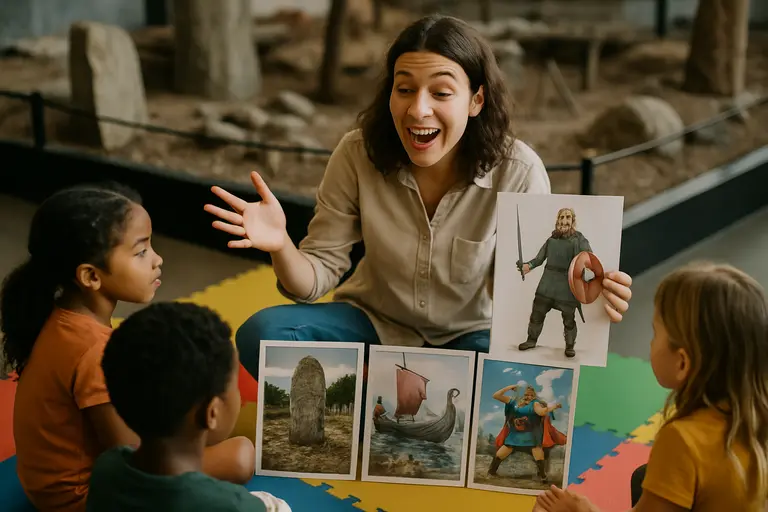
ASHM’s “Scandinavian Storytelling” educational program for grades K–6, as described in the research material, introduces folktales such as The Ice Queen, Stone Soup, and Knos the Giant. The program also addresses Norse mythology and Viking sagas, presenting origin stories as ways people explained the natural world.
That is a careful and useful educational frame. Myths are not scientific explanations in the modern sense, but they are evidence for imagination, values, fear, hope, humor, and social teaching. When children hear myth as story rather than as literal history, they can begin to understand why people made meaning through giants, gods, trolls, witches, and strange places beyond ordinary life.
Outdoor Knowledge And Cosmology
ASHM’s outdoor-themed exhibition, as summarized in the research, treats Viking travel knowledge through stars, compasses, and environmental cues while also addressing mythological cosmology as part of a Viking worldview. The same exhibit connects Swedish cultural history with orienteering, which the research notes identify as invented in Sweden in the 1890s.
This pairing is interpretively strong because it separates practical knowledge from myth without forcing them apart. A sailor may read stars for direction while also living within a cosmology that gives the sky sacred or symbolic meaning. A modern museum should not reduce Viking travel to myth, but it also should not strip the past of belief. The difficulty is to show that technical skill and sacred imagination could coexist.
ASHM’s earlier traveling exhibit “Skål: Scandinavian Spirits,” no longer on display according to the research notes, made a similar connection between belief and practice. It included stories in which Odin was credited with teaching humans how to brew beer and treated ritual drinking as part of offerings to deities. Since that exhibit has ended, it should be discussed retrospectively, not as a present display. Its subject still helps explain how food, drink, gods, and communal action can meet in Scandinavian cultural memory.
Visual Storytelling Beyond Norse Myth
Pippi, Murals, And Civic Memory
Not every imaginative display at ASHM is mythological. The Pippi Longstocking gallery, as described in the research, gives children chances to find treasures, dress up, and take part in a gallery hunt. Pippi belongs to modern Swedish literary fantasy rather than ancient religion. Even so, the gallery sits within a broader pattern: Swedish culture is often presented through play, exaggeration, independence, and the testing of ordinary rules.
The Grand Hall also belongs to symbolic display, though not to Norse myth. The research notes describe a ceiling mural showing New Sweden settlers arriving aboard the Kalmar Nyckel, with walls showing Count Axel von Fersen at the Surrender of Cornwallis and John Morton signing the Declaration of Independence. These scenes use heroic and civic imagery. They are better understood as Swedish-American memory and public symbolism than as mythology.
This difference is worth preserving. If every dramatic image is called myth, the word loses force. A museum can show saga, folklore, literary fantasy, colonial memory, and national commemoration under one roof, but each category asks for its own method of reading.
Swedish Heritage Exhibitions At ASHM
The best reading of Swedish Heritage Exhibitions at ASHM is not that they prove an unbroken line from Viking warriors to modern Swedish-American identity. The evidence is more interesting than that. The museum places Viking objects beside early modern runic ornament, folk weaving, Easter witch drawings, children’s storytelling, modern literary fantasy, carved saga revival art, outdoor knowledge, and civic murals.
Together, these displays show how Swedish heritage is made visible through objects and stories that belong to different periods. Some are archaeological or historical artifacts. Some are folk and family materials. Some are educational tools. Some belong to modern memory. The task for visitors is to enjoy the display without collapsing those categories.
ASHM’s value lies in making that distinction possible. Its exhibitions show that mythology and culture are not fixed possessions from the past. They are patterns of memory, image, object, teaching, and reuse. A Viking sword, a cane axe with runes, a Sigurd carving, a Blåkulla drawing, and a Pippi gallery do not say the same thing. Read carefully, they show how Swedish heritage has been preserved, revised, taught, and imagined across many generations.
