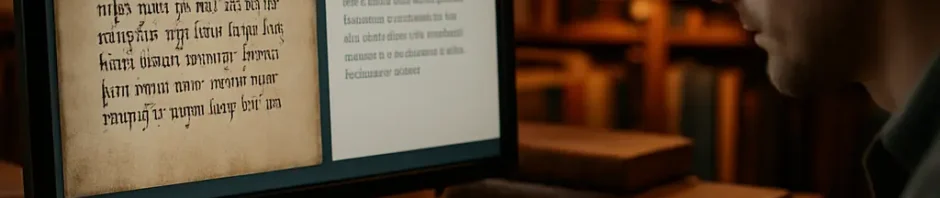
Old Norse AI has moved from a speculative research aid to a tested tool for specific textual tasks, at least in limited settings. On September 8, 2026, the University of Iceland hosted a presentation titled “From Normalisation to Understanding,” where recent Large Language Models were tested on normalising material from the Dictionary of Old Norse Prose database. The university’s event notice reported a “substantial improvement in performance” and said current models can produce highly accurate normalisations across a wide range of texts, while framing the work as a pilot study rather than a settled replacement for human scholarship University of Iceland event.
What Old Norse AI Can Now Do
The main gain described by the University of Iceland was not a general claim that machines now “understand” medieval literature in the way trained readers do. The reported task was narrower: normalisation. In Old Norse and Old Icelandic study, normalisation usually means bringing varied written forms into a more standard form so that texts can be compared, searched, and interpreted with less friction. That is already significant, because medieval textual work often begins before interpretation, with the basic problem of making forms consistent enough to analyse.
Old Norse AI And Normalisation
The phrase Old Norse AI can sound larger than the evidence allows. The September 2026 pilot was tied to normalising material from the ONP database, not to replacing dictionaries, editions, or expert commentary. Even so, the reported improvement matters. If language models can handle a wider range of forms with higher accuracy, they may help researchers prepare material for later philological, linguistic, and literary study.
That shift has contemporary relevance because Old Norse texts are no longer read only in printed editions by a small circle of specialists. Digital corpora, search tools, and teaching platforms all depend on the quality of the underlying text. Better normalisation can make variants easier to compare and can reduce the time spent on repetitive preparation. It can also introduce new risks if users treat a normalised output as if it were the manuscript witness itself.
Normalisation Before Interpretation
The University of Iceland title, “From Normalisation to Understanding,” is useful because it marks a sequence rather than a shortcut. Normalisation is not the same as interpretation. A model may produce a convincing standard form while still lacking a defensible account of genre, context, transmission, or cultural meaning. The safer reading is that improved normalisation may support understanding, not that it completes it.
From Variant Forms To Reading Tasks
A normalised word can become easier to search, but medieval evidence still needs careful handling. A standard form may hide the features that made a manuscript valuable in the first place: local spelling habits, copying choices, or signs of textual transmission. The research point from the University of Iceland is therefore best treated as a gain in workflow. It may help scholars ask questions faster, but it does not decide which questions are worth asking.
This distinction also matters for public readers. Ancient stories reach modern audiences through layers of copying, editing, translation, and commentary. AI tools add another layer. Used cautiously, that layer may make difficult texts more approachable. Used carelessly, it may make uncertainty look cleaner than it is. For readers interested in manuscript survival and cautious interpretation, the site’s discussion of Old Norse manuscripts in context offers a useful companion point: the evidence that reaches us is partial and shaped by transmission.
Handwritten Recognition And Manuscript Access
A second recent development came from handwritten text recognition. On September 29, 2026, the OICEN-HTR model for Old Icelandic and Old Norse handwritten material was published on Zenodo. The record describes the model as fine-tuned for Old Icelandic manuscripts and fragments. Its reported in-domain held-out test reached about 90.12% character accuracy and 71% word accuracy. Two out-of-domain test texts scored about 88.53% character accuracy with 63.55% word accuracy, and about 82.65% character accuracy with 50.45% word accuracy OICEN-HTR record.
Accuracy Numbers In Context
Those figures are promising, but they also show why caution is needed. Character-level accuracy can look strong while word-level accuracy remains much lower. That gap matters for readers because a single wrong character may or may not damage interpretation, while a wrong word can change how a sentence is understood. The out-of-domain results are especially useful because they show performance dropping when the model meets material outside its closest training conditions.
For archives and scholars, even imperfect handwritten recognition can still be useful. It may speed up first-pass transcription, help locate passages, or support indexing. Yet the numbers argue against blind trust. Human review remains necessary, especially where a reading affects translation, dating, attribution, or literary analysis. Readers comparing textual archives with visual notebook culture may also know The Sketchbook Project, a related network site The Sketchbook Project; the shared lesson is that access improves when material can be described and searched, but the original artifact still deserves direct attention.
Why Old Norse AI Still Needs Philology
The strongest case for these tools is practical. They may assist with normalisation, recognition, search, and first-stage comparison. The weakest case would be the claim that they can settle meaning on their own. Old Norse texts carry literary, legal, religious, and cultural signals that require more than pattern matching. A model can produce a plausible form without knowing whether a reading is paleographically secure, contextually likely, or shaped by later editorial habit.
Why Training Data Shapes Trust
The research notes point to one reason for caution: models perform differently across test settings. The OICEN-HTR record reported stronger in-domain results than some out-of-domain results. That is not a failure; it is a reminder that machine performance depends on training data, test data, and the match between them. A model that works well on one group of manuscripts or fragments may need fresh testing before being trusted on another group.
The University of Iceland pilot also belongs in this cautious frame. Its reported results were encouraging, but the event description did not turn the pilot into a full editorial method. A strong workflow would likely keep the model’s output visible as output: useful, revisable, and checked against sources. That approach suits Norse studies, where confidence often grows through comparison rather than a single decisive reading.
- Normalisation can improve search and comparison, but it should not erase variant evidence.
- Handwritten recognition can speed access, but word-level errors still need review.
- Model results should be tested against the kind of text being studied.
- Human editorial judgment remains necessary when interpretation depends on small details.
Old Norse AI And University Of Iceland Insight
The recent University of Iceland presentation is valuable because it places machine learning inside a philological problem rather than outside it. The work was not presented as a magical reading machine. It was tied to a defined task, a known database, and a measurable improvement. That is the right scale for trust-focused language technology.
The September 2026 HTR release adds a second piece of the same picture. If normalisation helps standardise readable text, handwritten recognition helps produce usable text from manuscript images and fragments. Together, these tools may shorten the distance between manuscript evidence and linguistic analysis. They may also widen access for students and researchers who cannot spend every stage of a project on manual transcription and form matching.
The cultural stakes are larger than convenience. Old Norse and Old Icelandic texts shape modern readings of saga literature, medieval law, mythic narrative, and North Atlantic memory. Better tools can help contemporary readers meet these sources with more context and less guesswork. The challenge is to keep the ancient voices from being flattened by the new machinery that helps us hear them.
Freya Nilsen’s cautious reading is that these 2026 developments mark a real advance, but not an endpoint. The best use of the technology is collaborative: models process, scholars verify, and readers are shown where certainty ends. That balance keeps the work honest. It also honors the texts themselves, which have survived not as clean data, but as human-made records shaped by hands, habits, time, and interpretation.
