
Twenty Anglo-Saxon coins found near the Vatican are changing the way historians picture England during the Viking Age.
The coins came from excavations beneath the garden of Palazzo della Rovere in Rome, within the area historically associated with the Schola Saxonum—an English community beside St Peter’s sometimes described today as Rome’s “Little England.”
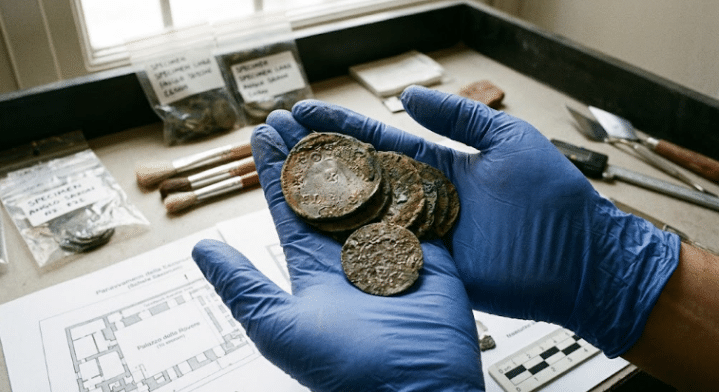
Researchers identified 19 silver pennies and one halfpenny minted during the reigns of Edward the Elder (899–924), Æthelstan (924–939) and Eadred (946–955).
Their discovery was announced by the University of Cambridge on October 1, 2026, following research by Rory Naismith, Francesca Tinti, Marzia Di Mento, Valentina Pica and Filippo Salamone.
The coins are important because they did not appear in a royal treasury or ceremonial deposit.
They were found among evidence for ordinary craft and commercial activity.
That makes them physical evidence that tenth-century England remained closely tied to Rome and continental Europe even while Scandinavian settlement, warfare and political power were transforming Britain at home.
Twenty English Coins Turned Up Beside The Vatican
Excavations began at Palazzo della Rovere in 2020.
The site became internationally known in 2023 when archaeologists identified remains associated with the theatre of Emperor Nero.
The medieval levels produced a different surprise.
Researchers found 20 Anglo-Saxon coins along with Roman and tenth-century Italian currency and evidence for leatherworking, boneworking and metalworking.
The University of Cambridge report on the Schola Saxonum discovery identifies the English money as 19 pennies and one halfpenny struck over approximately four decades.
Fourteen coins came from rubbish pits in two clusters containing between six and eight pieces each. Some fused together after roughly a thousand years underground.
The remaining coins appeared separately nearby.
That distribution makes the discovery very different from a deliberately hidden hoard.
Researchers interpret it as evidence that English money was actually moving through the local economy.
The Coins Came From Several Parts Of England
The coins were not products of one mint.
Naismith and Tinti traced examples to East Anglia, Kent, London and the West Midlands.
That geographic spread matters.
Money reaching Rome was not simply coming from one royal court or one southern port.
Coins from different English regions converged there.
Such movement fits the expanding monetary system of tenth-century England.
Earlier research led by Naismith has shown that England experienced a major revival in silver coinage centuries before these Roman finds. The Cambridge research on early medieval silver coinage demonstrates how English monetary networks had already become closely connected to wider European sources of bullion.
By the tenth century, English pennies had become standardized enough to travel far beyond the kingdom that issued them.
Rome now provides physical evidence for just how far.
Edward, Æthelstan And Eadred Ruled During A Viking Transformation
The rulers represented by the coins belong to one of the most important periods in English history.
Edward the Elder, son of Alfred the Great, fought Scandinavian-controlled territories and expanded West Saxon authority.
His son Æthelstan became king in 924 and is often regarded as the first ruler to exercise effective authority over a kingdom resembling unified England.
Eadred continued the struggle for control of Northumbria during the 940s and 950s.
These kings did not rule an England isolated from Scandinavia.
They governed a society reshaped by Scandinavian armies, settlement and political alliances.
Places such as York remained deeply connected to the Norse world.
Yet the Rome coins reveal another direction of connection.
While English rulers struggled with Viking power in Britain, English people and English money were travelling south across continental Europe.
The same England participated simultaneously in North Sea and Mediterranean-facing networks.
The Halfpenny Suggests Everyday Trading
One coin stands out because of its denomination.
The assemblage includes a rare halfpenny.
Researchers consider this important because small-value money tends to appear where frequent, relatively modest transactions took place.
The halfpenny therefore supports the archaeological evidence for ordinary economic activity.
The Schola Saxonum was not simply a religious hostel where pilgrims slept before visiting St Peter’s.
People worked there.
Archaeologists uncovered evidence for processing leather, bone and metal across an area covering at least 3,000 square metres.
Rory Naismith has suggested that hundreds of people may have lived within the English community.
If so, “Little England” functioned less like temporary accommodation and more like a permanent expatriate neighbourhood.
Rome’s English Quarter Had Existed For Centuries
The Schola Saxonum did not suddenly appear in the tenth century.
Written sources mention an Anglo-Saxon community near St Peter’s from at least the late eighth century.
Its origins belonged to an even longer relationship between England and the papacy.
English pilgrims had travelled to Rome for generations.
Kings also maintained diplomatic and religious connections with the pope.
Offa of Mercia, who ruled from 757 to 796, established an annual payment associated with supporting Roman churches.
Alfred the Great continued sending alms to Rome during the ninth century.
His biographer Asser recorded that in 883, Pope Marinus I freed the Schola Saxonum from certain tolls and obligations at Alfred’s request.
Researchers are careful not to claim that this document directly proves English coins received special legal treatment.
The archaeological evidence now shows, however, that Alfred’s son’s money really did circulate in Rome.
A Viking-Driven Exile Was Buried There
The Schola Saxonum also connects directly with Viking political history.
Burgred, king of Mercia from 852 to 874, lost his kingdom during the Viking invasions.
After leaving England, he travelled to Rome.
He died there and was buried in the English community’s church.
His story demonstrates how the routes between England and Rome could become politically important during periods of Scandinavian expansion.
Rome was not simply a distant religious destination.
It could become a refuge for displaced English elites.
The newly discovered coins show that the connection extended beyond kings.
Ordinary residents, craftspeople and pilgrims also participated in the movement between England and Italy.
English Coins May Have Received Exceptional Treatment
One of the most intriguing aspects of the discovery concerns foreign money in Rome.
Early medieval documents usually describe transactions there using papal currency.
Other travellers apparently expected to exchange their money before spending it.
The English coins appear to challenge that pattern.
Researchers note that comparable quantities of Frankish or northern Italian foreign coinage have not been found in the same way.
One papal coin found alongside the Anglo-Saxon pieces suggests both currencies may have circulated together.
That raises the possibility that residents of the Schola Saxonum enjoyed unusual permission to use English money.
Researchers have not found a surviving document explicitly granting that privilege.
The archaeological pattern nevertheless suggests that England’s relationship with Rome may have operated under exceptional arrangements.
The Coins Complicate The Idea Of A Viking-Age English Economy
Viking-Age English coinage is often discussed mainly in relation to Scandinavian warfare.
Armies demanded payments.
Kings raised taxes.
Danegeld transferred vast amounts of silver.
Scandinavian rulers eventually struck their own coins in England.
All of that matters.
The Rome discovery adds another dimension.
English currency was also moving through peaceful religious and commercial networks.
Coins reached Italy because pilgrims, merchants, churchmen and residents crossed Europe.
That resembles the larger lesson found in the Goddard Coin and long-distance Norse exchange debate: a coin’s final archaeological location can reveal networks much larger than the life of the person who originally received it.
Rome’s pennies survived at the opposite end of such a network.
Æthelstan’s Europe Was Already International
Æthelstan’s reign provides an especially useful example.
He maintained diplomatic relationships with rulers across continental Europe.
His sisters married into powerful European dynasties.
Foreign clerics and political visitors reached his court.
His kingdom also remained deeply involved in warfare against Scandinavian-controlled territories.
Those two realities were not contradictory.
Viking-Age England could fight Norse rulers in one region while maintaining religious, diplomatic and economic ties across Europe elsewhere.
The Rome coins make that complexity tangible.
A penny carrying an English king’s authority could circulate thousands of kilometres from the conflicts that shaped his reign.
“Little England” Was Part Of Rome, Not A Separate English Colony
The modern phrase “Little England” needs some caution.
The Schola Saxonum was not an independent English colony in the modern political sense.
It operated within Rome.
Its residents interacted with Roman religious institutions, local craftspeople and the papacy.
Other foreign groups had similar institutions near St Peter’s, including communities associated with Franks, Frisians and Lombards.
What seems unusual is the amount of physical evidence now associated with the English group.
The new coins provide the first strong archaeological material tied directly to the Schola Saxonum.
That makes it possible to move beyond written accounts and study how its residents actually lived.
Peter’s Pence Deepened The Connection
During the tenth century, links between England and Rome became increasingly institutional.
The practice later known as Peter’s Pence involved payments from England to Rome.
Its exact early development remains debated, but it reflects the durability of the relationship.
The connection survived the very Viking political changes that transformed England.
When Cnut ruled England in the 11th century, he too travelled to Rome.
In 1027, Cnut attended the imperial coronation of Conrad II and negotiated conditions affecting travellers from his kingdoms.
That continuity is revealing.
Anglo-Saxon kings and a Scandinavian king of England both used the same broader European religious networks.
Rome connected political worlds that modern historical labels often separate.
Why The Rome Coins Change The Viking-Age Map
The 20 coins found beside the Vatican do not prove that England was uniquely global.
People, silver and ideas moved across early medieval Europe in many directions.
What makes this assemblage important is how clearly it documents one relationship.
Nineteen pennies and a halfpenny travelled from mints in East Anglia, Kent, London and the West Midlands to an English community in Rome.
They circulated alongside local currency.
Craft production surrounded them.
The coins belonged to the reigns of kings who were simultaneously fighting, absorbing and governing Scandinavian populations at home.
That combination challenges a narrow map of Viking-Age England.
England faced north toward Scandinavia and the North Sea.
It also faced south toward Francia, the Alps and Rome.
Pilgrims, craftsmen, money and political messages moved along those routes while Viking kingdoms rose and fell in Britain.
The Schola Saxonum coins therefore reveal something broader than an English neighbourhood in Italy.
They show that Viking-Age England was already embedded in a European system of travel, religion, diplomacy and trade.
The Vikings changed England profoundly.
They did not cut it off from Europe.
Rome’s “Little England” proves just how far the connections continued to reach.
