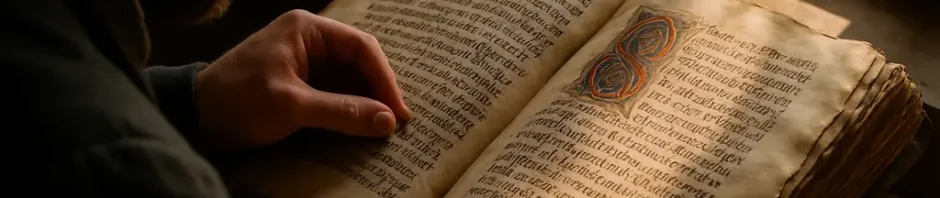
Old Norse Readability is a necessary aim, but it cannot be separated from textual fidelity without changing what students and scholars are able to see. A diplomatic edition keeps manuscript spellings and variation close to the surviving witness. A normalised edition standardises orthography and grammar so that readers can move through the text with less friction. The tension is not a minor classroom preference. It affects dictionary use, translation, metrical interpretation, linguistic history, and the way medieval Norse texts enter public culture.
Why Old Norse Readability Needs Fidelity
The central issue is that readability and fidelity answer different needs. Readability helps learners, translators, and non-specialist readers understand the sentence in front of them. Fidelity protects the evidence that makes philology possible: spellings, variants, scribal habits, dialectal forms, and other signs of manuscript transmission. If the editor regularises too much, the text may become easier to read while losing traces that matter for historical interpretation.
Old Norse Readability In Normalised Texts
A September 2026 University of Iceland lecture framed this problem through the contrast between diplomatic editions and normalised editions. The lecture reported that users of the Dictionary of Old Norse Prose had found unnormalised diplomatic texts difficult to access, while normalisation could make the material more usable for readers and digital tools University of Iceland lecture. That is a clear practical finding: a text that preserves every manuscript feature may serve specialists well, yet still become a barrier for many readers.
What Fidelity Protects
Fidelity protects more than quaint spelling. In Old Norse work, form can be evidence. A manuscript spelling may suggest a phonological development, a regional habit, a scribal choice, or a stage in transmission. A variant reading may help scholars compare witnesses. Even when the reading is awkward, it may tell us something about how a text was copied, taught, altered, or misunderstood. I find this point especially important for Norse studies because the surviving record is uneven. We often work through later manuscripts, layered copying histories, and editorial mediation. A clean text is useful, but it should not pretend to be the manuscript itself.
What Normalisation Changes
Normalisation changes the reader’s first encounter with a text. It may align spelling, grammar, and word forms with a learned standard, making the prose or verse easier to parse. For students, that can be the difference between meeting the text directly and giving up before reaching the sentence’s meaning. For digital projects, standardised forms can also help search, comparison, and lemmatisation.
Access Is Not The Same As Replacement
The strongest case for normalisation is not that it replaces the manuscript record. It is that it provides an entry point. A normalised text can let a reader identify a word, test a translation, or compare passages before consulting a diplomatic form. In that sense, readability is a bridge, not an endpoint. The difficulty begins when the bridge is mistaken for the original terrain. If students only see standardised forms, they may never learn that the manuscript record contains variation worth studying.
Layered Presentation Works Best
A careful edition can show both levels: a diplomatic transcription for evidence and a normalised version for access. That pairing encourages readers to ask why the two differ. It also supports different users without forcing one format to do all tasks. A lexicographer, a graduate student, a literary critic, and a public reader do not always need the same view of the text. Yet each benefits when the editorial choices are explicit.
How AI Tests Old Norse Readability
The September 2026 University of Iceland lecture also reported a pilot study in which several large language models were tested on normalising Old Norse material from the Dictionary of Old Norse Prose. According to the lecture notice, the results showed substantial improvement in performance, with highly accurate normalisations across a wide range of text types. For Old Norse Readability, this is promising because it suggests that computational tools may help widen access to difficult unnormalised material.
Why Human Review Still Matters
The promise should not be confused with certainty. A model can produce a plausible normalised form while concealing the editorial decision behind it. Human review remains necessary because Old Norse texts are not only strings of characters; they are witnesses within transmission histories. A scholar must still ask whether a form should be regularised, preserved, flagged, or discussed. Readers interested in this digital side of the field may compare the issue with Old Norse AI and manuscript preservation, where machine assistance is useful but does not remove the need for human checks.
AI As A Reading Aid
The most cautious use of AI normalisation is as a reading aid. It can help readers move from a difficult diplomatic line toward a more recognisable form, then back again to the witness. That back-and-forth matters. If computational output becomes the only text readers see, fidelity suffers. If it remains paired with manuscript-based forms, it can serve teaching, dictionary access, and exploratory research without hiding the underlying evidence.
Metrical Evidence And Eddic Interpretation

The readability problem is not limited to prose spelling. Verse adds metre and linguistic patterning. In an article published on 16 December 2022, Mikael Males argued that Eddic scholarship had gradually shifted since the 1930s toward metrical and linguistic imprecision, with less concern for strict fidelity to metrical and linguistic metrics in favor of broader interpretability Males in Neophilologus. That claim is important because Eddic poetry often depends on form as much as narrative content.
Readable Verse Can Lose Its Measure
A smooth translation or simplified commentary can make a stanza feel immediate, but it may also hide the formal pressures that shaped it. Metre is not decorative packaging. It can influence word order, diction, and the plausibility of an emendation. If a reading makes good narrative sense but violates expected metrical structure, the conflict deserves attention rather than quiet removal. The question is not whether every reader must master technical metrics at once. The question is whether editions and teaching materials give readers a path toward seeing why metre matters.
Interpretation Needs Restraint
Old Norse texts invite interpretation, but interpretation is strongest when it remains answerable to form. A literary reading that ignores linguistic evidence risks making the text too modern, too smooth, or too dependent on the interpreter’s preference. A purely technical reading can also fail if it never explains why the poem mattered as literature. The best work holds both demands together: it lets the poem speak as poetry while keeping the formal evidence visible.
Public Access And Scholarly Duty
Public-facing Norse scholarship has a duty to be readable. If the field speaks only to specialists, medieval texts become museum cases with the glass darkened. Yet public access should not require flattening the evidence. The better aim is honest mediation: explain what has been normalised, what remains uncertain, and where the manuscript record resists a simple reading.
Readers Need Clear Signals
Clear labels help. An edition can identify a normalised text, a diplomatic transcription, a translation, and a commentary as separate layers. A classroom handout can explain why a form has been regularised. A digital display can let users compare levels. These practices do not burden readers; they give them choices. They also teach a central habit of historical work: every readable version has been shaped by decisions.
Networks Of Public Explanation
Specialist sites are not alone in facing the challenge of plain explanation. Across the same network, a related community site such as the Stuyvesant Yacht Club demonstrates that public writing often has to translate expert practice into usable language. For Old Norse studies, that translation must be especially careful because the evidence is distant, fragmentary, and easily romanticised.
Old Norse Readability And Textual Fidelity
The necessity of balance lies in the nature of the sources. Old Norse texts survive through manuscripts, editorial histories, commentary traditions, and modern tools. A normalised form can open the door. A diplomatic form can keep the evidence intact. A translation can widen the audience. A commentary can explain the stakes. None of these layers should pretend to be the whole text.
For students, the practical answer is to read in layers whenever possible. Begin with the normalised text if needed. Check the diplomatic form when a word, metre, or variant matters. Ask what the editor has changed. Treat AI output as assistance, not authority. For scholars, the duty is to make those layers visible and to resist the temptation to hide difficult evidence for the sake of smoothness.
This balance is not a compromise that weakens the field. It is the condition that lets Old Norse study remain both teachable and truthful. Readability brings people to the text. Fidelity keeps the text historically accountable. The finest work in Norse philology does not choose one against the other; it shows readers why both are needed.
