Norse Artifacts in the American context sit at the meeting point of archaeology, public memory, ethnic identity, and source criticism. The evidence is uneven. L’Anse aux Meadows in Newfoundland remains the only undisputed Norse site in North America outside Greenland, while many claimed finds in the United States and Canada have been rejected, doubted, or left without secure context. As of October 17, 2026, the debate is not whether Norse voyagers reached North America; that is settled by the Newfoundland site. The harder question is whether any artifact farther south can prove Norse travel, trade, or settlement beyond that known base.
Why Norse Artifacts Need Strict Context
Archaeology depends on association. A coin, inscription, or weapon fragment can be authentic in itself and still fail to prove the story later attached to it. This is why isolated objects have caused so much argument in the American material. Without secure excavation records, associated features, datable layers, and comparable finds, an object can drift from evidence into folklore.
L’Anse aux Meadows shows the difference. The site has structural remains and archaeological deposits that support Norse activity. Recent fieldwork east of the main site and Bayesian reanalysis of older radiocarbon dates have suggested that Norse use may have extended across about a century, though not as continuous occupation. The authors instead discuss intermittent use, which fits the idea of a base camp rather than a permanent colony L’Anse aux Meadows study.
What A Secure Site Can Show
A secure site can connect objects to human activity. At L’Anse aux Meadows, the argument does not rest on a single dramatic item. It rests on a set of archaeological relationships: structures, work areas, and dated material. That does not answer every question about Norse activity in North America, but it gives scholars a firm place from which to reason.
By contrast, many American claims begin with one object and move outward to a large historical claim. That method is weak. A single object may have moved through trade, collection, loss, planting, or later disturbance. It may even be genuine but not local in origin. The American debate has often suffered because the wish for discovery outran the evidence needed to support it.
Norse Artifacts And The Problem Of Proof
Norse Artifacts require more than visual similarity. A carved stone needs linguistic and geological testing. A coin needs provenance and archaeological association. A tool or weapon needs context, wear analysis, and comparison with securely dated examples. Even then, the answer may remain uncertain if the find history is weak.
This is not excessive caution. It is the basic discipline that protects Viking Age studies from turning every unusual object into a migration story. It also protects Indigenous histories, because claims of Norse presence in North America often concern sites already connected to Native communities and exchange networks.
The Maine Penny And The Limits Of A Genuine Object
The Maine penny is the strongest United States example because the coin itself is not usually dismissed as a modern fake. It was reportedly discovered in 1957 at a Native American site at Naskeag Point in Brooklin, Maine. The coin was struck in Norway between 1065 and 1080 during the reign of King Olaf Kyrre. That makes it an authentic Norse object, but authenticity is not the same as proof of Norse settlement in Maine.
The central problem is context. No securely associated Norse structures, tools, burials, or settlement remains have been found with it. The coin could point to long-distance exchange reaching south from the Norse world of Greenland and Newfoundland. It could also have entered the site through later collection activity or other movement that is now hard to reconstruct. The evidence allows questions, not certainty.
For readers who want the debate framed through heritage memory as well as archaeology, our earlier discussion of the Maine penny treats the coin as both an object and a public symbol. That distinction matters. The coin has become powerful because it is real, rare, and unresolved. Yet its unresolved status should not be used to fill the map with unsupported voyages.
Trade Is Not Settlement
Trade can move objects far beyond the people who made them. A Norwegian coin found in Maine, if accepted as ancient in its site context, could still have passed through Indigenous exchange networks from farther north. Such a scenario would be historically significant. It would not require Norse houses, farms, or ships in Maine.
This is where public discussion often becomes too simple. People ask whether the coin proves Vikings in Maine. A better question is what kind of contact, if any, the coin can support. Direct Norse landing, indirect trade, later intrusion, and collection error are different explanations. The current evidence does not support choosing the most dramatic one.
Runestones, Relics, And Rejected Claims
Several famous objects have shaped the American debate even though they are not accepted as evidence for Norse exploration. The Kensington Runestone, reported in Minnesota in 1898 and dated in its inscription to 1362, remains widely rejected by runologists because its language and runic features fit poorly with medieval Scandinavian usage and better with later forms. The AVM Runestone, also from Minnesota and claimed in 2001, has likewise not been accepted as ancient evidence. The Beardmore Relics from Ontario involve Norse-style material, but the claimed discovery context has long been treated as unreliable.
Gordon Campbell’s Norse America, published in 2021, has been influential because it gathers many such claims and argues that most are spurious, misread, or hoaxes. A review in The Medieval Review notes Campbell’s position that the Maine penny remains the one genuine United States object with potential relevance, while still pointing away from sweeping claims of settlement review of Norse America.
- L’Anse aux Meadows: accepted archaeological site in Newfoundland.
- Maine penny: authentic coin, disputed meaning.
- Kensington Runestone: widely rejected as medieval evidence.
- AVM Runestone: not accepted as ancient Norse evidence.
- Beardmore Relics: Norse-style material with a discredited context.
Why Rejection Still Teaches Us Something
Rejected claims are not useless. They show how historical desire works. In the nineteenth and twentieth centuries, stories of Norse discovery often became tied to Scandinavian-American identity, New England antiquarian interest, religious argument, racial thought, and nationalist pride. These uses do not make every claim false by themselves, but they do explain why evidence was sometimes stretched.
Careful interpretation asks why an artifact claim became persuasive to a community. A runestone could serve as a local origin story. A coin could become a sign of early contact. A sword fragment could be used to place Vikings where evidence has not placed them. Public heritage needs to recognize those meanings without mistaking them for proof.
Why The American Debate Still Matters
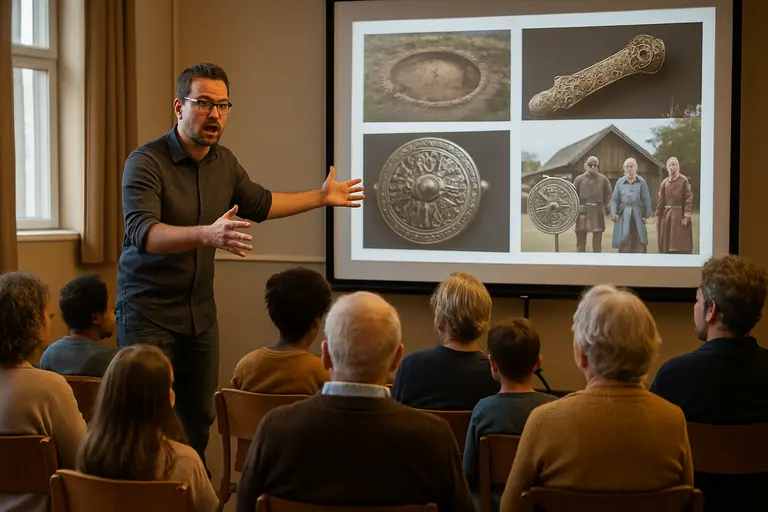
The debate remains significant because it shapes how North American audiences imagine the Viking Age. If every uncertain object is promoted as proof, then L’Anse aux Meadows loses its real force as an archaeological discovery. If every disputed item is dismissed without explanation, then the public misses a chance to learn how evidence works.
Museums, writers, and educators should separate three categories: proven sites, authentic objects with uncertain movement, and claims rejected on technical grounds. That separation makes room for both curiosity and restraint. It also helps prevent Norse history from being used to overwrite Indigenous histories of place, movement, and exchange.
Material culture has a public life beyond excavation reports. Objects are drawn, photographed, copied, displayed, and retold; this wider interest in how people record and interpret objects is also visible through related cultural projects such as The Sketchbook Project. The point is not that art replaces archaeology. It is that public memory often begins with how an object is seen.
How Better Questions Improve The Debate
For Norse Artifacts, better questions are often smaller questions. Where was the item found? Who recorded it? Was it excavated under controlled conditions? Are there associated datable materials? Does the language, metal, carving, or wear match the claimed date? Are there nearby finds that support the same interpretation?
Those questions may sound modest, but they are the route to stronger history. The Viking Age in North America does not need invented certainty. L’Anse aux Meadows already proves Norse presence west of Greenland. The Maine penny, if handled carefully, can still raise valuable questions about exchange and contact. The rejected runestones and relics show why source criticism is not an obstacle to heritage; it is what keeps heritage honest.
Norse Artifacts In The American Context
The American debate over Norse Artifacts is best understood as a debate about context, not romance. The evidence supports Norse activity at L’Anse aux Meadows and leaves open cautious discussion of how a Norwegian coin reached Maine. It does not support broad claims of Norse settlement across the United States or inland North America.
That answer may disappoint readers who want a larger Viking map. Yet it gives us a better historical method. Provenance, excavation context, dating, language, and comparison must come before identity claims. The most responsible account is also the most interesting one: Norse contact with North America was real, but the American artifact record remains narrow, contested, and often misused. Treating that record carefully lets the known evidence speak without forcing it to say more than it can.
