
Old Norse AI has moved from broad promise into visible manuscript work during 2026, especially in handwritten text recognition, normalisation, and damaged-text restoration. The recent discussion is not that machines have replaced philologists. The stronger, better-supported claim is narrower: AI tools can help scholars read, search, compare, and prepare difficult medieval material when the data, task, and limits are stated openly.
What Old Norse AI Can Read From Manuscripts
The September 2026 OICEN-HTR Release
On September 29, 2026, the OICEN-HTR model, using a PP-OCRv6-small version, was released by the University of Vienna for Old Icelandic and Norse manuscripts and fragments. Its in-domain test results were reported at about 90.12% character accuracy and about 71% word accuracy. The same release recorded weaker out-of-domain results, including about 88.53% character accuracy and 63.55% word accuracy on a fragment, according to the Zenodo model record.
Those numbers show real progress, but they should be read with restraint. Character accuracy and word accuracy do not mean the model has understood a saga, law code, homily, or fragment in a human sense. They show how often a system’s output matched a reference text under a defined test. That is useful evidence, not a declaration that the manuscript problem has been solved.
Why In-Domain Scores Do Not Settle The Question
The contrast between in-domain and out-of-domain results is central. A model can perform well on material close to its training set yet struggle when handwriting, abbreviations, damage, layout, or orthography differ. The research notes for OICEN-HTR state that out-of-domain word accuracy can fall to about 50–65% on manuscripts or fragments outside the training set. That drop is not a small technical footnote. It reflects the lived texture of medieval books: hands change, scribes abbreviate, pages suffer damage, and spellings shift across time and place.
For editors and language historians, this means automated transcription is best treated as a draft layer. It can speed first contact with a page, suggest readings, and make large sets more searchable. Yet every output still needs checking against the image and, where possible, against parallel witnesses, editions, lexica, and the habits of the scribe.
Normalisation, Access, And Scholarly Caution
Old Norse AI And Normalisation
A second 2026 discussion centered on normalisation: turning variable manuscript spellings into more regular forms that readers and search tools can use. A talk titled “From Normalisation to Understanding: AI and the study of Old Norse” was held at the University of Iceland on September 8, 2026. According to the event description in the research notes, a pilot study tested several large language models on material from the Dictionary of Old Norse Prose and found substantial improvement, with current models producing highly accurate normalisations across a range of texts.
This matters because many readers first meet Old Norse through normalised forms, while manuscripts preserve spelling variation that is historically valuable but difficult for non-specialists. Normalisation can act as a bridge between the page and the learner, between the scribe’s habits and the dictionary search box. The danger is that the bridge may hide what it crosses. If normalised text replaces manuscript spelling too early, evidence for scribal practice, regional usage, metre, sound change, and textual transmission can be flattened.
The ONP Access Problem
The Dictionary of Old Norse Prose relies heavily on diplomatic editions and unnormalised scholarly editions, according to the research notes. That choice preserves manuscript spellings and protects evidence, but it can also make access hard for students, public readers, and scholars from adjacent fields. Automated normalisation may help here if the system keeps both layers visible: the manuscript form and the suggested normalised form.
Good language technology should not ask users to forget the manuscript. It should help them see more of it. A useful interface might show a line image, an automated transcription, a normalised suggestion, and a confidence measure. Such a design would make the machine’s work inspectable rather than invisible.
From Transcription To Damaged Text Restoration
A Legal Manuscript Test Case
On June 3, 2026, a handwritten text recognition model for AM 305 fol., the 13th-century Old Norse legal manuscript associated with Járnsíða and Magnúsbók, was published, according to the research notes. It was trained on 145 folios and reported a Character Error Rate of 2.64% and a Word Error Rate of 8.33% on a held-out validation set. Those figures are stronger than many general-purpose expectations for difficult medieval material, though they apply to a specific manuscript and evaluation setting.
The legal context is significant. Law manuscripts preserve not only language but social order, procedure, authority, and scribal habits. A transcription error in such material may affect a word ending, a legal term, or a syntactic relation. The lower the error rate, the more useful the draft becomes, but the need for expert review remains high because the historical stakes can rest on small forms.
Damaged Manuscripts And Wider Tools
Some AI work now discussed around ancient and medieval manuscripts is not specific to Old Norse but may still matter for low-resource manuscript traditions. In spring 2026, Professor Paul Dilley at the University of Iowa received a US$500,000 Schmidt Sciences grant for a three-year project titled “AI Models with Reinforcement Learning to Edit Text in Damaged Manuscripts,” according to the University of Iowa announcement.
The project was framed around tools that can help reconstruct faded or fragmentary letters and propose restorations. The research notes state that such methods may be applicable to low-resource medieval manuscript material, including Old Norse, though that should be read as potential rather than proof. A model trained or tested for one manuscript culture cannot simply be assumed to work for another. Scripts, layouts, writing materials, damage patterns, and editorial conventions all shape the task.
Why Human Philology Still Sets The Terms
Low Data And Manuscript Variation
Old Norse AI is most useful where it respects the low-data problem. The research notes identify limited annotated data as a core challenge: many manuscripts remain unedited in digital form, and fewer still are edited closely enough to manuscript spellings for lexicon building and textual analysis. This is not only a technical shortage. It is a scholarly condition created by the survival of manuscripts, the labor of editing, and the uneven history of digitisation.
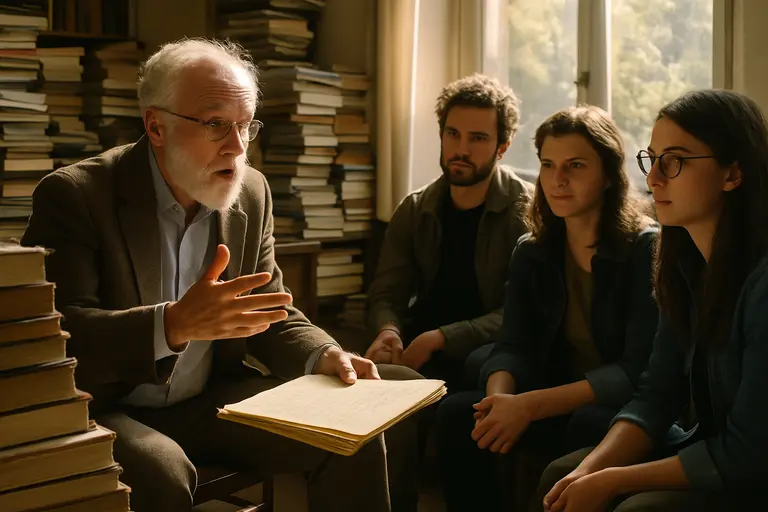
The same problem explains why human judgment remains central. A model can suggest readings across a fragment, but a philologist asks what kind of fragment it is, what hand wrote it, whether an abbreviation is conventional, whether a spelling belongs to a particular copying habit, and whether a proposed word makes sense in the genre. For readers interested in the preservation side of these tools, Old Norse News has also treated Old Norse AI and manuscript preservation as a separate but closely related issue.
Ethics, Teaching, And Energy Use
The University of Iceland discussion also raised ethical and pedagogical questions, according to the research notes. If a system can normalise medieval text for a reader who has not learned Old Norse, what happens to language learning? The answer should not be panic, but it should not be indifference either. Tools that make texts accessible can widen interest, yet they may also tempt institutions or students to treat language training as optional.
Environmental cost was part of the same discussion. Large models require energy to train and run, and manuscript scholars should not speak about access as if computation has no material cost. The strongest case for AI in manuscript studies is not “use it everywhere.” It is “use it where the benefit is clear, the evidence is preserved, and the output can be checked.”
Clear prose also matters. Technical claims about medieval texts can become vague very quickly when they pass from research settings to public explanation. A related network resource on writing, Top Ten Writing Services, offers insights into how effective communication can support readers in navigating complex texts.
Old Norse AI and Manuscript Understanding
What The Recent Discussion Shows
The recent Old Norse AI discussion shows a field in useful tension. Handwritten text recognition has produced measurable gains. Normalisation has become more credible for difficult prose material. Damaged-text restoration projects in adjacent manuscript fields may offer tools that Old Norse scholars can test with caution. Multimodal and language-model methods are being discussed for semantic search, matching parallel passages, and identifying relationships between texts and translations.
Yet each of these gains depends on evidence. A transcription model needs images and reference texts. A normalisation model needs clear editorial targets. A restoration tool needs uncertainty marking. A semantic search system needs scholars who understand genre, transmission, and language. The machine can help move through material, but it does not inherit the cultural knowledge of the manuscript tradition by itself.
For contemporary readers, the value is not only speed. It is the possibility of seeing more layers at once: manuscript spelling beside normalised text, uncertain letters beside proposed readings, one witness beside another. That can make Old Norse manuscripts more approachable without pretending they are simple. The old pages still ask for patience. The new tools can help, provided we keep the manuscript, not the model, at the center of interpretation.
