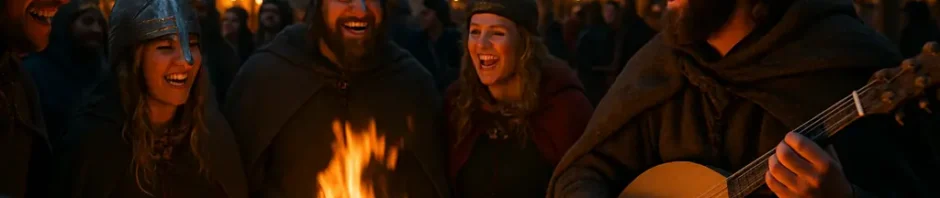
Norse Heritage Festivals have become one of the clearest public signs that interest in Scandinavian ancestry, Viking imagery, and Norse cultural memory remains active across the United States. The evidence is not simple growth everywhere. Some events have drawn large crowds, while others have reduced their scale or ended long-running operations. Taken together, recent U.S. festivals show a culture of revival shaped by family memory, public performance, regional identity, food, craft, music, and careful use of myth.
What Norse Heritage Festivals Revive
Norse Heritage Festivals And Ancestry Work
At their strongest, these events do not only stage shields, horn cups, and dramatic costumes. They give descendants of Scandinavian immigrants a place to connect names, stories, recipes, textiles, language fragments, and family routes. In Ephraim, Utah, the Scandinavian Heritage Festival has been held each Memorial Day weekend and, according to KSL, drew roughly 30,000 annual visitors while offering historical tours, storytellers, Scandinavian artisan villages, a Viking village, and chances to trace ancestral ties through Sanpete County’s Scandinavian community memory KSL reported.
That blend matters because heritage is often revived through repeated social action rather than private reading alone. A person may first encounter Norse material through mythic names, popular media, or family stories. A festival can then turn that interest into shared practice: listening to a storyteller, watching craft, tasting regional food, or asking where a grandparent’s surname came from. For a site concerned with language and older northern memory, this is where the old stories breathe again, though always through modern interpretation.
Stories, Food, And Public Memory
Food, costume, and performance can look light from a distance, but they carry memory when framed honestly. Norwegian dress at a parade, a Scandinavian artisan booth, or a Viking village at a local festival should not be treated as direct proof of medieval practice. They are public symbols. Their value lies in how they invite questions: What is inherited from immigrant communities? What is borrowed from medieval sources? What is modern theater? Those questions are healthier than simple nostalgia.
Readers curious about how visuals influence public memory might find the resource at Finest Image as a helpful exploration of how images shape cultural perception alongside written accounts.
Recent U.S. Events And Evidence
Growth, Scale, And Retrenchment
Recent events show both enthusiasm and strain. The Michigan Nordic Fire Festival in Charlotte, Michigan, founded in 2015, had reportedly reached more than 15,000 attendees by 2023. Its draw included fire displays, Viking reenactments, a mid-winter feast, mead halls, and artisan markets. In Ohio, the Ashville Viking Festival has drawn about 12,000 visitors over a single weekend, with attendees coming from at least 14 states, and has mixed reenactment, fantasy costuming, arts, music, and Norse-themed theater.
Other events show that revival is not the same as guaranteed expansion. Norsk Høstfest in Minot, North Dakota, founded in 1978 and long described as North America’s largest Scandinavian festival, announced in January 2026 that it would cease operations after the 2025 event. The reasons given in the research notes were rising operational costs and attendance that had not returned to pre-COVID levels. A smaller Minot event, Fjord Folk Fest, was then established with inaugural dates of August 21–22, 2026. Since those dates had passed by October 21, 2026, the event should now be discussed retrospectively rather than as an upcoming replacement.
The contrast is useful. Norse Heritage Festivals are not immune to venue costs, volunteer limits, travel patterns, or shifting entertainment habits. A smaller event can still preserve memory, but it changes the public scale of that memory.
Constitution Day As Civic Memory
Norwegian Constitution Day, or Syttende Mai, shows another form of Scandinavian public culture. In 2026, Stoughton, Wisconsin held a three-day Syttende Mai Festival from May 15 to May 17, and Ballard in Seattle held its parade on May 17, 2026. Forbes described North American celebrations of May 17 as community events that include parades, music, food, children’s activities, and Norse dress Forbes noted.
This type of celebration is not a Viking festival in the narrow sense. It is a modern national and immigrant-memory event. Yet it belongs in the same discussion because it shows how Norwegian identity, dress, public procession, food, and family participation keep Scandinavian heritage visible in American towns. The mythic past and immigrant past are not identical, but festivals often place them near one another in public imagination.
Public Ritual, Costume, And Myth
Where Viking Imagery Helps
Viking imagery can be a doorway into older literature and myth when interpreters avoid overclaiming. Fire festivals, axe-throwing areas, mead halls, leather armor displays, and Viking villages can attract people who might never begin with a saga translation or a museum catalog. The Topeka Viking Renaissance Festival in Kansas, described in the research as being in its third year as of March 2026, averaged about 3,000 attendees per weekend and offered leather armor displays, axe-throwing, Norse-inspired crafts, and community storytelling. Its June 13–14, 2026 dates had already passed by October 21, 2026.
The public appetite is clear. Yet the evidence base must stay visible. A festival axe-throwing lane is a modern activity. A leather armor display may be inspired by historical material but should not be presented as a settled reconstruction unless evidence supports that claim. Storytelling can introduce Odin, Thor, Freyja, and saga heroes, but later medieval texts, archaeological finds, and modern fantasy should not be blended without labels.
Where Fantasy Needs Labels
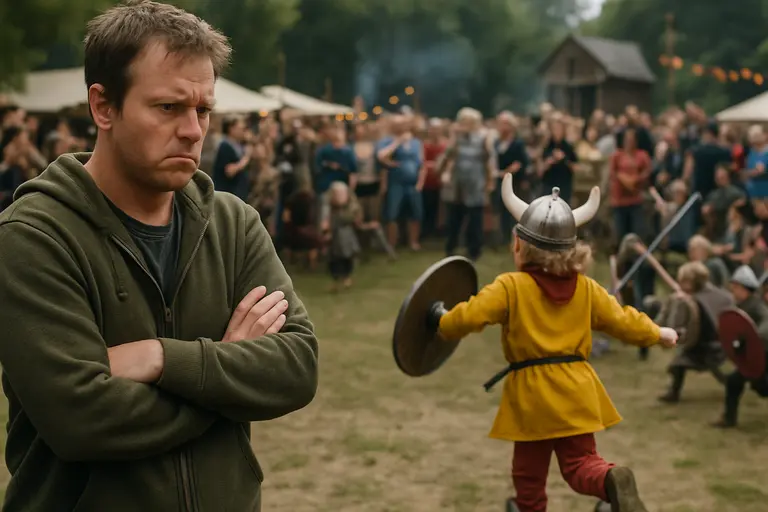
The Ashville Viking Festival’s mixture of historical reenactment, fantasy costuming, arts, music, and Norse-themed theatrical performance illustrates a common American pattern. The mixture can be enjoyable and even educational if it tells visitors what is theatrical and what is source-based. The danger comes when fantasy costume becomes mistaken for evidence. Horned helmets, generalized warrior culture, and vague pagan labels have long histories in modern media, but they are not neutral teaching tools.
For related discussion of how U.S. events frame ancestry, myth, and public culture, see Norse heritage festivals in the U.S.. That broader pattern matters because festival revival is not only about attendance; it is about the stories communities choose to repeat.
Why Norse Heritage Festivals Need Caution
Attendance Is Evidence, Not Proof Of Accuracy
Large attendance can show public interest, but it does not prove historical accuracy. The Mead on Main – A Viking Festival in Festus, Missouri, held on October 3, 2026, was identified in the research as its 7th annual event and drew about 6,000 people, its highest turnout to date. That number suggests strong local engagement with Viking-themed entertainment, food vendors, mead sampling, music, and cultural programming. It does not, by itself, tell us whether the interpretation was historically precise.
This distinction is central for Norse Heritage Festivals. A festival may revive interest by making old northern themes socially appealing. Scholarship then has to help visitors separate immigrant memory, medieval evidence, modern Heathen practice, fantasy performance, and commercial entertainment. None of those categories must be dismissed, but they should not be confused.
Revival Can Be Regional
The research also points to regional patterns. Utah, North Dakota, Michigan, Kansas, Ohio, Missouri, Wisconsin, Washington, and Minnesota all appear in recent examples. Minnesota’s 2025 commemoration of 200 years of Norwegian emigration, marked by Crown Prince Haakon’s visit on October 7, 2025, was tied to the state’s more than 800,000 residents claiming Norwegian ancestry. That figure helps explain why Scandinavian public memory can be especially visible in the Upper Midwest.
Regional revival, however, should not be mistaken for one uniform American Norse identity. A Syttende Mai parade, a Viking-themed Renaissance festival, a Scandinavian heritage weekend, and a mid-winter fire festival each carry different meanings. Some lean toward immigrant ancestry. Some lean toward mythic spectacle. Some mix both. Careful interpretation begins by naming the difference.
Norse Heritage Festivals As Living Memory
Norse Heritage Festivals are best understood as living memory rather than direct windows into the Viking Age. They bring people together around names, stories, food, dress, music, craft, and performance. They can renew interest in sagas and myths, but they also preserve the more recent memory of Norwegian, Swedish, Danish, Finnish, Icelandic, and broader Scandinavian immigrant communities in the United States.
The recent record is mixed, which makes it more credible. Ephraim’s Scandinavian Heritage Festival drew large crowds and linked visitors to ancestry work. Stoughton and Ballard used Syttende Mai to carry Norwegian civic memory into American streets. Michigan, Ashville, Topeka, and Festus showed strong appetite for Viking-themed public culture. Minot’s shift from Norsk Høstfest to the smaller Fjord Folk Fest showed that even beloved heritage institutions face economic and attendance pressure.
For contemporary readers, the lesson is not that every festival revives the past in the same way. The better reading is that festivals create public spaces where heritage can be performed, questioned, corrected, and passed on. When organizers mark the difference between evidence and theater, these events can guide newcomers from spectacle toward study. That is where ancient northern stories, immigrant memory, and modern community life meet with the most integrity.
