
For decades, historians have debated whether Norse settlers in Greenland actually cultivated grain or depended on imports from Iceland and Norway.
A new 2026 study strengthens the case that at least some barley was grown locally.
Published on October 1, 2026, in Activating Arctic Heritage: Interdisciplinary Studies of Northern UNESCO World Heritage Parks, the research brings together archaeobotany, strontium-isotope analysis and charcoal evidence from Norse farm sites in South Greenland.
The team includes Peter Steen Henriksen, Robert Frei, Anna Marie Stevnsvig, Claudia Baittinger, Sascha Krüger and Anne Birgitte Gotfredsen, working across the National Museum of Denmark and University of Copenhagen research environments.
Their most important result is cautious but significant: barley recovered from two Norse middens produced isotope signatures consistent with cultivation in Greenland.
Imported grain from southwestern Norway still cannot be completely excluded.
That uncertainty matters. The study does not prove that Greenland’s Norse farmers produced large cereal surpluses. It instead suggests that crop growing formed a genuine part of a farming system usually described almost entirely through cattle, sheep, goats, hay and imported food.
Barley Appeared In Both Studied Middens
The new Plant Resources in the Norse Society study analyzed botanical material from two excavated Norse middens in southwestern Greenland.
Both contained barley.
Middens are especially useful because they accumulate the remains of everyday activity: animal bones, ash, broken objects, food waste and charred plant material.
A grain inside such a deposit tells archaeologists that barley reached the farm.
Determining where it grew is much harder.
Norse settlers maintained maritime connections with Iceland and Norway, so grain found in Greenland could theoretically have arrived aboard ships.
The new study therefore tackles a question that ordinary identification cannot answer.
Was this barley imported, or did someone sow and harvest it in Greenland?
Strontium Isotopes Offer A Geographic Clue
The researchers used strontium-isotope analysis to investigate the grains.
Plants absorb strontium from local soils and water while growing. Different geological environments can produce different isotope signatures, potentially allowing researchers to compare a plant with the landscape where it may have originated.
Greenland creates complications.
The barley grains had been charred and later buried inside middens containing animal bones, fish, seal and whale remains. Over centuries, surrounding material contaminated their original strontium signals.
Researchers therefore had to remove much of that later contamination chemically.
The process eliminated more than 90 percent of the labile strontium before deeper analysis began recovering a different signal from the grains themselves.
Those results moved the evidence toward local cultivation.
The Two Farms Are Known As Ø35 And Ø49
The barley came from archaeological sites Ø35 and Ø49 in southwestern Greenland.
At Ø35, the midden appears to have been established during the early 1000s and remained in use for at least several centuries.
Ø49 probably began accumulating material around the middle of the 11th century and continued at least into the mid-1200s.
Radiocarbon work showed that both middens had experienced considerable disturbance and reworking.
Researchers therefore cannot reconstruct a clean year-by-year sequence of barley use.
The broad chronology still places the material firmly inside the mature Norse settlement period.
These were not experimental grains belonging only to Erik the Red’s first generation.
They came from farms occupied after Norse Greenland had developed into an established society.
The Isotope Results Fit Greenland Better Than Expected
Earlier stages of the analysis produced strontium values heavily influenced by midden contamination.
More aggressive chemical treatment eventually recovered ratios ranging roughly between 0.711 and 0.718.
At Ø49, those values matched local environmental samples including soil extracts and plants.
The Ø35 barley produced similar signatures.
Researchers argue that the Ø35 grains may therefore have grown on elevated terrain near the farms where geology produced comparable values.
This makes local cultivation the study’s preferred explanation.
Yet scientific caution remains necessary.
Parts of southwestern Norway possess similar bioavailable strontium signatures.
An imported Norwegian origin cannot be completely eliminated from isotopes alone.
The research therefore strengthens the farming hypothesis without turning it into certainty.
Earlier Archaeology Had Already Pointed Toward Cultivation
The 2026 work builds on a much longer investigation.
Previous research led by Peter Steen Henriksen examined hundreds of kilograms of soil from 12 Norse farmsteads in Greenland.
Archaeologists found charred barley grains and threshing waste at four sites.
Threshing waste matters because imported finished grain would not normally arrive with every piece of processing debris produced during harvesting.
Finding crop-processing remains near farms therefore supported the idea that at least some grain was grown locally.
The newer isotope work attacks the same question from a different direction.
Archaeobotany asks what plant remains are present.
Isotope analysis asks where those plants might have grown.
When both methods point toward Greenlandic cultivation, the argument becomes stronger.
Greenland Farming Was More Flexible Than The Stereotype Suggests
Norse Greenland is usually associated with pastoral farming.
That emphasis is justified.
Cattle, sheep and goats formed major components of the settlement economy, while hay production was critical for keeping livestock alive through winter.
Archaeological evidence also shows increasing exploitation of seals and other marine resources.
Barley adds a smaller but revealing piece.
Growing grain in Greenland would have required selecting favorable microclimates and accepting unreliable harvests.
Southern Greenland can support limited cereal cultivation under suitable conditions, but medieval farmers operated near the climatic margin for barley.
A successful crop in one year did not guarantee success in the next.
Norse farmers therefore may have treated barley as a supplementary crop rather than the foundation of their diet.
Barley Did Not Need To Mean Bread
Finding cereal does not automatically mean Greenlanders were baking large quantities of bread.
Barley could be prepared in several ways.
People might cook grain into porridge or use it in other foods.
Malted barley could potentially contribute to brewing.
Researchers should be cautious about assigning one use unless archaeological residues support it.
The important issue is agricultural capability.
If farmers sowed barley locally, they invested labour in ploughing or preparing soil, planting, harvesting and processing a crop whose success depended heavily on weather.
That choice reveals more experimentation in Greenlandic agriculture than a livestock-only model allows.
Local Cultivation Could Reduce Dependence On Shipping
Imported grain carried costs.
Ships crossing the North Atlantic had limited cargo capacity.
Every sack of barley occupied space that could otherwise carry timber, iron, luxury goods or other materials difficult to obtain locally.
Producing even modest quantities of cereal in Greenland could therefore improve household resilience.
It would not eliminate overseas dependence.
Norse Greenland remained connected to Atlantic networks for centuries.
The new evidence instead suggests that settlers adapted imported farming traditions to local conditions rather than reproducing Norwegian agriculture unchanged.
That distinction is important for understanding colonization.
Successful settlement required deciding which Old World practices could survive in Greenland and which needed modification.
The Study Also Changes The Story Of Norse Fuel
Barley is only half of the 2026 research.
Charcoal analysis examined how Greenlanders obtained fuel.
The results show that local willow and birch dominated everyday burning, with smaller contributions from imported timber and driftwood.
That pattern contrasts with evidence showing greater reliance on imported wood for specialized uses such as construction and toolmaking.
Greenland’s native trees and shrubs rarely produced the large straight timbers needed for major buildings or ships.
They could still provide firewood.
The distinction again shows selective resource management.
Norse households imported materials when necessary but exploited local vegetation where it could meet everyday needs.
Barley cultivation may belong to the same adaptive strategy.
Erik The Red’s Greenland Became A Farming Society
Norse settlement began around AD 985, traditionally associated with Erik the Red and settlers arriving largely from Iceland.
The first colonists brought a North Atlantic farming tradition with them.
Over subsequent generations, their descendants developed hundreds of farms in the Eastern and Western Settlements.
Old Norse News has examined how Greenland continued changing beyond its pioneering generation in its coverage of Norse maritime cultures after the Viking Age.
The barley evidence fits that longer history.
Greenland was not simply an expedition base established by famous explorers.
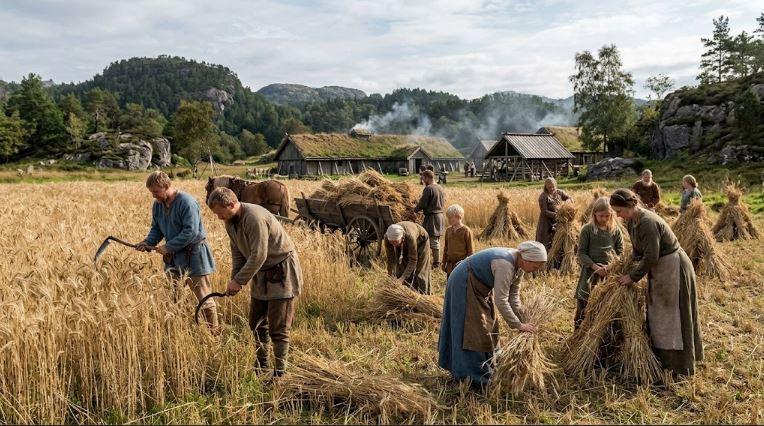
It became a settled agricultural society where households experimented with livestock, hayfields, local wood, marine resources and apparently limited cereal cultivation.
Local Barley Does Not Mean Greenland Was Self-Sufficient
The study should not be turned into a claim that Norse Greenland fed itself entirely from local fields.
Researchers explicitly leave room for imported barley.
Archaeological evidence also demonstrates continuing dependence on overseas networks for many resources.
Iron, suitable ship timber and manufactured objects remained important imports.
Bad harvests could make imported food valuable as well.
The barley evidence therefore points toward a mixed strategy.
Some grain may have grown locally while additional supplies arrived from abroad.
Such flexibility would make sense in a marginal agricultural environment.
Households could produce what conditions allowed while retaining access to Atlantic exchange.
Climate Still Set Hard Limits
Greenlandic agriculture operated close to ecological boundaries.
Even during relatively favorable medieval conditions, the growing season remained short.
Temperature changes could alter hay production and cereal success rapidly.
Barley is among the hardiest cereal crops grown in northern Europe, helping explain why it appears in Norse Greenland.
Its presence does not mean conditions were easy.
Instead, successful cultivation would show how carefully farmers exploited favorable pockets of land.
As climate conditions changed during the later medieval period, those margins may have become increasingly difficult to maintain.
The 2026 study does not claim barley failure caused the disappearance of Norse Greenland.
It simply provides better evidence for what farming looked like while settlements were functioning.
Why The New Barley Research Matters
The strongest contribution of the new research is methodological.
Charred grains alone proved that Norse households possessed barley.
Threshing remains suggested cultivation.
Strontium isotopes now add a geographic test.
After researchers removed substantial contamination from the midden environment, the surviving isotope signatures were compatible with local Greenlandic landscapes.
Norwegian imports remain possible, preventing a simple verdict.
Yet local cultivation has become harder to dismiss.
That changes the image of Greenland’s Norse farmers.
They were not merely livestock farmers surviving on hay, meat and imported cereal.
At least some appear to have experimented with growing barley at the climatic edge of medieval European agriculture.
The scale may have been modest.
Harvests were probably inconsistent.
Imported food still mattered.
None of those limitations makes the result less important.
Instead, they reveal a farming society constantly balancing local production against the risks and opportunities of North Atlantic exchange.
Greenland’s Norse settlers did not simply bring Scandinavian agriculture west.
They adapted it.
Barley may now provide some of the clearest evidence of how far that adaptation went.
