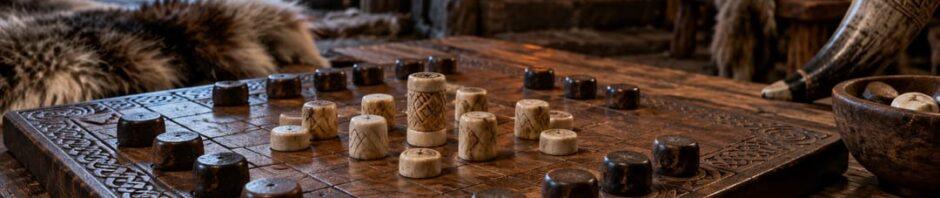
Viking Age games and gambling offer an unexpected view of medieval Scandinavian life. Archaeologists have discovered playing pieces, dice and gaming boards in settlements and burial sites across the Norse world. These objects show that competition and recreation mattered alongside farming, trading and warfare. Yet an important distinction remains: finding a game does not automatically prove that people wagered money on it, and discovering a gaming set in a grave cannot tell us exactly how its owner played.
Modern gambling provides a useful contrast. Today, someone might ask Does BetOnline have reduced juice odds?, a question involving the margin built into a bookmaker’s prices. Historical gaming evidence works differently. Viking-period objects and medieval literary accounts reveal participation, competition and occasional references to wagering, but they do not preserve comparable records of standardized betting prices.
That gap makes Viking games especially interesting. Rather than projecting modern gambling practices onto the past, researchers can examine the physical objects, their archaeological settings and the surviving written accounts. Together, those sources reveal a culture in which entertainment could intersect with skill, reputation, craftsmanship and social standing.
What Archaeologists Have Discovered About Viking Age Games
Gaming pieces are among the clearest surviving traces of leisure in Viking Age Scandinavia. They appear in graves and settlements, sometimes individually and sometimes in groups large enough to suggest complete or partial gaming sets.
The objects were made from different materials, including bone, antler, stone, amber, glass and ivory. Their variety suggests that gaming equipment could range from relatively simple counters to carefully crafted possessions.
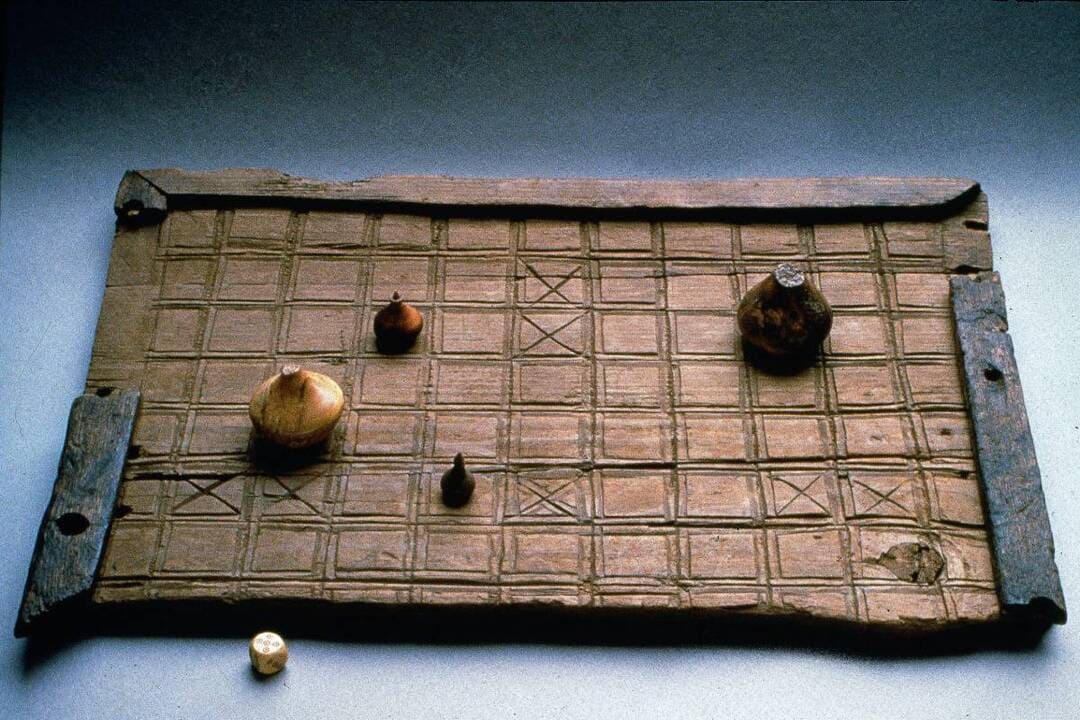
The Viking Ship Museum’s research and educational resources describe gaming pieces, dice and boards recovered from Viking contexts. One example from Aarhus, Denmark, is a wooden plank marked with a gaming pattern resembling Nine Men’s Morris.
Such discoveries establish that board games were part of everyday life. They also reveal an important archaeological limitation: wooden boards decay more readily than durable counters, potentially leaving an incomplete picture of how frequently people played.
This distinction matters when estimating the popularity of particular games. A settlement containing many counters may have supported repeated recreational activity, but the number of surviving objects cannot be converted directly into a count of players or matches.
Hnefatafl: The Viking Strategy Game With Missing Rules
Hnefatafl is among the most recognizable games associated with the Viking world. Often marketed today as Viking chess, it belongs to a family of asymmetric strategy games involving opposing forces with different objectives.
In widely played modern reconstructions, one side attempts to protect a central king and help him escape, while a larger opposing force tries to capture him. That unequal arrangement creates an interesting strategic problem: the defenders must preserve a crucial piece while the attackers control more of the board.
However, modern explanations sometimes suggest greater historical certainty than the surviving evidence permits.
The original Viking Age rules were not preserved in a complete contemporary manual. Scholars use archaeological finds, medieval literary references and descriptions of related games recorded centuries later to reconstruct how hnefatafl may have worked.
A particularly important source comes from 1732, when Carl Linnaeus documented a related Sámi game called tablut. His observations provide valuable comparative evidence, but the substantial time separating that record from the Viking Age means that its rules cannot automatically be treated as identical.
Modern hnefatafl is therefore best understood as a historically informed reconstruction rather than a perfectly preserved ancient rulebook.
Did Vikings Gamble on Their Games?
Evidence of Viking Age gambling comes partly from dice and partly from medieval writing that associates gaming with wagering or financial risk.
Shetland Museum and Archives documents both board games and gambling in its discussion of Viking toys and recreation. The museum also describes physical competitions, including wrestling and games involving sticks and balls, illustrating that competitive entertainment extended beyond the gaming board.
Nevertheless, three activities should not be treated as interchangeable:
- Recreational play: Competing for entertainment without necessarily exchanging valuables.
- Wagering: Putting something of value at risk on an uncertain outcome.
- Organized bookmaking: Establishing and offering prices on outcomes through a structured betting operation.
The first two have historical relevance to Norse gaming traditions. The third should not be projected onto Viking society without specific evidence.
A dice find establishes that an object associated with chance-based play existed at a particular place. It does not reveal whether its users staked silver, food, personal possessions or nothing at all.
Later saga references are valuable but require caution. Many Icelandic sagas were written down centuries after the events they describe. Their scenes can reveal medieval attitudes toward competition and gambling without necessarily recording Viking Age practices exactly as they occurred.
Why Gaming Pieces Appeared in Viking Graves
Gaming equipment has also been discovered in burial contexts, raising questions about its significance beyond entertainment.
A gaming set might have been a meaningful personal possession, an indicator of social connections or an object selected by mourners for symbolic reasons. Archaeologists must evaluate these possibilities alongside the rest of the burial assemblage.
The mistake would be assuming that every person buried with gaming equipment was necessarily a dedicated gambler, military strategist or exceptionally skilled player.
This challenge resembles broader questions surrounding the interpretation of Viking-era grave goods. Objects placed beside the dead can communicate status, cultural connections and funerary choices without providing a straightforward biography.
The material used to produce gaming pieces can also matter. Carefully worked luxury materials may suggest access to specialized craftsmanship or valuable exchange networks, while simpler counters demonstrate that games did not always require expensive equipment.
What survives in a burial is therefore evidence of deliberate deposition, not a complete inventory of someone’s leisure habits.
How Whalebone Gaming Pieces Reveal Ancient Trade Networks
One of the most revealing archaeological findings concerns the materials from which Scandinavian gaming pieces were manufactured.
A 2018 study published in the European Journal of Archaeology, titled Whalebone Gaming Pieces: Aspects of Marine Mammal Exploitation in Vendel and Viking Age Scandinavia, examined evidence from burials and settlements dating across several centuries.
Researchers identified whalebone in 99 of the 166 burial assemblages examined in that part of their analysis. Their findings suggest that whalebone gaming pieces became widespread from approximately AD 550, well before the conventional beginning of the Viking Age.
The researchers argued that the objects could provide evidence for organized production and exchange linking coastal northern Norway with communities farther east in Scandinavia.
This interpretation changes the significance of an apparently ordinary gaming counter.
Its presence may reveal more than the popularity of a game. The raw material can connect a small artifact to coastal resource exploitation, craft specialization and regional movement of goods.
The researchers also acknowledged limits: identifying whalebone does not establish whether the animal was deliberately hunted or found stranded. Their proposed production and trade networks are evidence-based interpretations, not a complete map of every object’s journey.
That is precisely why gaming equipment can be historically valuable even when its original rules remain uncertain.
What the Evidence Can and Cannot Tell Us
Understanding Viking Age games requires separating direct observations from historical interpretations.
| Archaeological or written evidence | What it supports | What remains uncertain |
|---|---|---|
| Gaming pieces in graves | Deliberate inclusion of gaming equipment in funerary settings | The deceased person’s skill, occupation or wagers |
| Boards and counters in settlements | Board games were played in Norse communities | The complete rules used in every location |
| Dice from Viking contexts | Equipment associated with chance-based play existed | Whether particular games involved money |
| Medieval saga references | Later writers knew of games, competition and wagering | How faithfully each account represents Viking Age practice |
| Whalebone gaming pieces | Production techniques and possible trade connections | The exact origin and journey of every object |
The most productive approach is to read these categories together without assuming that one answers every question.
Archaeology establishes the material setting. Written sources contribute vocabulary, stories and cultural attitudes. Modern reconstructions help demonstrate possible gameplay, but they remain interpretations.
For visitors to museums, readers of Norse literature and anyone interested in historical gaming, this separation makes the subject more rewarding rather than less exciting.
A Different Picture of Viking Life
Viking Age games and gambling deserve attention because they show a society that was not defined entirely by raids, kings and warfare.
Gaming pieces demonstrate that people invested time and resources in recreation. Their materials reveal connections to craftsmanship and trade. Burial contexts suggest that some gaming objects held meanings significant enough to accompany the dead.
The evidence for wagering adds another dimension, although it does not justify inventing a sophisticated ancient betting industry.
Ultimately, the most fascinating discovery is not that Vikings played games resembling those enjoyed today. It is that something as small as a carved counter can preserve clues about everyday enjoyment, social relationships and economic connections across the medieval North.
Those clues do not provide every rule or every outcome. They reveal something more enduring: competitive play was part of the human experience long before modern gaming terminology, commercial betting markets or standardized rules existed.
