
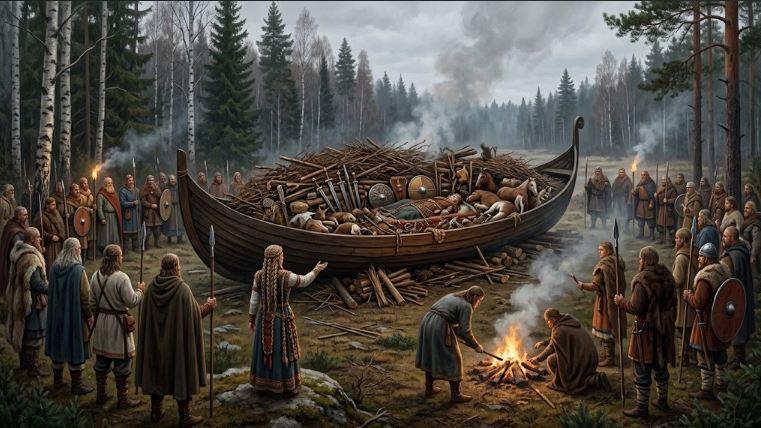
Around AD 700, someone in Pukkila, Isokyrö, in western Finland received an extraordinary funeral.
The deceased was cremated and placed in a boat with weapons, ritual objects and prestigious artefacts whose closest parallels reach across Scandinavia, eastern Europe and northern Fennoscandia.
At first glance, the burial looks Scandinavian.
Its wider archaeological setting does not.
Pukkila belongs to a cremation cemetery under level ground, a burial tradition commonly associated with Finnic-speaking areas. Research from nearby southern Ostrobothnia has also identified genetic affinities toward populations ancestral to modern Sámi groups.
That mixture is why archaeologist Anna Wessman, folklorist Frog, and archaeologist Charlotte Hedenstierna-Jonson argue that familiar labels such as “Finn,” “Sámi,” and “Scandinavian” can obscure more than they explain.
Their interpretation treats Pukkila as evidence for cultural creolization: a local society actively combining practices, objects and ideas drawn from different cultural worlds.
The grave predates the conventional Viking Age, yet it reveals the Baltic environment from which the Viking world would soon emerge.
Pukkila Dates To Around AD 700
The burial comes from Pukkila in Isokyrö, in southern Ostrobothnia.
Researchers date it to approximately AD 700, placing it within Finland’s Merovingian-period archaeology and roughly a century before the conventional beginning of the Viking Age.
Wessman revisited the grave in an October 7, 2026 seminar at Uppsala University’s Center for the Human Past. The Uppsala University seminar description emphasizes that the burial combines a Scandinavian-style boat funeral with artefacts linked to Scandinavia, eastern Europe and northern regions.
That combination immediately creates a classification problem.
A boat burial can look “Scandinavian.”
The cemetery surrounding it belongs to a different tradition.
The objects point in several directions at once.
The Grave Contained A Bent Ring-Sword
One of the most striking objects was a long ring-sword measuring about 92 centimetres, with a blade roughly 79 centimetres long.
Its form has been compared with a sword from Vendel I in Sweden, helping support the burial’s dating around AD 700.
Before deposition, the weapon had been deliberately bent several times.
Its copper-alloy hilt carried elaborate decoration in Salin Style II, a Scandinavian animal-art tradition of the later Iron Age.
Weapons were not unusual in Finnish burials of this period, so a sword alone does not make the deceased Scandinavian.
The specific form and decoration nevertheless show access to elite material culture shared across the Baltic.
Prestige objects could move without their owners changing ethnicity.
That distinction sits at the centre of the Pukkila interpretation.
Boat Rivets Connect The Funeral With Scandinavia
Numerous iron rivets found across the cemetery led early excavator Alfred Hackman to interpret Pukkila as a cremated boat burial.
Boat graves have some of their strongest contemporary parallels in central Sweden.
The famous cemeteries at Vendel, Valsgärde and Ultuna contained elite boat burials furnished with weapons, animals and high-status equipment.
Pukkila drew on that funerary language.
Yet its boat was inserted into a cemetery whose dominant practice differed from those Swedish elite graves.
The researchers argue that this contrast may have been intentional.
A conspicuously Scandinavian-style funeral could mark the deceased as unusually powerful while still integrating that person into the local community.
Rather than replacing local tradition, the boat burial seems to have been layered onto it.
Ritual Objects Complicate The Warrior Identity
Weapons might encourage a straightforward reading of the deceased as an elite male warrior.
Other grave goods make that interpretation less comfortable.
The burial included a staff, a rattle, a meat fork and a small bird-face ornament.
In Scandinavian contexts, staffs have frequently been discussed in connection with ritual specialists and practices associated with seiðr, a form of magic described in later Old Norse sources.
Such staffs are often associated archaeologically and textually with women.
Pukkila therefore combines objects linked with a masculine warrior identity and another object that could signal ritual authority traditionally coded differently.
Wessman, Frog and Hedenstierna-Jonson explore this tension in their 2025 peer-reviewed chapter, “A Völva or Seiðmaðr in Finland?”
Their argument does not require identifying the deceased confidently as either a völva or a seiðmaðr.
The importance lies in the mixture itself.
Scandinavian Objects Do Not Automatically Mean A Scandinavian Person
Archaeologists once relied heavily on grave goods when assigning cultural identities.
A Scandinavian sword could imply a Scandinavian warrior.
A Finnic burial form might imply a Finn.
Objects associated with northern groups could then create a third category.
Pukkila demonstrates the weakness of that method.
People can acquire foreign objects through trade, marriage, diplomacy, warfare or gift exchange.
Communities can borrow funerary practices without adopting another language.
Religious specialists can incorporate symbols from neighbouring cultures while remaining rooted in local society.
Material culture therefore documents relationships more reliably than ethnicity.
Pukkila seems to sit inside an especially dense web of such relationships.
The Cemetery Context Points Toward Local Belonging
The Pukkila burial occurred within a cremation cemetery under level ground.
This cemetery type is widespread in areas usually connected with Finnic cultural traditions.
That makes the setting different from Swedish boat-grave cemeteries such as Vendel and Valsgärde.
Researchers have suggested that boat rivets may have been distributed more widely across the Pukkila cemetery after the cremation.
If that interpretation is correct, parts of the boat funeral became physically integrated into the local burial ground.
Such a practice could have linked an exceptional deceased person with the wider community.
The Scandinavian elements would remain highly visible, but they would not erase local tradition.
That is one reason the researchers describe the process as creolization rather than simple imitation.
Nearby Genetics Make The Picture Even More Complex
Southern Ostrobothnia contains another famous burial site: Levänluhta, where people were deposited in water between approximately AD 300 and 800.
Ancient DNA work on individuals from Levänluhta has found affinities closer to modern Sámi populations than to many later Finnish groups.
Pukkila lies within that broader regional setting.
This does not mean the Pukkila individual can simply be labelled Sámi.
No such direct genetic identification is currently available for the cremated person.
It does show why projecting modern ethnic boundaries backward becomes risky.
The region around Isokyrö contained communities whose biological, linguistic and material histories do not map neatly onto the modern categories of Finland, Sweden and Sápmi.
The archaeological evidence points toward interaction rather than isolation.
The Fur Trade May Explain Some Of The Connections
The researchers interpret the Pukkila individual as a possible local middleman in the fur trade linking Scandinavia with eastern and northern networks.
That suggestion fits a broader economic pattern.
Northern Fennoscandia contained highly valuable resources, especially furs.
Scandinavian elites wanted those materials.
Eastern trading systems provided additional routes and consumers.
Communities in Ostrobothnia occupied potentially important positions between those worlds.
An individual who managed relationships across such networks might accumulate foreign weapons, imported prestige goods and ritual practices from several traditions.
Cultural mixture would then be socially useful rather than unusual.
Knowing how to operate between groups could itself become a form of power.
Cultural Creolization Offers A Different Model
“Hybrid” is often used for sites containing objects from several traditions.
Wessman, Frog and Hedenstierna-Jonson prefer the more specific concept of cultural creolization.
The idea emphasizes that people do not simply pile unrelated traditions together.
They can create new systems from them.
A Scandinavian boat funeral performed within a local Finnic-style cemetery becomes something different from either tradition alone.
Likewise, combining a warrior’s sword with a ritual staff need not represent confusion.
The pairing could communicate a locally meaningful social identity.
Creolization therefore treats cultural mixture as creative.
Pukkila was not necessarily caught between cultures.
Its community may have deliberately built identity from several of them.
The Burial Also Complicates Gender
The grave’s gender signals deserve similar caution.
A long sword and weapon assemblage fit conventions often interpreted as masculine.
The staff introduces associations that later Scandinavian evidence often places within feminine ritual roles.
Trying to force the assemblage into either category could reproduce the same problem as forcing it into one ethnicity.
Objects did not necessarily carry identical meanings everywhere they travelled.
A staff used in western Finland may not have meant exactly what a comparable object meant in Sweden.
The Pukkila deceased could also have occupied a religious role that combined forms of authority rarely preserved clearly in the archaeological record.
Researchers therefore use the burial to question how confidently archaeologists should infer gendered identity from individual artefacts.
Pukkila Belongs To The World Before The Vikings
The burial dates to around AD 700, before Viking raids transformed the historical visibility of Scandinavia.
That chronology makes Pukkila especially useful.
By the eighth century, Baltic communities were already connected through boats, weapons, ritual practices and long-distance exchange.
The networks later associated with Viking expansion did not appear from nothing around AD 793.
Old Norse News has explored a related pre-Viking maritime world through the Salme ship burials and the decades before the conventional Viking Age.
Pukkila expands that story eastward.
Its burial suggests that Scandinavian-style elite practices were already being adapted inside western Finland before classic Viking raiding began.
Modern National Labels Can Distort An AD 700 Landscape
Calling someone a “Finn” in AD 700 can imply a national identity that did not yet exist.
Using “Scandinavian” as an ethnic label can create similar problems when the evidence comes mainly from objects.
“Sámi” also carries a long cultural and linguistic history that cannot be assigned to one cremated person simply because nearby ancient populations show genetic affinities with later Sámi groups.
These terms remain useful when carefully defined.
They become misleading when treated as rigid boxes.
Pukkila instead reveals a Baltic world in which language, ancestry, material culture, trade and ritual could cross one another.
One person could participate in several networks without possessing a modern-style ethnic identity.
Why Pukkila Makes Simple Identities Hard To Defend
The Pukkila grave combines an elite boat funeral, a bent Scandinavian-style ring-sword, ritual equipment and artefacts connected with several regions.
Its cemetery context points toward local western Finnish traditions.
Nearby population history adds northern genetic connections.
Trade provides a plausible mechanism joining these worlds.
None of those strands needs to cancel the others.
Together they suggest that the deceased gained status through participation in a culturally mixed Baltic network.
That interpretation matters beyond one grave.
The Viking Age is often narrated through named peoples: Danes, Norwegians, Swedes, Finns and Sámi.
Archaeology increasingly reveals messier realities beneath those labels.
Communities borrowed practices.
Objects travelled farther than people.
Individuals crossed cultural boundaries, while local traditions absorbed foreign influences and turned them into something new.
Pukkila captures that process around AD 700.
The burial does not ask archaeologists to choose whether its occupant was “Finn,” “Sámi,” or “Scandinavian.”
Its greater value lies in showing why the question itself may be too simple.
