
The raid on Lindisfarne in AD 793 still supplies one of history’s most familiar dates. Generations of textbooks have used the attack on the Northumbrian monastery as a convenient starting point for the Viking Age. The two ship burials at Salme on Estonia’s Saaremaa island make that boundary increasingly difficult to defend as the beginning of Scandinavian maritime violence.
The Salme dead were buried around AD 750, nearly half a century before Lindisfarne. Archaeologists recovered the remains of 41 men from two vessels together with swords, shields, arrows, gaming pieces, dice, combs, animals, and other equipment. Isotope and genetic studies point mainly toward eastern central Sweden, especially the Mälaren and Uppland region.
This was not simply a group of Scandinavian travelers who died abroad. Skeletal injuries and weapon evidence indicate violent conflict. The larger ship could sail rather than merely row, making it the oldest known Nordic sailing vessel yet identified according to the current Vrak – Museum of Wrecks presentation.
Salme therefore shifts the Viking question eastward and backward. Scandinavian warrior groups were already crossing the Baltic, traveling in organized companies, carrying elite equipment, and dying violently overseas decades before English monks recorded the raid that later became the Viking Age’s symbolic opening.
The 2026 Exhibition Keeps Salme At The Centre Of The Viking Debate
Salme returned to public attention in Sweden through the exhibition Vikings Before Vikings at Vrak – Museum of Wrecks in Stockholm.
The exhibition originally opened there on April 11, 2025 after Saaremaa Museum created the presentation in Estonia. Vrak currently lists it as running through November 1, 2026, giving visitors access to original objects, films, reconstructions, weapons, and material connected with the two ship burials.
Vrak’s Vikings Before Vikings exhibition openly frames Salme against the traditional AD 793 date. The museum argues that armed Scandinavian expeditions into the Baltic occurred before the end of the eighth century and describes Salme as the oldest known burial site of a Viking-Age war band.
That current museum framing does not mean archaeologists have universally replaced 793 with a new official starting year.
Historical periods rarely begin on one universally accepted day.
AD 793 remains valuable because Lindisfarne provides a dated written event recorded in western European sources. Salme provides a different type of evidence: archaeology documenting maritime movement and organized violence decades earlier.
The distinction matters.
Lindisfarne tells historians when Scandinavian raiders became dramatically visible in surviving English records. Salme asks whether those raiding systems had already developed elsewhere before western chroniclers noticed them.
The First Salme Ship Appeared By Accident In 2008
The discovery began during construction work in the village of Salme in 2008.
Workers encountered human bones, iron objects, sword fragments, rivets, and gaming pieces. Archaeologists soon realized that the remains belonged to a boat burial rather than an ordinary cemetery.
The first vessel, now called Salme I, had suffered considerable disturbance from modern construction.
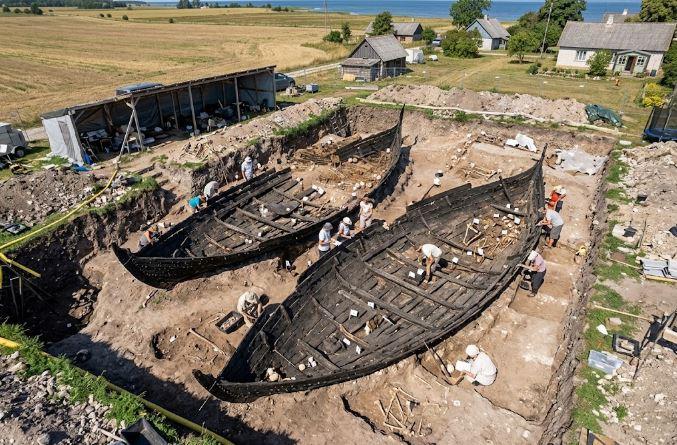
Researchers reconstructed it as a clinker-built rowing vessel approximately 11.5 metres long, probably equipped with six pairs of oars. Seven men lay inside or around the surviving portion of the vessel.
Another discovery followed nearby.
Archaeologists located a second and much larger vessel, Salme II, and investigated it during excavations between 2010 and 2012. This ship held 34 men, producing a combined total of 41 individuals between the two burials.
Tallinn University’s Salme ship burial research describes the pair as exceptional because no other known Viking ship burial contains so many individuals.
The numbers immediately separate Salme from famous elite ship graves built around one high-status individual.
These vessels held groups.
That makes them evidence for organized companies rather than simply individual funerary status.
Around AD 750 Changes The Chronology
Dating places the burials around AD 750.
That date falls in an awkward zone between archaeological period labels. Swedish archaeology traditionally calls much of the seventh and eighth centuries the Vendel Period. Estonian archaeology can describe Salme as Pre-Viking. Other researchers increasingly place the finds at the very beginning of the Viking phenomenon.
Uppsala University’s Salme research project puts the issue plainly: Salme dates to the point where the Vendel Period shades into the Viking Age.
That blurred boundary may prove more historically useful than replacing 793 with 750.
Political, maritime, technological, and social changes do not happen because one calendar date arrives. Long-distance sailing, warrior retinues, elite gift exchange, ship technology, and Baltic mobility developed over time.
Salme gives archaeologists a snapshot from that development.
By around 750, a large group of armed Scandinavian men had already crossed the Baltic in vessels, reached Saaremaa, entered violent conflict, and received elaborate ship burials far from home.
Those actions resemble behavior that later defines the Viking Age.
The archaeological problem concerns how much earlier those systems began.
Forty-One Men Make Salme A War-Band Burial
The human remains provide some of the most direct evidence.
Researchers identified seven individuals in Salme I and 34 in Salme II. The dead were overwhelmingly young or middle-aged adult men with physiques consistent with physically demanding lives.
Many showed injuries.
Weapon trauma and arrow evidence point toward a violent encounter shortly before burial. Archaeologists found arrowheads lodged in parts of the vessel and shields, adding physical evidence for combat.
The larger burial had careful organization despite the violence that preceded it.
People arranged bodies inside Salme II in layers, with some positioned several deep. Weapons and other possessions accompanied them.
This combination makes the deposit unusual.
It was neither an improvised dumping of battlefield casualties nor a normal single-person elite burial.
Someone survived long enough to organize a complex funeral.
That detail raises questions that Salme has not yet answered. Were the people who buried the warriors fellow Scandinavians who survived the battle? Did local people perform the burial? Was there a negotiated aftermath between opposing groups?
The graves record what happened to the dead more clearly than they identify the burial party.
The Men Came Mainly From The Swedish Side Of The Baltic
Scientific analysis has narrowed the group’s probable origins.
A 2020 study in the Journal of Archaeological Science: Reports examined strontium, oxygen, and carbon isotope evidence from the Salme individuals. The results indicate that most did not grow up on Saaremaa.
Researchers linked the strongest isotopic signals with the Mälaren region of east-central Sweden. Five men in Salme II produced lower strontium values that could fit Gotland or other locations.
The peer-reviewed Salme isotope study therefore supports an origin across the Baltic rather than among the local Saaremaa population.
Artifacts point in the same direction.
Sword fittings and other high-status material find close parallels around Mälaren, Uppland, Valsgärde, and related Swedish elite environments.
The group consequently looks less like an anonymous Baltic force and more like a company whose strongest connections lay in what is now Sweden.
That geographic direction changes the Viking story.
Early western European written accounts naturally direct attention toward Norway, Denmark, Britain, Ireland, and Francia. Salme shows a major maritime arena developing east of Scandinavia at the same time.
The Baltic may have served as one of the training grounds for the social and military practices later made famous in the west.
Four Brothers Turn A War Band Into A Family Network
Ancient DNA gave Salme an even more personal dimension.
The major 2020 Nature study Population genomics of the Viking world analyzed genomes from Viking-period populations across Europe and Greenland. Among the Salme individuals, researchers obtained genetic information for 34 men.
The analysis identified four brothers buried side by side.
Scientists detected another man who had a third-degree genetic relationship with one of the brothers.
The Viking population genomics study therefore shows that close family relationships existed inside the expedition.
This finding complicates the image of Viking war bands as temporary collections of unrelated adventurers.
At least part of the Salme company traveled with close kin.
Family relationships could have influenced loyalty, recruitment, inheritance, military obligation, and the organization of elite followers. The four brothers do not prove that the entire group belonged to one clan, but they provide direct evidence that kinship formed part of the company.
Their burial positions matter too.
Someone placed the brothers beside each other.
Whether the burial organizers knew their exact relationships seems likely, though archaeology cannot reconstruct the decisions in detail.
Genetics has turned what looked like a mass of warriors into a group containing identifiable family structure.
The Weapons Look Like Elite Equipment, Not Random Travel Gear
Salme produced an extraordinary collection of weapons.
Archaeologists recovered remains from around 40 swords, including single- and double-edged examples. Some had elaborately decorated hilts with gilded bronze and garnet fittings.
Shields covered or accompanied several bodies.
Researchers found numerous arrowheads, a smaller number of spearheads, knives, and other equipment.
The quantity of swords matters because good swords demanded substantial resources. They required skilled forging, valuable materials, maintenance, and access to elite exchange systems.
Some decorative pieces closely resemble objects from high-status Swedish contexts.
That makes the group socially significant without proving that every man held aristocratic rank.
The expedition could have contained members of an elite retinue.
A 2016 Antiquity study even proposed that the men might represent a diplomatic delegation protected by armed warriors rather than a raiding force. The researchers based that interpretation partly on luxury weapons, hunting animals, gaming equipment, and other possessions that do not resemble the minimum kit for a straightforward raid.
That hypothesis remains open.
Salme records violence.
It does not tell us whether violence formed the expedition’s original purpose.
The Larger Ship May Be The Most Important Artifact Of All
The people and weapons often dominate discussion, but the vessel itself may carry the biggest chronological consequence.
Salme II appears to have possessed the ability to sail.
Vrak currently describes it as the oldest known Nordic sailing ship.
That claim pushes an important technological threshold earlier than many popular Viking narratives suggest.
The transition from primarily rowing craft toward efficient sailing ships transformed Scandinavian mobility. Sail reduced dependence on human rowing power and made longer open-water journeys more practical.
It did not happen overnight.
Shipwrights needed experience with hull form, masts, rigging, sails, steering, loading, and the stresses created by wind propulsion.
A sailing vessel around 750 implies that these technological traditions had already advanced before Lindisfarne.
The Baltic provided an ideal environment for that development.
Scandinavian communities had centuries of maritime experience before the Viking Age. Islands, archipelagos, narrow sounds, and long coasts demanded boats for communication, fishing, warfare, migration, and exchange.
Salme places sail-powered Scandinavian movement inside that earlier maritime tradition.
The famous western raids may represent an expansion of existing capacity rather than the invention of something new in the late eighth century.
The Baltic May Have Come Before The Atlantic Viking Story
The traditional Viking narrative looks west.
Lindisfarne stands in England. Soon come attacks and settlement around Britain, Ireland, Francia, and the North Atlantic.
Salme faces east.
A company from central Sweden crossed the Baltic toward Saaremaa decades before 793.
Uppsala University’s Viking Phenomenon project has highlighted this directional problem directly. Its Salme research argues that the origins of Viking raiding may lie partly within the Baltic sphere rather than beginning with expansion toward western Europe.
That interpretation fits geography.
Swedish communities around Mälaren had natural maritime connections toward the Baltic islands, Finland, the eastern Baltic coast, and river routes leading farther east.
Later Viking-Age archaeology confirms extensive Swedish involvement in those eastern systems.
Salme shows that movement had an armed dimension at an early date.
This does not mean eastern expeditions caused every later western raid.
It does mean the west should not monopolize the Viking origin story.
Scandinavian seafarers could have developed military practices through multiple maritime zones at once.
Why Salme Keeps Moving The Viking Age Before 793
Salme changes the chronology through accumulation rather than one dramatic claim.
Two Scandinavian vessels reached Saaremaa around AD 750.
One appears capable of sailing.
Forty-one men died violently and received organized ship burials.
Their weapons included around 40 swords, shields, arrows, and high-status fittings. Hundreds of gaming pieces, hunting animals, combs, food, and other possessions show that the travelers carried more than battle equipment.
Isotopes connect most of the men to central Sweden.
Ancient DNA reveals four brothers buried side by side.
Every one of those observations belongs almost half a century before Lindisfarne.
The question has consequently changed.
Historians no longer need to ask whether Scandinavian maritime expeditions existed before 793. Salme demonstrates that they did.
The harder questions concern how far back those systems extend, whether the eastern Baltic played a formative role, when sailing became routine, and how elite households recruited the men who traveled overseas.
The current Vikings Before Vikings exhibition at Vrak keeps those questions visible through November 1, 2026.
Its title makes a useful historical point even if the terminology remains deliberately provocative.
The Salme men lived at a period that some archaeological systems still call Pre-Viking.
Their ships, weapons, overseas movement, kinship group, violent deaths, and burial treatment look remarkably like features later used to define the Viking Age.
That is why 793 now works better as a famous historical marker than a hard archaeological border.
Salme has already crossed it.
