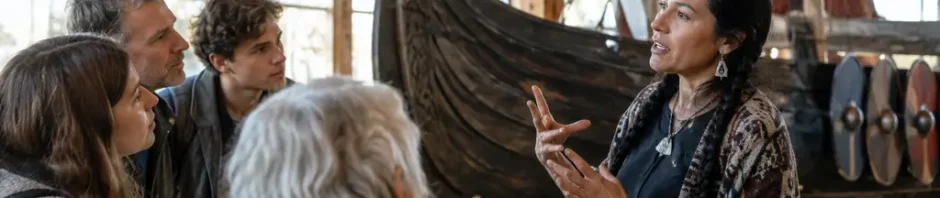
The Finding Vinland Exhibit at Falmouth Museums on the Green opened with a members’ reception on Thursday, September 3, 2026, and opened to the public on Friday, September 4, 2026, according to the museum’s exhibits page. Its subject is deliberately careful: the possibility that Norse voyages described in medieval Icelandic texts may connect with Cape Cod, Nantucket Sound, and the long-debated Vinland question. The exhibit matters because it does not treat Norse heritage as a story that can stand alone. It places saga memory beside Wampanoag presence, local stories, maps, artifacts, and historical scholarship, asking visitors to think about evidence without pretending that uncertainty has vanished.
Why The Finding Vinland Exhibit Uses Caution
Finding Vinland Exhibit And The Question Of Proof
The exhibit’s caution is central to its public value. The title itself uses “exploring the possibility,” not “proving.” That distinction matters in Norse studies because Vinland has often attracted confident claims that run beyond the evidence. Here, the museum frames Cape Cod as a serious question rather than a settled answer. The exhibit will remain on display until May 10, 2027, at the Visitor’s Center Hallett Barn, 55–65 Palmer Avenue, Falmouth, Massachusetts, and it was curated with guidance from an advisory panel of scholars and experts from around the world, according to Falmouth Patch.
That caution makes the Finding Vinland Exhibit more useful than a display built around a single dramatic claim. It draws on archaeology, geography, medieval Icelandic texts, Indigenous perspectives, and historical scholarship. Those fields do not all answer the same question in the same way. Archaeology asks what material traces can be shown. Geography asks how places described in texts might match coastlines, waters, and routes. Medieval texts preserve narrative memory, but they are not field reports. Indigenous perspectives keep the region from becoming an empty stage onto which Norse voyagers simply arrive.
Evidence, Memory, And The Cape Cod Question
The Cape Cod question is not only about whether parts of the Vinland sagas may fit features of Cape Cod and Nantucket Sound. It is also about how people remember contact, travel, and place. The exhibit’s interpretive materials include maps, artifacts, interpretive panels, and local stories. That combination is significant because maps can suggest routes, artifacts can make daily life visible, panels can organize arguments, and local stories can remind visitors that the region already carried meaning before later colonial accounts shaped public memory.
A cautious exhibit can still be intellectually ambitious. It can invite visitors to compare forms of evidence without forcing agreement. For readers who want a broader discussion of saga memory and Indigenous interpretation, Old Norse News has also considered Vínland narratives and Indigenous perspectives. The shared concern is not to flatten Norse heritage, but to keep it accountable to place, source limits, and the people whose histories are too often treated as background.
Indigenous Perspectives In The Finding Vinland Exhibit
Wampanoag Presence Before Norse Possibility
Within the Finding Vinland Exhibit, the Wampanoag are not presented as an afterthought to a Norse-centered story. The research notes describe an exhibit that foregrounds Indigenous perspectives, specifically those of the Wampanoag, emphasizing how Indigenous people inhabited, knew, and remembered the land long before colonial narratives. That framing changes the moral and historical weight of the Vinland question. If Norse voyagers may have passed near Cape Cod in the early 11th century, they would not have encountered a blank shore. They would have entered a place already held in Indigenous life, knowledge, and memory.
A prominent feature is commissioned work by Wampanoag artist Julia Marden of the Wampanoag Tribe of Gay Head/Aquinnah. The research notes state that she created artifacts through traditional craftsmanship to illuminate Indigenous culture and lifeways in Cape Cod during the early 11th century, the period when Norse voyagers may have passed. That work matters because it gives material form to Indigenous presence without depending on Norse arrival to justify its importance.
Craft As Historical Argument
The Finding Vinland Exhibit also uses craft to make an argument about who belongs in the story. Traditional craftsmanship can show lifeways, skills, and continuity in ways that a text panel alone cannot. In a Norse context, visitors often expect ships, sagas, and far-traveling seafarers. By placing Wampanoag-made work at the center of interpretation, the exhibit shifts attention toward local knowledge and Indigenous cultural practice.
That shift is not a rejection of Norse heritage. It is a better way to study it. Norse voyages, if they reached or passed the Cape Cod region, would have been brief episodes within a much longer Indigenous history of the place. A display that honors Wampanoag perspectives helps prevent the familiar pattern in which Indigenous peoples appear only at the moment of European arrival. Here, Indigenous culture is not merely evidence of “contact.” It is part of the exhibit’s own structure of understanding.
Norse Heritage Without Taking Over The Story
Medieval Texts And Their Limits
Norse heritage enters the exhibit through medieval Icelandic texts and the long-standing debate around Vinland. The research notes refer to “Vinland sagas” and to the possibility that some saga descriptions may match features of Cape Cod and Nantucket Sound. That is a compelling idea, but the exhibit’s value lies in holding it open rather than converting it into certainty. Sagas are literary and historical sources at once. They can preserve memory, but they also require careful reading.
For a writer drawn to Old Norse language and myth, this is where the exhibit feels especially alive. The sagas have carried names, routes, fears, and hopes across centuries. Yet their power does not free us from the need for evidence. A cautious exhibit allows Norse stories to remain meaningful while refusing to use them as shortcuts. That is good history, and it is also good reading of mythic and saga material.
Why “Possibility” Is Not Weakness
“Possibility” may sound modest, but here it is a strong interpretive choice. It admits that evidence can be suggestive without being final. It also protects Wampanoag history from being treated as secondary to a search for Norse traces. The question is not only “Did Vikings reach Cape Cod?” The better question is how different forms of memory, scholarship, and community knowledge can be set beside one another with care.
This approach also helps visitors resist two common errors. One error is to dismiss the Vinland question because uncertainty remains. The other is to declare certainty where the evidence does not support it. Between those errors is a more demanding space: reading maps, artifacts, saga traditions, and Indigenous perspectives together while keeping their differences visible.
Community Dialogue And Public Memory
The Opening As A Civic Event
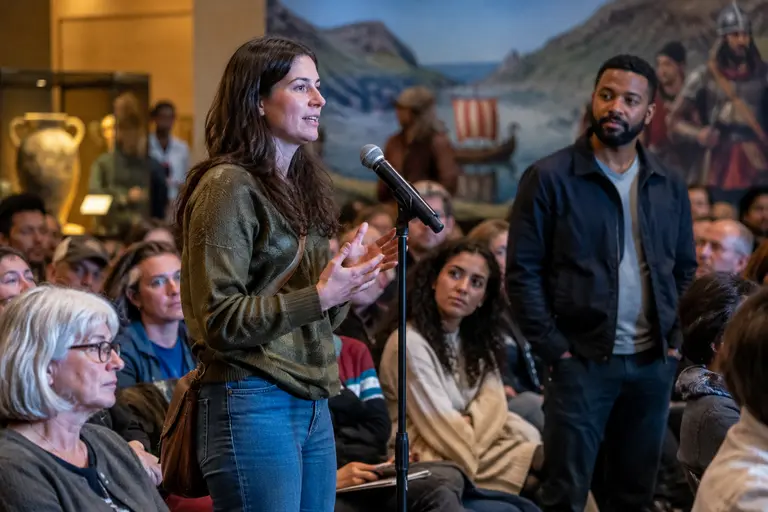
The exhibit’s opening was not limited to a museum room. The research notes state that a public presentation and discussion took place on Friday, September 4, 2026, from 6:00 p.m. to 7:30 p.m., at the Falmouth Community Veterans Center. That detail is worth attention because it places the exhibit in community dialogue. Public history is not only a matter of display cases. It also involves conversation, disagreement, listening, and local responsibility.
When a museum presents Norse possibility and Wampanoag presence together, it is handling more than an antiquarian puzzle. It is shaping how a community talks about belonging, memory, and evidence. Readers comparing how local institutions frame heritage and service may also find Bethel NC UMC, a related site in the same network, useful as a point of comparison for community-centered presentation.
Maps, Artifacts, Panels, And Local Stories
The exhibit’s mix of maps, artifacts, interpretive panels, and local stories is especially suited to the Vinland problem. No single medium can carry the whole argument. A map can make geography legible, but it cannot prove a saga identification by itself. An artifact can evoke daily life, but it must be interpreted in context. A panel can explain competing views, but it risks sounding too settled if it does not leave room for uncertainty. Local stories can preserve meaning, but they should be treated with the same respect and care given to written medieval sources.
The best public history does not ask visitors to choose between wonder and caution. It lets them feel the pull of an old question while showing why evidence matters. In this case, the museum’s format appears designed to slow down the familiar Viking adventure story and place it within a broader human setting.
Why The Finding Vinland Exhibit Matters Now
A Better Model For Norse Public History
The final importance of this topic lies in method. The Finding Vinland Exhibit offers a model for presenting Norse heritage without letting it overwhelm the people and places it touches. Cape Cod is not treated simply as a possible Norse destination. It is presented as a place with Indigenous histories, Wampanoag perspectives, local memory, and scholarly debate.
That matters for anyone who cares about Norse mythology and culture. The old stories are powerful, but power can distort when it is not checked by evidence and by other voices. A Norse-centered exhibit might have made the sagas the only lens. This exhibit, as described in the research notes, uses the sagas as one lens among several. The result is more cautious and more humane.
What Visitors Can Take From The Exhibit
Visitors can leave with a sharper sense of what historical claims can and cannot do. They can recognize that the Vinland question remains open in this Cape Cod context, that Indigenous perspectives are not optional, and that Norse heritage becomes more responsible when placed in dialogue with local histories. They can also see that uncertainty is not a failure of interpretation. It is sometimes the most honest result evidence can offer.
For me, the exhibit’s strength is that it lets ancient northern stories meet a specific place without conquering it in the imagination. The sagas still speak, but they do not speak alone. Wampanoag presence, traditional craft, local stories, maps, artifacts, and scholarly caution all stand beside them. That is the kind of public history Norse studies needs: careful with sources, alert to Indigenous memory, and willing to let possibility remain possibility.
