
A tiny silver penny found among thousands of Viking-Age coins at Mørstad in eastern Norway may be one of the clearest surviving examples of how early Norwegian kings turned money into political communication.
The Museum of Cultural History announced on October 9, 2026 that archaeologist Anne Skogsfjord had identified an exceptionally rare coin issued by Olav Haraldsson, better known after his death as Saint Olaf. Struck around 1024–1028, the penny carries a royal portrait, crosses and inscriptions identifying Olav as king of the Norwegians.
Fewer than 20 coins issued by Olav Haraldsson are known to survive. Only four other examples of this particular type had previously been identified, according to the museum.
That rarity matters, but the imagery may be even more significant. The penny suggests that coinage in early 11th-century Norway was doing more than facilitating payment. It allowed a king to circulate a carefully constructed image of Christian monarchy.
The Mørstad Penny Puts Christian Kingship On A Piece Of Silver
The newly identified penny comes from the Mørstad Hoard near Rena in Åmot, a remarkable deposit discovered in 2026 and now recognized as Norway’s largest known Viking-Age coin hoard.
According to the University of Oslo’s Museum of Cultural History, the coin was initially grouped with English pennies of Æthelred II. Closer examination revealed the inscription ONLAF R+ NORMANORV, identifying its issuer as Olav, King of the Norwegians.
Its imagery is just as revealing.
The obverse depicts Olav facing left in a conical helmet. Beside him stands a stepped cross. The reverse carries a double cross and an inscription reconstructed from coins struck from the same dies as +CE DVX DOMINNVS MEI, translated by the museum as “My leader, my lord.”
For an audience accustomed to handling silver from England, Germany and elsewhere in Europe, those symbols would have placed Norway’s king inside a recognizable Christian political language.
Professor of numismatics Svein H. Gullbekk described the piece as a major “Christianisation coin,” arguing that Olav was using coinage both to legitimize Christianity and to present himself as a Christian monarch of European standing.
The point is significant. A coin could travel farther than a royal court. Every transaction potentially moved the king’s name, title and Christian symbolism into another person’s hands.
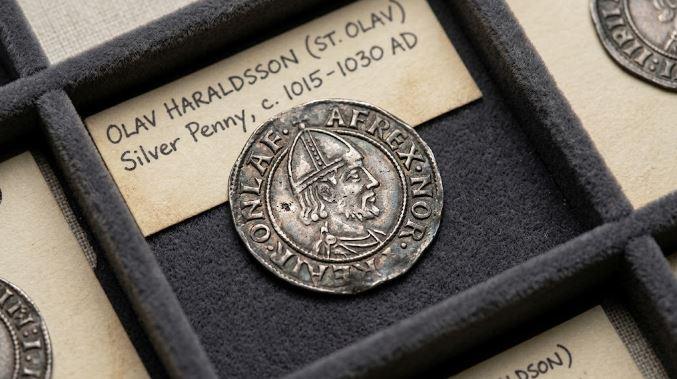
Olav Was Borrowing A European Language Of Royal Authority
Olav Haraldsson did not invent the visual vocabulary on the penny.
Three coin types are known from his reign, and the Museum of Cultural History notes that all were strongly influenced by Anglo-Saxon models. That connection makes sense in a Scandinavian world filled with English silver and shaped by decades of political, military and commercial contact across the North Sea.
Copying an established English coin type should not automatically be dismissed as imitation. Using recognizable European designs could itself make a political claim.
Kings in Christian Europe placed royal portraits, crosses, titles and moneyers’ names on coins. By issuing comparable pennies, Olav could present Norway’s monarchy as belonging to the same political order.
That interpretation fits a larger transition in Scandinavian history. Norway’s first known royal coinage had appeared under Olav Tryggvason around the end of the 10th century. Olav Haraldsson continued that experiment, yet Norwegian royal coinage remained limited in scale during his reign.
Readers interested in the broader evidence for reconstructing this period can also see Old Norse News’ Viking Age source guide, which points toward primary sources and scholarship used to study Viking political, religious and cultural change.
The limited number of Olav’s pennies makes them particularly interesting. Mass circulation was probably not their only purpose. Numismatist Jon Anders Risvaag of NTNU told Science Norway that such early issues were closely connected with demonstrating royal status: producing coins showed that a Norwegian ruler could exercise one of the privileges associated with established European kingship.
The Coin Joined Religion And Royal Identity
Modern readers should be careful about describing Norway’s Christianization as one king imposing a new religion through a single political program. Conversion unfolded unevenly over generations and involved missionaries, aristocratic networks, laws, churches, foreign contacts and local negotiations.
The penny still provides unusually direct evidence of what Olav’s monarchy wanted to communicate.
Unlike later saga narratives written generations after the events, the coin belongs to Olav’s own reign. Its kingly title, portrait and Christian symbols therefore come much closer to the political environment of the 1020s.
That is one reason numismatic evidence is so valuable.
The coin does not prove what every Norwegian believed. Nor does it establish how ordinary people interpreted its imagery. It does show that royal authority and Christian symbolism were deliberately presented together on an object issued in the king’s name.
Olav died at the Battle of Stiklestad in 1030. His cult developed after his death, and he eventually became one of medieval Scandinavia’s most prominent saints. The newly identified penny predates that later saintly reputation. It shows Olav first as a living king employing Christian imagery, rather than as the saint remembered by subsequent generations.
That distinction makes the artifact especially useful for separating contemporary royal propaganda from later religious memory.
Mørstad Shows That The Penny Was More Than A Ceremonial Object
There is another important detail on the coin: small knife cuts.
Researchers interpret these marks as tests of the silver during payments. That suggests the penny did not simply exist as a presentation piece or symbolic royal object. It circulated.
The Mørstad Hoard provides a remarkable setting for that circulation. Earlier analysis showed that more than 95 percent of the hoard’s coins came from kingdoms in what are now England and Germany. The deposit therefore reflects an economy in which foreign silver remained dominant.
Yet mixed into those thousands of imported coins was Olav’s Norwegian penny.
This contrast helps explain why the object matters. Norway did not yet possess the mature national currency system that developed under Harald Hardrada in the mid-11th century. The Historical Museum explains that Harald later standardized Norwegian pennies at about 0.9 grams and displaced foreign money as Norway developed a more established royal currency. Its account of Harald Hardrada’s monetary system shows how dramatically Norwegian minting changed within a generation.
Olav’s penny belongs to the earlier experimental stage.
Its scarcity suggests that royal minting had not yet become an ordinary nationwide monetary system. Yet the Christian iconography and royal inscription show that kings already understood the political possibilities of coinage.
Why One Penny Can Say So Much About Royal Power
The Mørstad discovery should not be treated as proof that coins single-handedly Christianized Norway. Its importance is narrower and more historically useful.
It demonstrates how religion, kingship and money could occupy the same physical object.
Someone holding this penny around 1025 encountered silver with Olav’s name, royal title, portrait and Christian crosses. The coin turned an abstract claim about Christian monarchy into something portable, recognizable and exchangeable.
The find is particularly valuable because contemporary material connected directly with Olav Haraldsson is scarce. According to the Museum of Cultural History, the newly discovered example carries collection number M152600/763, and only three different penny types from Olav’s reign are currently known.
The Mørstad coin therefore captures a transitional moment: foreign pennies still dominated Norwegian circulation, royal Norwegian minting remained small, Christianity was becoming increasingly connected with political authority, and kings were adopting European symbols to define what Norwegian monarchy should look like.
Later kings would issue far more coins and build a more organized monetary system. Olav Haraldsson’s rare penny shows that before coinage became routine economic infrastructure, Norway’s rulers had already recognized another use for it.
A penny could advertise who the king was, which faith his rule represented, and where he believed Norway belonged in Christian Europe.
