
Runes are often imagined as the writing system Scandinavian Vikings carried wherever they raided and settled.
The surviving evidence from Britain and Ireland is considerably more complicated.
A new analysis published on October 27, 2026 examined 84 runic inscriptions dated to the Viking Age from England, Ireland, Scotland, Orkney, Shetland and the Isle of Man. Instead of finding one uniform Scandinavian writing culture, researchers identified several distinct communities using runes for very different purposes.
On the Isle of Man and the Scottish islands, runes appear mainly on Christian memorial monuments.
In Dublin, people scratched them onto everyday objects to record names and ownership.
England preserves a smaller and more varied group, including makers’ names, short everyday texts and inscriptions invoking supernatural ideas.
The people behind those texts were not simply Scandinavian conquerors.
Gaelic and Norse names occur within the same families. Women appear prominently in Manx memorials. Some professional carvers identified themselves. Meanwhile, the Swedes who famously recorded expeditions to England on runestones back home are almost invisible in the British runic corpus itself.
The 84 inscriptions therefore reveal something more interesting than the spread of an alphabet.
They show who actually used runes after Scandinavian people settled abroad—and how migration changed what runic writing was for.
The Corpus Contains 84 Viking-Age Inscriptions
The new analysis comes from Vitki, which used the Scandinavian Runic-text Database to assemble inscriptions from the British Isles.
Researchers began with 149 known runic inscriptions from England, Ireland, Scotland, Orkney, Shetland and the Isle of Man.
They then selected the 84 dated to the Viking Age.
The geographical distribution is striking:
- 33 come from the Isle of Man
- 16 from Ireland
- 13 from England
- 11 from Orkney
- 7 from Scotland
- 4 from Shetland
Another 65 inscriptions were excluded because 55 are classified as medieval and 10 lack a secure date.
The October 2026 analysis of British Isles runic inscriptions also found that **21 of the 84 Viking-Age examples are too fragmentary to interpret securely.
That leaves a comparatively small readable corpus, making caution essential.
Yet clear regional patterns still appear.
The Isle Of Man Used Runes To Remember People
On the Isle of Man and the Scottish islands, runic writing was heavily connected with commemoration.
Among 41 readable inscriptions from this broader island group, 32—or about 78 percent—are memorials.
Many appear on stone crosses.
That immediately distinguishes them from the large freestanding runestones familiar from Sweden.
The Manx monuments were also Christian.
Their inscriptions commemorated relatives at places associated with churches while using Scandinavian runes and Old Norse language.
This combination demonstrates how rapidly writing traditions could adapt.
Runes did not disappear when Scandinavian settlers became Christians.
They could become part of Christian commemoration.
Gautr Tells Us Who One Runecarver Was
One of the most valuable people in the British corpus is a runecarver named Gautr.
He identified himself in his own work.
On a cross at Andreas on the Isle of Man, Gautr states that he was the son of Bjôrn from Coll, the Hebridean island.
Another inscription at Kirk Michael boasts that Gautr made that cross and “all in Man.”
Whether the claim should be taken completely literally is less important than what it reveals.
Gautr seems to have been a specialist craftsman operating across the island.
His background also points toward the Hebrides and Norwegian cultural networks, rather than Sweden.
The runes therefore document professional mobility inside the Norse-Gaelic Irish Sea world.
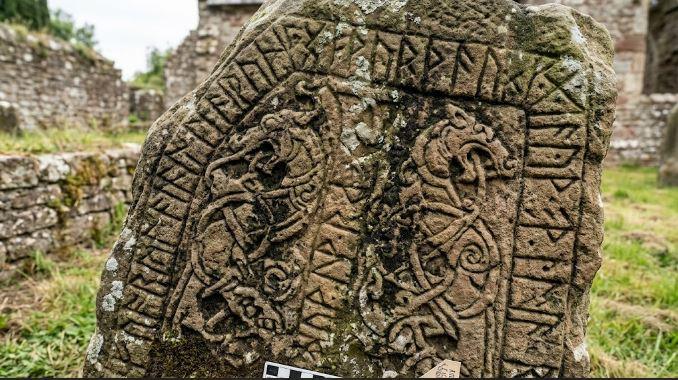
A Gael Could Commission A Norse Runecarver
The person paying Gautr did not necessarily have a Norse name.
One cross was commissioned by Melbrigði, son of Aðakán the Smith.
Both names are Gaelic.
Yet the monument uses Scandinavian runes.
This is exactly the kind of evidence that makes simple ethnic categories difficult to sustain.
A person with a Gaelic name could commission a Norse-speaking craftsman to create a Christian monument using runes.
The writing system was no longer restricted to newly arrived Scandinavians.
It had entered a culturally mixed society.
Gaelic And Norse Names Appear In The Same Families
The wider name evidence strengthens that interpretation.
Researchers could identify 75 personal names across the inscriptions.
Of those, 16 are Gaelic.
Nearly all of the Gaelic names occur on the Isle of Man.
Even more revealingly, five Manx crosses contain Gaelic and Norse names within the same family networks.
At Kirk Michael, one inscription commemorates Malmury, daughter of Dufgal and wife of Aðísl.
Malmury and Dufgal are Gaelic names.
Aðísl is Norse.
The same inscription incorporates an Old Norse proverb.
This is not the archaeological signature of two completely separate populations living side by side.
It records marriage, fosterage and linguistic exchange.
Runic writing had become part of that mixed world.
Women Are Unusually Visible On Manx Crosses
The Manx material also challenges another assumption about who runestones commemorated.
Among 13 Manx crosses where the relationship between the commemorator and deceased can be assessed, nine were raised for women.
That proportion is dramatically different from Scandinavian runestone traditions.
Vitki notes that only about one Swedish runestone in 30 commemorates a woman under the comparable measure.
The reason remains uncertain.
Inheritance customs, Christian memorial traditions or regional family structures may have influenced the difference.
Researchers explicitly treat the explanation as a hypothesis rather than a settled result.
The numerical pattern itself, however, is difficult to ignore.
Runes abroad could give women far greater visibility than many Scandinavian memorial corpora do.
A Woman Also Carved Runes
Women did not appear only as the people being commemorated.
The British Isles corpus includes a female rune user named Þuríð.
Her appearance matters because runecarving is often imagined as an overwhelmingly male activity.
The surviving evidence is certainly male-dominated, but individual inscriptions show that literacy in runes was not restricted entirely to men.
Combined with the large number of female memorial subjects on the Isle of Man, Þuríð makes the island’s runic culture look particularly distinctive.
Runes were embedded within households and local communities rather than belonging only to warrior groups.
Dublin’s Runes Belong To A Different World
Ireland produces a very different pattern.
Most of the Viking-Age runic finds come from Dublin, where excavations at places such as Fishamble Street and Christ Church Place have recovered extraordinary quantities of material from the Norse town.
Only one of 13 readable Irish inscriptions in the Vitki dataset is a memorial.
Ten involve categories such as ownership, personal names, ordinary messages or the runic alphabet.
People wrote on small portable objects including bone, combs and handles.
One inscription identifies an owner of a sword.
That kind of writing feels far removed from the monumental crosses of the Isle of Man.
Dublin’s runes belonged to an urban environment.
They were labels, marks and everyday communications.
England Produces Another Pattern Again
England has just 13 Viking-Age inscriptions in the corpus, of which nine are readable enough for classification.
Those nine divide almost evenly among several functions.
Two are memorials.
Two identify carvers or makers.
Three involve ownership, names or other everyday writing.
Two concern magic or supernatural beings.
The numbers are too small for sweeping statistical conclusions.
Still, the diversity contrasts strongly with the memorial-heavy Manx corpus.
There was no single “British Viking” way to use runes.
Different communities developed different practices.
Runes Abroad Could Mix Languages And Alphabets
Research on British runic inscriptions increasingly shows that even the writing itself could become hybrid.
Some objects combine Scandinavian runic traditions with linguistic features associated with English.
Others mix rune forms or incorporate characters from different writing systems.
That is exactly what might be expected in settlement zones where speakers of Old Norse, Old English and Gaelic interacted for generations.
Writing changes when communities change.
A Scandinavian immigrant might teach runes to children growing up bilingual.
Local craftspeople could adopt Scandinavian signs.
Marriage could connect speakers of different languages within one household.
Runic literacy abroad therefore became something locally adapted rather than simply imported intact from Scandinavia.
The Swedes Are Surprisingly Difficult To Find
Perhaps the most striking result concerns Sweden.
Swedish runestones famously mention England.
The analysis identified 28 Swedish stones referring to England, including monuments commemorating men who collected payments or died during western expeditions.
Yet among the 84 Viking-Age inscriptions found in Britain and Ireland, none explicitly mentions Sweden.
Researchers could not securely connect any of them with a Swedish rune-carver.
Instead, the inscriptions on the Isle of Man and Scottish islands largely use short-twig rune traditions associated with Norway and the Hebrides.
English inscriptions show stronger connections with Danish traditions.
This does not mean Swedes were absent from Britain.
Historical and archaeological evidence proves Scandinavian movement from several regions.
The runes simply preserve different groups more clearly.
Swedish Vikings Wrote About England At Home
The contrast is revealing.
Swedish travellers frequently commemorated English expeditions after returning—or were commemorated by families in Sweden when they died abroad.
Their runic story about England was largely written back in Scandinavia.
Communities in Britain itself produced another story.
There, Norse and Gaelic families raised Christian crosses.
Dublin residents scratched names and ownership marks onto everyday possessions.
Local carvers worked within communities that had already begun blending languages and traditions.
The location of an inscription therefore changes what history it records.
Runic Evidence Complements Archaeology
Runes cannot reconstruct Viking migration on their own.
Only a small fraction of the population ever appears in inscriptions.
Wooden texts have largely vanished.
Some regions preserve stone much better than others.
Twenty-one of the 84 British Viking-Age inscriptions are too damaged to read.
The database itself is also a scholarly reconstruction that depends on dating and interpretation.
The Scandinavian Runic-text Database at Uppsala University collects inscriptions in transliterated and normalized form while recording information such as chronology, find location and source.
Combining that corpus with archaeology provides a much stronger picture than treating individual inscriptions in isolation.
Britain’s Runes Show Settlement, Not Just Raiding
The strongest pattern in the inscriptions concerns permanence.
A Christian memorial cross implies people expecting a monument to remain within a community.
Mixed Gaelic-Norse families imply marriage and children.
Urban ownership inscriptions imply houses, workshops, trade and personal possessions.
Professional carvers suggest markets for skilled labour.
These are not principally traces of raiders passing through.
They document settlement.
That distinction complements archaeological evidence from early Scandinavian expeditions such as the Salme ship burials before the conventional Viking Age.
Salme preserves armed travellers far from home.
The British runic corpus increasingly reveals what could happen after Scandinavian mobility turned into permanent communities.
Why The 84 Inscriptions Matter
The 84 inscriptions do not reveal one Viking diaspora.
They reveal several.
On the Isle of Man and the Scottish islands, runes became a language of Christian family memory.
In Dublin, people used them on ordinary objects inside a trading town.
England preserves a smaller mixture of commemoration, craftsmanship, everyday writing and supernatural expression.
Gaelic names appear beside Norse ones.
Women are remarkably visible in Manx memorials.
A female runecarver appears among the people actually producing inscriptions.
Meanwhile, Swedes who talked extensively about England on stones at home left surprisingly little identifiable runic writing in Britain itself.
That difference changes the question historians should ask.
Instead of asking whether Vikings brought runes to Britain, the more useful question is what happened to runic writing once Scandinavian communities lived abroad.
The answer appears to be adaptation.
Runes crossed the sea with Scandinavian settlers, but they did not remain culturally sealed.
They entered Christian churches, mixed families, trading towns and multilingual communities.
The alphabet may have originated in Scandinavia.
The people using it abroad were already creating something new.
