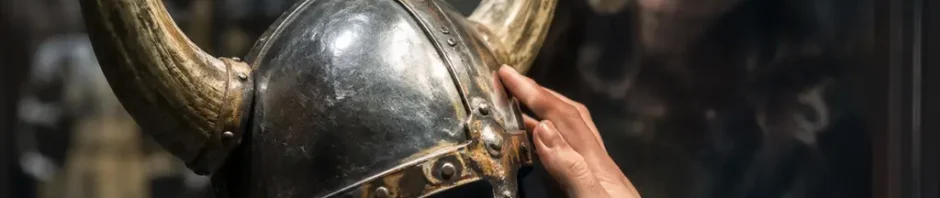
The Vikingmania Exhibition opened on May 11, 2026, and is scheduled to run through April 23, 2027, in the Kramme Gallery at the Museum Building, 2212 Washington Street, Elk Horn, Iowa. Organized by the Museum of Danish America and presented by Viking Aggregates, the traveling exhibition sets historical artifacts and high-quality replicas beside Viking-themed material from the 19th, 20th, and 21st centuries, according to the Museum of Danish America. That pairing is the exhibition’s strongest interpretive choice: it asks visitors to look at Vikings not only as people of the past, but also as figures repeatedly remade by later culture.
Why The Vikingmania Exhibition Matters Now
On November 9, 2026, the exhibition was already open and still within its listed run. That timing matters because it places the show inside a period when Viking images remain highly visible in fiction, games, television, music, design, and heritage branding. A museum display cannot control every popular use of the Viking past, but it can slow the viewer down and ask what is being shown, what is supported, and what has been added by later imagination.
How The Vikingmania Exhibition Frames Identity
The Vikingmania Exhibition does not appear to present modern Viking identity as a single tradition. Based on the museum description, it compares historical material with later Viking-themed culture. That structure suggests a careful question: how did a historical seafaring, trading, raiding, farming, and storytelling world become a modern symbol used in so many different ways?
For readers of Norse myth and literature, this is familiar ground. Odin, Thor, runes, longships, warriors, and saga-like plots often travel far from their medieval and archaeological contexts. Sometimes that travel produces useful curiosity. Sometimes it produces shorthand that hides evidence. A museum setting can help separate these layers without treating modern enthusiasm as automatically false or historically pure.
- The exhibition is a traveling show organized by the Museum of Danish America.
- Its listed dates are May 11, 2026, to April 23, 2027.
- Its location is the Kramme Gallery at the Museum Building in Elk Horn, Iowa.
- Its method is comparison: historical artifacts and replicas beside Viking-themed material from the 19th, 20th, and 21st centuries.
Why A Museum Comparison Works
Comparison is useful because Viking identity has never been received in a neutral vacuum. A helmet, ship, brooch, carved figure, or replica weapon can sit beside a poster, book cover, toy, costume, or screen image and reveal how meanings change. The historical object asks for context. The modern object asks why later people wanted Vikings to look a certain way.
This does not mean the older item is simple and the modern item is false. Replicas, too, are modern constructions, even when based on evidence. Popular culture, too, can preserve fragments of older stories, even when it changes them. The important distinction is that artifacts, replicas, and entertainment objects answer different questions.
Pop Culture As A Modern Viking Mirror
Viking imagery has been used widely across heavy metal, fantasy literature, films, television, and video games, a pattern discussed by Origins at Ohio State University in its account of why modern audiences remain drawn to Vikings through popular culture. The point is not simply that Vikings are popular. The more useful question is why these images continue to attract meanings such as danger, freedom, endurance, travel, violence, mystery, and resistance to ordinary life.
Pop Culture Is Not A Primary Source
A television warrior, a game character, or a fantasy figure is not evidence for the Viking Age. Yet those figures are evidence for modern desire. They show what later societies want from the Viking image. Some viewers want adventure. Some want ancestry. Some want myth. Some want the drama of a world imagined as harsher and less regulated than their own.
That is where a show like the Vikingmania Exhibition can help. It can make the viewer ask whether a modern image is drawing from archaeology, medieval literature, nationalism, opera, fantasy, commercial design, or a mixture of these. The answer may vary from object to object, and that variation is part of the story.
Old Norse myth has always depended on retelling. The poems and prose texts that preserve many Norse myths were themselves written down after the pre-Christian period. Modern retellings are another layer, but they must not be confused with the earlier sources. A museum exhibition can honor retelling while still marking the boundary between evidence and adaptation.
Artifacts, Replicas, And The Limits Of Display
The Museum of Danish America’s description says the exhibition uses historical artifacts and high-quality replicas. That mixture is worth taking seriously. Original artifacts carry the force of survival: they are material witnesses, though they rarely explain themselves without context. Replicas can show form, scale, and use more clearly, especially when originals are fragile, incomplete, or unavailable. Both can teach, but neither removes uncertainty.
What Display Choices Can And Cannot Show
A display case can show an object, but it cannot fully recreate the social world that gave the object meaning. A replica may help visitors imagine handling, weight, or appearance, but it remains a modern interpretive object. A modern Viking-themed poster or costume can show later fascination, but it cannot prove what people in the Viking Age believed or wore.
This is why juxtaposition is so useful. The visitor is invited to see difference rather than absorb a single blended Viking image. A historical item may resist the drama of a modern screen image. A modern object may reveal how strongly later audiences prefer certain symbols. Between them, the viewer sees that “Viking” is both a historical label and a cultural construction.
Readers interested in a closely related discussion of exhibition practice and public memory may find useful context in Old Norse News coverage of the Vikingmania exhibit and modern Norse memory. The shared concern is not whether modern audiences should enjoy Viking material. They clearly do. The concern is whether enjoyment is paired with source awareness.
Evidence, Identity, And Responsible Reading
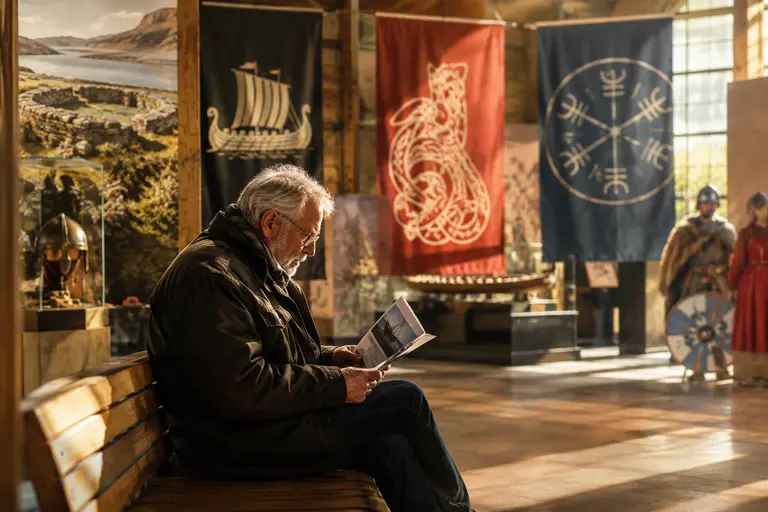
The strongest writing about Norse culture usually begins with limits. We know some things through archaeology, some through runic inscriptions, some through later medieval texts, and some through comparative interpretation. We also know that modern culture often fills gaps with images that feel convincing even when they are not securely evidenced.
Why Caution Is Not Hostility
Caution can sound cold beside myth, saga, and spectacle, but it is a form of respect. If a visitor wants to understand Viking Age people, the evidence deserves patience. If a visitor wants to understand modern Viking enthusiasm, the modern material also deserves care. A costume, film still, album cover, or game design may be historically inaccurate in some details while still revealing how Vikings function in modern imagination.
This source discipline is not limited to history writing. Across the publisher’s network, a related site such as Polygraphianz also benefits from discerning evidence from speculation. It may cover a different subject, but the method remains: claims should be accurately supported by evidence.
For Norse studies, that habit is especially valuable because the Viking image is emotionally charged. People may approach it through ancestry, fiction, religion, music, gaming, national memory, or academic interest. Those paths are not the same, and a museum exhibition should not flatten them into one story. A careful exhibition gives visitors a way to ask where an image came from and what work it is doing.
What The Vikingmania Exhibition Leaves Us With
The Vikingmania Exhibition is strongest when read as a study of contact between evidence and imagination. Its dates, location, and organizing institution are clear. Its interpretive method is also clear: place historical material and replicas beside later Viking-themed culture, then let the comparison raise questions about identity.
That approach suits the subject. Vikings have never stayed still in cultural memory. They appear as raiders, traders, explorers, settlers, gods’ companions, saga figures, fantasy heroes, villains, ancestors, rebels, and commercial icons. Some of those images rest partly on evidence. Others are later inventions. Many sit somewhere between the two.
For contemporary readers, the value of the exhibition is not that it gives one final meaning for Norse identity. It offers a better habit of looking. Ask what is old, what is modern, what is copied, what is imagined, and what is uncertain. That habit keeps Norse mythology alive without turning it into decoration, and it keeps Viking history visible without pretending that every modern Viking image is a window onto the past.
