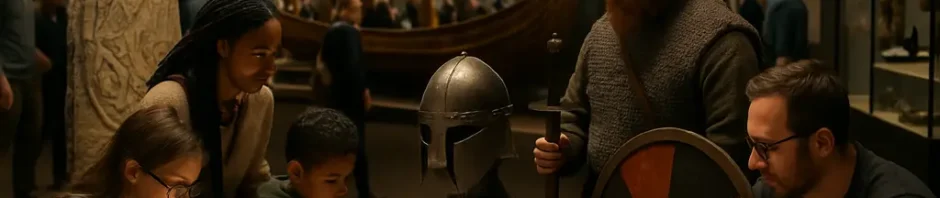
The Vikingmania Exhibit at the Museum of Danish America in Elk Horn, Iowa, offers a useful case study in how modern audiences learn to see Norse heritage through both evidence and popular culture. The museum states that Vikingmania! runs from May 11, 2026, to April 23, 2027, and that it places authentic Viking artifacts beside Viking-themed objects from the nineteenth through twenty-first centuries to examine modern perceptions of Vikings Museum of Danish America. That pairing is not a minor display choice. It asks visitors to consider how helmets, ships, warriors, gods, television characters, souvenirs, and museum cases all take part in shaping public memory.
What The Vikingmania Exhibit Places Side By Side
Why The Vikingmania Exhibit Matters As A Pairing
The Vikingmania Exhibit matters because it does not treat the Viking Age as a closed historical subject separated from later imagination. By placing artifacts near later Viking-themed material culture, the exhibit shows that “Viking” has become a cultural label as well as a historical term. The Viking Age belongs to the past, but the word “Viking” also circulates through entertainment, branding, costume, tourism, literature, games, and personal identity.
That is both useful and risky. Popular culture can make Norse subjects approachable for people who would not begin with a runic inscription or a typological study of brooches. Yet the same images can flatten the past into repeated signals: horned or heavy helmets, violent masculinity, gods as fantasy figures, and ships as shorthand for raiding. The museum’s format invites the viewer to see those signals as objects with their own dates, makers, and audiences.
Objects As Arguments, Not Props
A cautious reading begins with the objects. Authentic artifacts can tell us about craft, trade, status, wear, burial practice, and contact, depending on context. Modern Viking-themed objects tell us different things: what later societies wanted Vikings to mean. One kind of object is not more “alive” than the other, but they answer different questions.
This distinction is central to responsible public history. A nineteenth-century or twenty-first-century Viking image is not direct evidence for the Viking Age. It is evidence for later reception. If a display keeps that boundary clear, it can show how modern Norse identity is made, remade, and debated without asking artifacts to support stories they cannot bear. This issue also connects with Old Norse News coverage of Vikingmania and Norse identity, where public memory is treated as a changing cultural process rather than a fixed inheritance.
Why Popular Media Matters For Norse Heritage
Television Audiences And Norse Recognition
Television has been one of the most visible modern forces in shaping Norse recognition. A 2026 Rascasse audience profile estimates that the TV series Vikings has 14.5 million viewers in the United States, with an average age of 33.8 years and an audience split of roughly 59% male and 41% female; the same profile says the audience strongly over-indexes for interest in Norse mythology Rascasse audience profile. These figures should not be read as a measure of historical knowledge. They do, however, show the scale at which a screen version of the Viking past can circulate.
For museums, that scale creates a practical challenge. Many visitors arrive already carrying images from serial drama, streaming platforms, games, comics, fantasy novels, and social media. They may know Ragnar, Lagertha, Odin, Thor, or Valhalla as cultural references before they know the difference between saga literature, archaeology, and later nationalism. A museum cannot ignore those entry points, but it also cannot let them define the evidence.
Interest Is Not The Same As Knowledge
Popular media often produces recognition before understanding. Recognition can be valuable: a familiar name or image can bring someone toward an exhibit case. Yet recognition may also create false confidence. The viewer may feel that the Viking Age is already known because its signs are familiar.
The Vikingmania Exhibit cannot by itself solve that problem, but its structure can slow the viewer down. If a visitor sees a real artifact beside a later imagined Viking object, the display can prompt questions: Who made this? When was it made? What was its purpose? What evidence links it to the Viking Age? What belongs to later fantasy, marketing, or national memory? These questions are simple, but they are the beginning of historical method.
Where Evidence Can Resist The Stereotype
Raider Images And The Limits Of Familiarity
The most durable popular Viking image remains the armed raider. That image is not invented from nothing; violence, warfare, and raiding appear in written sources and archaeological interpretation. The problem begins when the raider becomes the whole story. Norse heritage then narrows into a theater of weapons, ships, and male aggression.
Evidence resists that reduction. Even within the limited facts supplied for this discussion, the museum’s decision to juxtapose authentic artifacts with modern objects points toward a wider question: how did certain images become dominant, and what do they leave out? Material culture can support stories of craft, exchange, domestic life, display, belief, movement, and social rank. The exact interpretation depends on the artifact and its context, but the principle is clear: Norse heritage is not best understood through a single stereotype.
Myth, Memory, And Caution
Norse mythology adds another layer. Odin, Thor, and other mythic figures are powerful modern symbols, but their popularity can blur the difference between mythic tradition and Viking Age social history. A god in a modern television drama is not the same kind of evidence as a runic inscription, a hoard, or a burial find. Museums help when they make those categories visible.
That caution does not make myth less significant. Myth shaped stories, names, poetic language, and later cultural memory. The historian’s task is not to strip away imagination, but to ask what kind of source is being used and what claim it can support. A modern image of Thor may reveal far more about modern taste than about Viking Age worship.
How Institutions Shape Public Memory
Museums As Filters, Not Neutral Windows
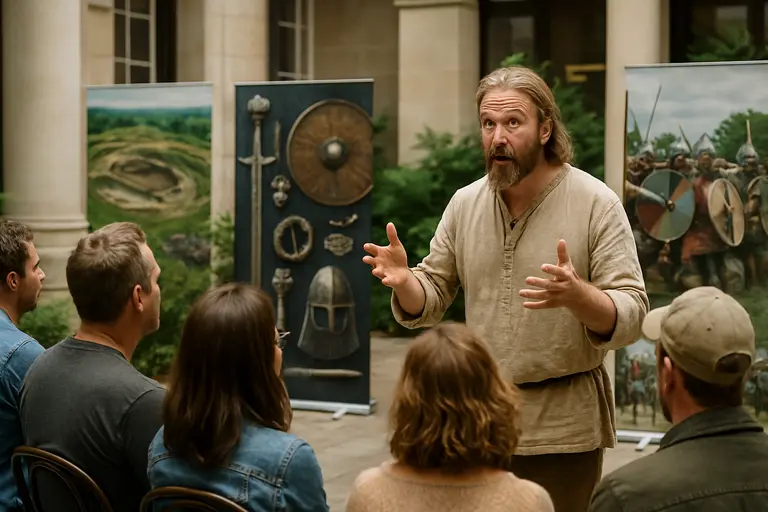
Museums do not simply show the past. They select, arrange, label, compare, and frame it. Every exhibit makes interpretive choices: which objects are placed together, which dates appear, which terms are defined, and which popular myths are challenged or left unspoken. The Museum of Danish America’s exhibit is valuable because its stated subject is perception itself. It treats modern Viking fascination as something worthy of study.
This makes the exhibit a mirror as well as a display. Visitors are not only looking at Vikings; they are looking at the ways people have wanted Vikings to look. That can be uncomfortable, especially where Norse heritage has been used for identity claims, romantic fantasy, masculine performance, or simplified ancestry. Yet careful discomfort can be productive when it is anchored in objects and clear sourcing.
The Professional Work Behind Public Heritage
Exhibitions also depend on labor that visitors may not see: curators, educators, collections staff, designers, conservators, researchers, installers, and public-program teams. Their work shapes how evidence becomes visible to a general audience. The staff side of heritage presentation is part of a wider professional culture, one that can be compared with other work-focused networks such as Alliance Recruitment, where various specialists collaborate, though museum interpretation requires its own specialist training and ethical standards.
For Norse heritage, that professional work matters because the subject carries strong modern associations. A poorly framed display can repeat clichés. A careful display can turn those clichés into evidence of reception. The difference lies in whether the institution explains what is Viking Age evidence, what is later imagination, and where uncertainty remains.
Vikingmania Exhibit And Norse Heritage Today
The Vikingmania Exhibit is most useful when read as a study of movement between past and present. It does not ask visitors to choose between artifacts and popular culture. Instead, it places them in conversation. That conversation shows why Norse heritage remains publicly powerful: it can be ancestral, mythical, entertaining, regional, aesthetic, and commercial, often at the same time.
A careful viewer should leave with better questions rather than easy certainty. Which images come from archaeological evidence? Which come from later art, theater, nationalism, television, or fantasy? Why do some images repeat while others fade? Who benefits when Vikings are imagined as warriors alone? Who is made visible when craft, family, migration, trade, and belief enter the story?
Read this way, the Vikingmania Exhibit does more than display Viking enthusiasm. It shows that modern perceptions of Norse heritage are historical evidence in their own right. They tell us how the Viking past is used, desired, simplified, challenged, and taught. For a subject so often pulled toward spectacle, that is a valuable form of public scholarship: not anti-popular, but evidence-aware.
