
Norway’s 7,000-year-old fish traps change the story of mountain life before the Norse because they show planning, food security, and environmental knowledge long before Viking ships or medieval kingdoms entered the record. A 2026 study in Antiquity by Axel Mjærum, Ellen K. Friis, Trygve Hesthagen, and Andreas J. Kirchhefer reports dates from four wooden fish traps found in the exposed bed of Lake Tesse in southern Norway. The earliest trap dates to around 5000 BC, when Mesolithic hunter-fisher-gatherers appear to have harvested brown trout that could only have reached the lake through human-mediated introduction. That finding matters because it shifts mountain history away from a simple “wild landscape” image and toward a deeper story of people actively managing food, water, fish, and seasonal movement thousands of years before Norse culture emerged.
Why Lake Tesse Matters For Pre-Norse History
Lake Tesse lies in the central Norwegian mountain region of Jotunheimen, at about 854 meters above present sea level. The study describes it as a low alpine lake that originally covered about 12 square kilometers. Before the lake became a hydropower reservoir in the 1940s, it ranked among Norway’s most productive brown trout lakes, with recorded annual yields of up to 9,000 kilograms.
That productivity now looks much older than modern fisheries, medieval lake rights, or Viking Age food systems. The fish traps show that people had already built fishing infrastructure at Lake Tesse around 5000 BC. In other words, the lake’s later reputation as a rich trout water may rest on a human intervention that began in the Stone Age.
This changes how readers should picture Norway’s mountain past. Mountain lakes were not just empty backdrops for hunters passing through. They could become planned resource zones, shaped by people who understood watercourses, fish behavior, wooden construction, seasonal access, and the risks of upland life.
For oldnorsenews.org readers, this topic connects naturally with the site’s coverage of pre-Viking mountain hunting systems, where preserved traps reveal organized work in landscapes that later Norse communities also used.
What The Fish Traps Actually Show
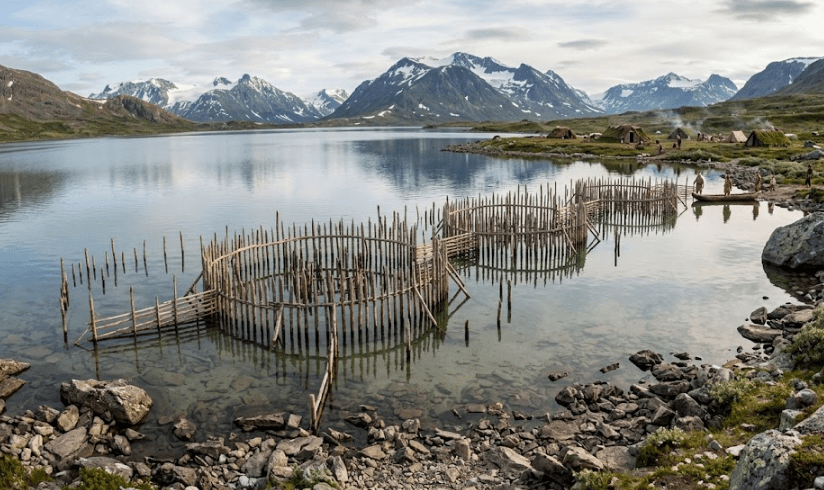
The Lake Tesse discovery centers on wooden stationary fish traps. The study reports that archaeologists manually excavated four traps from the dredged lakebed. Trap 5 received the most complete excavation, while traps 1, 2, and 3 only exposed parts of their preserved pole structures.
Researchers collected 113 larger wooden samples for dendrochronological analysis. They interpret 73 of those samples as components of separate poles used in the four traps. Radiocarbon analysis then placed trap 5 around 4950 BC and trap 2 around 5000 BC. Trap 1 dates to about 3850 BC, while trap 3 dates to around 2700 BC.
Those dates matter because they do not point to one short experiment. Instead, they suggest a long tradition of fishing infrastructure at Lake Tesse. The study argues that people constructed and used traps there from around 5000 BC onward, with later Neolithic phases continuing the practice.
The authors also note signs of maintenance. Two posts in one trap appear to have been placed about 12 years apart. That detail matters because maintenance suggests repeated knowledge, not a one-time accident. People returned to the lake, repaired equipment, and kept the fishing system working.
Why Brown Trout Should Not Have Been There Naturally
The strongest claim in the study does not come from the wooden traps alone. It also comes from fish distribution. After the Fennoscandian Ice Sheet retreated, topographic barriers prevented fish from naturally migrating into many upland watercourses. Waterfalls and other obstacles blocked fish from reaching lakes such as Tesse by ordinary upstream movement.
Historically, the lower part of the watercourse supported about 25 fish species, while the upper part only had brown trout. That pattern matters. If fish had reached the lake through random natural dispersal, researchers would expect a more complicated species picture. Instead, brown trout dominate the evidence.
The study also discusses arguments for bird-mediated spread of fish eggs. However, the authors find that explanation weak in this Norwegian mountain context. Bird transport does not easily explain why brown trout alone appear so consistently in high-altitude lakes, nor does it explain the apparent emergence of mountain fishing from around 5000 BC onward.
Therefore, the study argues that people likely moved live brown trout into these lakes. Brown trout made sense as a choice. They can grow large, provide valuable calories, and enter traps more easily than many other species. The result was not just fishing. It was an ecological decision.
How People May Have Moved Fish Into Mountain Lakes
The practical question matters: how could Mesolithic people move fish into a lake? The study does not claim to know every detail. Instead, it points toward likely requirements. Fish translocation needed living fish, equipment to catch them, containers to transport them, routes between lowland and upland waters, and enough knowledge to place fish where they could survive.
The authors suggest that trap fishing may have provided one way to catch live fish. They also note that waterskins may have helped people carry fish, since Mesolithic Norway has strong evidence for hide and skin processing. That interpretation remains cautious, but it gives readers a practical picture of the work involved.
This was not a simple gesture. People had to understand which waters had fish, which lakes lacked fish, and which barriers stopped natural migration. They also needed to know that trout could survive after relocation. Moreover, they needed enough social coordination to transport fish and later harvest them.
That turns the mountain landscape into a planned food system. The people who stocked Lake Tesse did not farm fields, but they still changed an ecosystem to support future meals.
Why This Happened Before Farming Took Hold
The timeline gives the discovery its wider importance. The Lake Tesse fish traps date to around 5000 BC at the earliest. In southern Scandinavia, the earliest evidence for husbandry and cereal farming appears around 4200 BC. In the central Scandinavian region discussed by the study, clear evidence of farming interaction during the Mesolithic before 3900 BC remains absent.
That means hunter-fisher-gatherers carried out the first fish translocations in the Norwegian mountains. They did not borrow a farming system and apply it to trout. They developed or used their own resource-management knowledge in a hunting, fishing, and gathering world.
This point challenges an old historical shortcut. Many people still imagine that humans began managing nature only after farming appeared. The Lake Tesse evidence complicates that idea. Mesolithic communities could reshape ecosystems without plows, livestock barns, or cereal fields.
The study even suggests that this practice may count as a form of food production among hunter-fisher-gatherers. That phrase matters because it blurs the hard line between “foragers who find food” and “farmers who produce food.” At Lake Tesse, people appear to have made future fishing possible by changing the lake itself.
How Fish Made Mountain Life Less Risky
Mountain life brought opportunity and risk. People could hunt reindeer, gather raw materials, move through upland corridors, and exploit seasonal resources. At the same time, big-game hunting could fail, weather could shift quickly, and extended stays in high terrain demanded reliable food.
The study notes that Langfonne, an ice patch just 11 kilometers west of Lake Tesse, has served as a reindeer hunting ground since at least the fifth millennium BC. That nearby evidence helps explain why fish mattered. A stocked lake could reduce the risk of long mountain stays by adding a dependable, fresh, calorie-rich food source to the hunting landscape.
Fish changed the terms of upland movement. People no longer had to rely only on unpredictable game. They could combine hunting, fishing, raw-material gathering, and seasonal camps into a more secure mountain strategy. In that sense, trout made the highlands more livable.
This matters for pre-Norse history because later mountain use did not begin from nothing. Long before Norse farms, hunting systems, and medieval travel routes, people had already learned how to make Norway’s interior landscapes support repeated human presence.
Why Wood Preservation Makes This Find Unusual
Wood rarely survives from the Mesolithic in many Scandinavian contexts. Wet lakebed conditions can preserve organic material that ordinary soils destroy, which makes the Lake Tesse traps especially valuable. The fish traps give researchers direct evidence of woodworking, construction, and tool use that stone artifacts alone cannot show.
The Museum of Cultural History at the University of Oslo has also highlighted the Lake Tesse fish-trap work through its research on inland fishing. One project page explains that the 2023 excavation investigated a Late Mesolithic fish trap at Tesse in Lom, consisting of 46 poles driven into the lakebed. Several poles showed traces of working, including chopping marks, splitting, and possible binding. (Museum of Cultural History Tesse project)
That level of detail matters because it turns an abstract “fish trap” into a human-made structure. Someone selected wood. Someone shaped poles. Someone drove them into the lakebed. Someone understood water depth, fish movement, and the seasonal moment when a trap would work.
Preserved wood therefore gives the story a technical side. Mountain life before the Norse depended not only on mobility, but also on skilled making.
How The Discovery Changes The Meaning Of “Wild” Mountains
Modern readers often describe ancient mountains as wild places. That word can mislead. A mountain landscape may look untouched today, yet archaeology can reveal long sequences of human intervention. Lake Tesse shows that people shaped upland ecology thousands of years ago.
The fish traps do not mean Mesolithic people controlled the mountains in a modern industrial sense. They did not dam every river or reorganize the whole landscape. Still, they made a lasting change by moving brown trout into lakes where natural barriers had kept fish out. That decision created food opportunities for future generations.
This kind of intervention also changes the emotional tone of pre-Norse history. It shows patience rather than only survival. People did not merely respond to scarcity. They improved future resource access. They turned water, fish, wood, and route knowledge into a system that could last.
For oldnorsenews.org, that is the key lesson. The deeper Scandinavian past was not passive. Long before sagas, runes, Viking kings, and medieval churches, communities already made strategic decisions about landscapes.
Why This Does Not Make Mesolithic People “Vikings Before Vikings”
This topic needs careful framing. The Lake Tesse fish traps do not belong to Norse culture, the Viking Age, or the Old Norse language world. They date thousands of years earlier. Calling the builders “Vikings” would distort the evidence and weaken the article.
The better connection lies in landscape continuity, not cultural identity. Later Norse communities also used mountains for hunting, grazing, travel, fishing, iron production, and seasonal work. However, they inherited landscapes that earlier people had already explored and modified. Lake Tesse reminds readers that Norway’s deep past extends far beyond the historical periods that usually receive attention.
This distinction helps oldnorsenews.org keep a source-aware tone. The article can show why pre-Norse evidence matters to readers interested in Norse history without pretending that Mesolithic fishers were early Norse people.
In practical terms, the traps reveal a foundation of mountain knowledge. Later communities may have used different tools, beliefs, languages, and social systems, but they moved through environments where human decisions had mattered for millennia.
What The Evidence Can And Cannot Prove
The Lake Tesse evidence supports a strong claim: people likely introduced brown trout into previously fishless mountain lakes and later harvested them with wooden traps. It also supports the idea that Mesolithic hunter-fisher-gatherers practiced environmental management before farming took hold in central Scandinavia.
However, the evidence cannot answer every question. Researchers do not know the names, language, beliefs, or exact social structure of the people who moved the fish. They cannot reconstruct every route used to carry trout. They also cannot say whether one small group, several groups, or repeated generations organized the first introductions.
The traps point toward planning, but they do not show a centralized authority. They reveal technical skill, but they do not identify individual makers. They suggest repeated use, yet they do not preserve the full social story around Lake Tesse.
Those limits matter. A good archaeological article should let the evidence remain impressive without turning it into myth. The fish traps change the story because they show resource management, not because they solve every mystery of Mesolithic mountain life.
Why The Find Matters For Environmental History
The 2026 study matters beyond Norwegian archaeology because it contributes to a larger debate about how early humans shaped ecosystems. The authors compare fish translocation with other examples of hunter-fisher-gatherer environmental influence, including animal movement, plant management, fire use, and hunting strategies.
Lake Tesse adds a strong aquatic example to that debate. Moving fish into a previously fishless lake changes more than one meal. It changes food webs, future settlement choices, seasonal movement, and the relationship between people and water. When later communities returned to the lake, they did not encounter a purely natural resource. They encountered an ecosystem already shaped by earlier human action.
The study argues that new fish traps continued in Lake Tesse over at least 2,300 years. That duration gives the find special force. It suggests that fish introduction created a durable entanglement between people and mountain waters.
This also explains why the discovery feels current today. Modern debates about environmental management often ask when humans began changing ecosystems. Lake Tesse shows that in Norway’s mountains, that story reaches back about 7,000 years.
How Readers Should Understand “Before The Norse”
“Before the Norse” does not mean irrelevant to Norse history. It means older than the societies that later spoke Old Norse and produced the Viking Age record. The Lake Tesse traps belong to a much deeper timeline, yet they help explain why Norway’s landscapes should not be read only through medieval names and saga memory.
Norse history grew in places that had long human histories. Fjords, coasts, uplands, forests, rivers, and mountain lakes all carried earlier evidence of use. Some later practices may have changed completely, while others may have echoed older patterns of seasonal movement and resource knowledge. Archaeology must test those links carefully.
For readers, the safest takeaway is not direct continuity. Instead, the discovery shows depth. Norway’s mountains had human histories thousands of years before Norse chieftains, Viking ships, Christian kings, and written law codes. Those histories included planning, technical skill, and ecological choices.
That broader frame makes Norse history richer. It stops the Viking Age from floating alone and places it inside a much longer human relationship with northern landscapes.
Why The Fish Traps Deserve Attention Now
The Lake Tesse fish traps deserve attention because they join fresh research with a clear public-history lesson. The new Antiquity study gives names, dates, methods, and cautious interpretation. It identifies the researchers, the traps, the lake, the brown trout problem, and the broader significance of Mesolithic resource management.
The story also offers a better way to write about Norway’s past. Instead of beginning with dramatic raids, royal sagas, or warrior graves, it begins with a lakebed, wooden poles, fish movement, and people who understood mountain water. That quieter evidence can change the reader’s mental map.
Norway’s 7,000-year-old fish traps matter because they show that mountain life before the Norse was not a thin story of survival in empty terrain. It involved planning, woodworking, repeated site use, ecological knowledge, and long-term food strategy. The people of Lake Tesse did not leave sagas behind, but they left a changed lake.
That is why this discovery belongs on oldnorsenews.org. It gives readers a deeper, more careful way to understand the landscapes that later Norse history would inherit.
