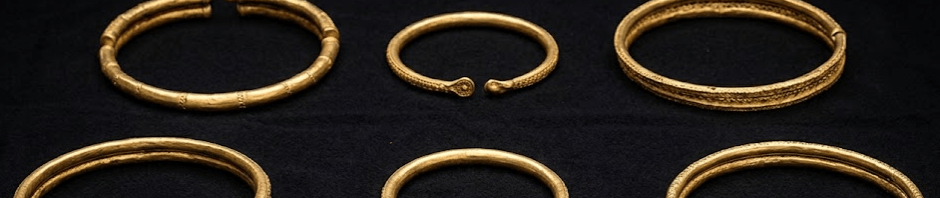
The Rold Treasure changes Denmark’s Viking gold story because it turns six intact arm rings into evidence for elite power, political connection, skilled goldsmithing, and deliberate deposition during the late Viking Age. Nordjyske Museer reports that a resident of Himmerland handed in two solid gold rings for danefæ assessment on April 22, 2026, after spotting them partly visible in the soil near a field road in a wooded area close to Rold, Himmerland. Museum archaeologists then surveyed the area and found four more gold arm rings. Together, the six intact pieces weigh 762.5 grams, making the Rold Treasure Denmark’s third-largest Viking Age gold find, after the Tissø ring from West Zealand in 1977 and the Fæsted hoard near Ribe in 2016. (Nordjyske Museer Rold Treasure report)
Why The Rold Treasure Matters
The Rold Treasure matters because Viking Age gold finds do not work like ordinary jewelry stories. Six solid gold arm rings from one location raise questions about wealth storage, political loyalty, public display, elite gifting, ritual deposition, and the growth of royal power in late Viking Age Denmark.
Nordjyske Museer identifies the objects as gold arm rings from the Viking Age and dates the treasure to around AD 900–1000. That period places the find near the political changes associated with Denmark’s movement toward one kingdom. The museum also connects this wider moment with Harald Bluetooth, who proclaimed his achievements on the large Jelling Stone around AD 965.
That timing does not prove that Harald Bluetooth owned the Rold rings or personally controlled the treasure. However, it places the hoard in a world where gold could express rank, alliance, loyalty, and access to powerful networks. The find therefore invites a more political reading of Viking gold.
How The Discovery Began
The discovery began in an unusually visible way. According to Nordjyske Museer, a Himmerland resident found two massive gold rings partly exposed in the soil near a field road in a wooded area near Rold. He brought them to the museum’s archaeological department for danefæ assessment on April 22, 2026.
Museum archaeologists immediately recognized the objects as extraordinary Viking Age gold arm rings. They then went to the findspot and carried out a more detailed investigation with metal-detecting across a larger area. That survey revealed a third similar arm ring near the original discovery spot.
Soon afterward, archaeologists found three additional gold arm rings about 15 meters from the first location. All six pieces were intact and made of solid gold. That pattern matters because the objects did not appear as scattered fragments of payment metal. They appeared as whole prestige objects deposited together or in close association.
Why Intact Gold Rings Change The Interpretation
The intact condition of the Rold rings changes the interpretation. Viking Age silver often circulated by weight. People cut silver objects into fragments, weighed them, and used them in exchange. In contrast, the Rold rings survived whole. Nordjyske Museer specifically notes that the intact condition supports the interpretation that these rings did not function as ordinary payment metal.
That detail matters for readers because “treasure” can sound vague. A hoard may represent emergency storage, ritual offering, wealth display, bullion, inheritance, political payment, or several meanings at once. In Rold’s case, the complete arm rings point strongly toward status and symbolic value.
Gold arm rings could signal power in ways that loose silver fragments could not. Their full circular form, weight, craftsmanship, and visibility made them useful as signs of rank or affiliation. A person wearing or giving such a ring communicated more than wealth. He or she also communicated social position.

Why Gold Was Different From Silver
Gold carried a different social meaning from silver in the Viking Age. Nordjyske Museer explains that arm rings of this Scandinavian type are known from the Viking Age, but gold examples are much rarer than similar silver ones. Torben Sarauw, cultural heritage manager and archaeologist at Nordjyske Museer, says gold in the Viking Age concentrated among society’s absolute elite.
That point makes the Rold Treasure more important than its weight alone. The hoard contains nearly three-quarters of a kilogram of gold, but the social message comes from rarity as much as mass. Gold arm rings belonged to a narrow world of high-status exchange and political meaning.
Silver could move widely through trade, tribute, payment, and hacksilver economies. Gold appeared less often and usually carried stronger elite associations. When six intact gold arm rings appear together, the find points toward people who operated near the top of Viking Age social structures.
What The Rings Reveal About Craft
The Rold Treasure also changes the gold story because the rings show varied and specialized metalwork. Nordjyske Museer reports that the hoard includes both twisted and smooth forms. Three rings consist of two twisted rods, and one includes thin inlaid gold wire with a knob-shaped closure.
Other rings were made from solid rods or wire. Several end with characteristic wrapped closures known as running knots. One arm ring stands apart because it has flat-hammered, joined ends decorated with zigzag motifs and triangles.
These details matter because they show craft knowledge, not just material value. A goldsmith had to understand form, weight, twisting, closure, surface decoration, and visual balance. The rings therefore reveal a technical culture in which elite objects required skilled labor.
The craft also helps explain why these objects carried political meaning. A ring made from precious metal with visible skill could become a gift, oath marker, alliance object, or status sign. Its value came from gold, but its authority came from form and social use.
Why Rold Belongs In The Harald Bluetooth Era Carefully
The Rold Treasure dates to the late Viking Age, around AD 900–1000. That period overlaps with major political developments in Denmark. The National Museum of Denmark explains that Harald Bluetooth raised the large Jelling Stone around AD 965 and that the inscription presents his achievements, including unifying Denmark and making the Danes Christian.
The Rold Treasure should not become a loose “Harald Bluetooth treasure” without proof. No inscription names him. No source links him directly to the rings. Still, the chronological overlap matters because the rings belong to a period when elites negotiated power, rank, loyalty, and regional authority.
Nordjyske Museer suggests that the original owners may have had connections with the emerging Danish kingship in the 900s. That careful wording gives the article its best interpretation. The treasure may reflect the social world around expanding royal power, even if it cannot identify a named owner.
Why Arm Rings Were Political Objects
Arm rings can look like jewelry, but in Viking Age contexts they often carried social and political weight. A ring could reward service, mark loyalty, display wealth, or connect a person to a leader. In a society where public reputation mattered, visible precious metal could speak loudly.
The Rold rings fit that logic because they combine material value with intact form. If someone had wanted only gold by weight, the rings could have been cut, melted, or divided. Their survival as complete objects suggests that form mattered.
Nordjyske Museer interprets the rings as status symbols and visible signs of power, rank, and affiliation. The museum also notes that they may have served as valuable gifts with strong symbolic meaning. That interpretation fits a world where elite relationships often depended on gift-giving and public recognition.
For oldnorsenews.org readers, this connects with the wider Viking economy. Wealth did not only sit in markets or coins. It moved through relationships. A gold arm ring could bind people together as strongly as a written contract did in later societies.
How Rold Compares With Other Danish Gold Finds
The Rold Treasure ranks third among Denmark’s Viking Age gold finds. Nordjyske Museer places it after the Tissø ring, found in West Zealand in 1977, and the Fæsted hoard, found near Ribe in 2016. That comparison matters because it shows how rarely large Viking Age gold deposits appear in Denmark.
Rold also differs from a mixed hoard because it consists of six intact gold arm rings. This gives the find a focused character. Rather than a broad collection of fragments, coins, and varied objects, the treasure centers on a small group of similar high-status pieces.
The comparison with Ribe also helps readers understand Denmark’s wider Viking economy. Old Norse News has covered how Islamic silver in Danish Viking coins reshapes the story of trade and minting around Ribe. The Rold Treasure offers a different but related lesson: elite gold and circulated silver reveal different layers of Viking Age wealth. (Islamic silver in Danish Viking coins)
Together, silver and gold evidence show that Danish wealth moved through several systems at once. Some value circulated through trade. Some value marked status, loyalty, and power.
Why Deposition Is The Hardest Question
The hardest question is why someone placed the Rold rings in the ground. Nordjyske Museer gives two broad possibilities: people may have deposited such rings to secure valuables in troubled times, or they may have placed them in the ground as part of rituals. Torben Sarauw emphasizes that the full meaning remains difficult to determine today.
That caution matters. A hoard can tempt writers into dramatic certainty. It could be called hidden war treasure, royal tax, ritual gold, emergency wealth, or a chieftain’s lost fortune. The evidence does not allow one simple answer.
The intact rings suggest deliberate deposition, but they do not reveal motive. If someone hid the rings for safekeeping, they never returned or could not recover them. If someone deposited them ritually, the act may have carried religious or social meaning. Another possibility could involve political storage, elite obligation, or a valuable gift placed beyond everyday use.
The strongest interpretation keeps several options visible. The Rold Treasure changes the story because it shows elite gold deposition, not because it solves every motive behind that deposition.
Why The Danefæ Process Matters
The Rold Treasure also illustrates why Denmark’s treasure system matters for archaeology. The National Museum of Denmark explains that Danish treasure trove includes unearthed archaeological finds made of precious metals, including coins, or objects with cultural-historical value. Such finds must be submitted because they belong to the state, and the National Museum administers the law.
That process protected the Rold find. The first two rings did not disappear into private hands. They went to Nordjyske Museer for assessment, which allowed archaeologists to investigate the site and recover the remaining pieces.
This reporting chain matters as much as the gold itself. Archaeological objects lose meaning when people remove them without location data, documentation, and professional study. In Rold’s case, responsible reporting preserved context and allowed the museum to document the discovery as a connected hoard.
The result gives researchers a stronger basis for interpretation. They can study the rings, the findspot, the spacing of the objects, the land context, and the deposition pattern.
What The Private Findspot Tells Readers
Nordjyske Museer notes that the find area lies on private land without public access, and both the finder and landowner wish to remain anonymous. That information deserves respect. Archaeological reporting should not turn a findspot into a tourist target or encourage unauthorized searching.
This point also gives readers a practical lesson. A spectacular find does not make a site open to the public. Cultural heritage work depends on responsible access, legal reporting, and cooperation between landowners, museums, finders, and national authorities.
The museum reports that the archaeological investigation in the area has ended and that all the gold has been submitted as danefæ. The rings will undergo further analysis and documentation before transfer to the National Museum.
That careful process stands against the fantasy of treasure hunting. The real story does not end when gold leaves the soil. It continues through documentation, conservation, study, legal handling, and public interpretation.
Why Aalborg Matters For Public Display
Nordjyske Museer states that the ambition is to display the arm rings at Aalborg Historiske Museum before the summer holidays, allowing the public to see the find close to where it emerged. That local display plan matters because archaeological finds belong to landscapes, not only national timelines.
A gold hoard from Rold carries national importance, but it also belongs to Himmerland’s local Viking Age story. Displaying the rings near the find region can help visitors connect elite gold with northern Jutland’s landscape, routes, settlements, and political changes.
Public display also changes how people understand the Viking Age. Seeing six intact gold arm rings together gives a stronger impression than reading a weight in grams. Visitors can compare forms, closures, surface patterns, and scale.
The best exhibition framing should avoid glamour alone. Gold attracts attention, but interpretation must explain why complete rings, elite control, political connection, and deposition matter. Otherwise, the treasure becomes beautiful but shallow.
What The Rold Treasure Does Not Prove
The Rold Treasure does not prove the name of its owner. It does not prove that Harald Bluetooth controlled the rings. It does not prove whether someone hid the treasure during conflict or deposited it for ritual reasons. It also does not prove that Rold served as a royal center.
The evidence supports more careful claims. The hoard contains six intact solid gold Viking Age arm rings, dated around AD 900–1000. It ranks as Denmark’s third-largest Viking Age gold find by weight. Its craftsmanship and intact form point toward elite status rather than ordinary payment metal. Its date places it in a period of political consolidation in Denmark. (National Museum of Denmark treasure trove guidance)
Those claims are strong enough. A source-aware article does not need to inflate the find into a royal mystery with a single answer. The real value lies in the way the treasure concentrates several important themes: elite wealth, specialized craft, political connection, legal reporting, and uncertain deposition.
For oldnorsenews.org, that balance matters. Readers should come away with a sharper understanding of Viking gold, not a simplified legend.
Why This Find Changes Denmark’s Viking Gold Story
The Rold Treasure changes Denmark’s Viking gold story because it forces readers to think beyond treasure as buried wealth. The hoard shows gold as a social language. Six intact arm rings could represent status, loyalty, rank, gift exchange, or values placed beyond ordinary circulation.
The find also places Himmerland inside the late Viking Age power landscape. Around AD 900–1000, Denmark was changing politically, and elite objects helped people express relationships within that changing world. The Rold rings may not name a king, but they belong to a society where gold could mark connection to powerful people and institutions.
Just as importantly, the find shows why context matters. A responsible finder, a quick museum response, archaeological survey, danefæ handling, and planned public display all shaped what scholars can now say. Without that process, the Rold Treasure would be only gold. With it, the hoard becomes historical evidence.
Denmark’s Viking gold story therefore gains a clearer shape. Gold was rare, elite, crafted, visible, and politically meaningful. At Rold, six intact rings bring that story out of the soil with unusual force.
