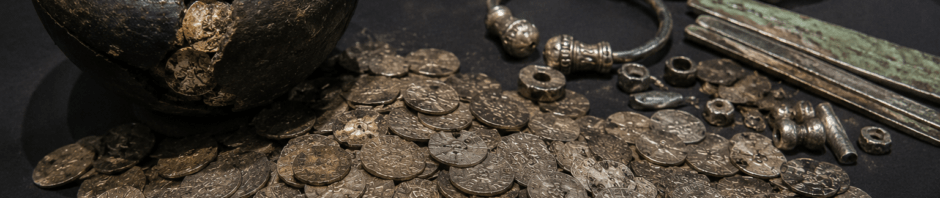
The Damhus hoard near Ribe gives Viking history a sharper economic map. Instead of reading early Danish coinage only as a local royal or market experiment, new research shows that some of the silver inside these coins had already traveled through the Islamic world before it reached a mint in Viking Age Denmark. The hoard was discovered near Damhus, south of Ribe on Denmark’s Jutland Peninsula, and the coins belong to one of Scandinavia’s earliest silver coinages. The recent study, published in Archaeometry, connects chemical analysis, die study, and early ninth-century minting to a larger story of long-distance exchange. The result is a more practical picture of Viking wealth: raiding mattered, but bullion, trade, melting, reminting, and market trust mattered too.
Why The Damhus Hoard Matters For Viking Coin History
The Damhus hoard matters because it is tied to Ribe, one of the most significant early towns in Scandinavia. The academic study identifies the hoard as a group of 266 silver Viking Age coins discovered in 2018 near Damhus, south of Ribe. The coins belong to the early ninth-century “KG 4” series, and most show a face on one side and a forward-looking deer or stag on the other. That iconography gives the coins a clear place in early Scandinavian minting, but the metal inside them tells the wider story. (Archaeometry)
Ribe is central to the interpretation. It was not a remote farmstead that happened to hold foreign metal. It was a trading town where craft, exchange, travelers, and political authority could intersect. A mint operating there would need silver supply, technical skill, dies, weights, and acceptance from people using the coins. The Damhus hoard shows that early Danish coinage was already plugged into material flows far beyond Denmark.
This makes the hoard a strong oldnorsenews.org topic because it separates artifact evidence from the simplified “Vikings took silver by force” story. Silver could arrive through plunder, tribute, trade, gifts, payments, or remelted bullion. The Damhus coins do not erase violence from Viking history. They show that coinage in Denmark was part of a wider metal economy. That same issue connects naturally with Viking Age trade routes, where commerce helps explain movement across the North Sea, Baltic, Frankish regions, and routes reaching into eastern silver networks.
The strongest point is not that a Danish coin “looks Islamic.” It does not. The Islamic link comes from the silver composition, not from the stamped image. That difference matters. The coin could carry local imagery, local minting practice, and long-distance metal in the same object.
How Scientists Traced Islamic Silver Inside The Coins
The Damhus research used scientific analysis to look beyond the visible design. Live Science reported that Thomas Birch, an archaeologist at the National Museum of Denmark and first author of the study, and his colleagues examined 25 coins with X-ray fluorescence and other analytical methods. Those methods helped identify trace elements and isotope patterns in the silver, showing that in some cases more than half of the precious metal came from Islamic silver coins known as dirhams. (Live Science)
That finding is different from simply finding a dirham in a Viking grave or hoard. Dirhams have long been known from Viking Age contexts, especially through eastern routes and silver hoards. The Damhus case is about recycling. Islamic silver had been melted, likely turned into ingots outside Scandinavia, and then moved into Ribe’s minting system. The silver had already gone through one or more economic lives before it became a Danish Viking penny.
That recycling process helps explain why the coins reveal trade without requiring direct travel from Denmark to the Islamic world by the person who minted them. The silver may have passed through several hands, markets, and melting stages before reaching Ribe. Archaeology Magazine summarized the interpretation clearly: trace elements suggest that more than half of the metal in some coins came from Islamic dirhams, and the Islamic coins were probably melted outside Scandinavia before the silver traveled to Ribe as ingots.
This is why metal analysis is so useful for Viking history. A coin can hide its earlier life. The stamped design may show local authority, a face, a stag, or a minting tradition, but chemistry can expose the source history of the silver. That lets archaeologists reconstruct exchange systems that written sources barely describe.
Why Ribe Was The Right Place For Early Minting
Ribe’s role gives the Damhus hoard its historical weight. A mint needs more than metal. It needs a town where coinage can circulate, buyers and sellers can recognize value, and authority can support production. The die evidence strengthens that interpretation. Birch and colleagues identified at least 30 dies used to make coins of this type, and Live Science reported that researchers estimate hundreds of thousands of these silver Viking pennies may have been produced at a single Ribe mint. (Live Science)
That scale changes the story. A few coins could be treated as experimental. Hundreds of thousands suggest organized production. Dies had to be cut, worn, replaced, and controlled. Silver had to be weighed, prepared, struck, and distributed. People had to accept the result in trade. The Damhus hoard therefore points to a minting system rather than an isolated treasure.
The iconography is part of that system. Reports describe one side of the coins as showing a face associated with Wodan or Odin, and the reverse as showing a stag. That imagery places the coins within a Norse symbolic setting, yet the silver itself may have come partly from Islamic dirhams. The object becomes a useful warning against simple cultural labels. A coin can be Danish in minting, Norse in imagery, and international in metal supply.
Ribe’s position on the Jutland Peninsula made it a practical contact point. Goods, silver, craft skill, and people could move through the town. If the mint used silver that had already passed through Islamic coinage, Ribe was participating in an exchange network that stretched far past its local landscape.
What Islamic Dirhams Reveal About Viking Exchange
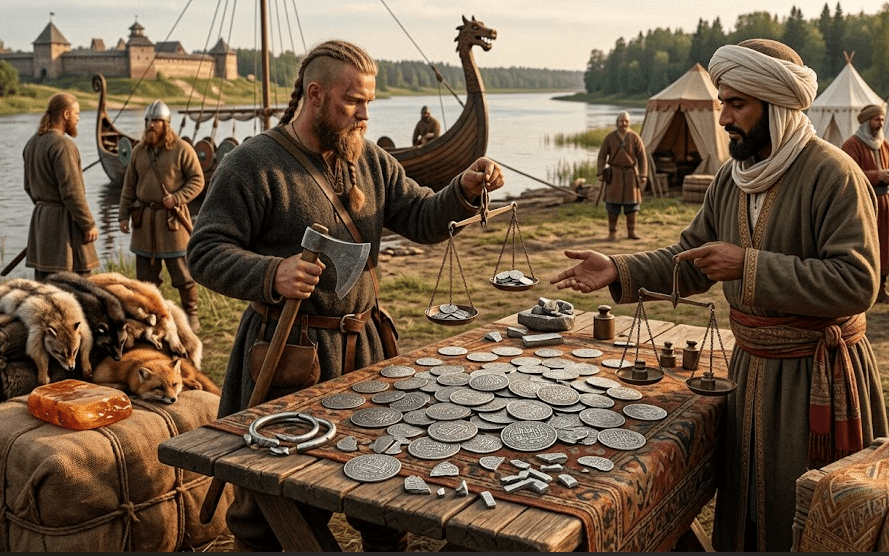
Islamic dirhams were silver coins minted across parts of the Islamic world and widely circulated through trade networks. In Viking Age contexts, they are often linked to eastern routes where Scandinavians exchanged goods such as furs, amber, weapons, enslaved people, wax, and other materials for silver. The Damhus evidence does not require every coin user in Ribe to know where the silver began. It shows that the town’s economy was connected to long-distance bullion movement.
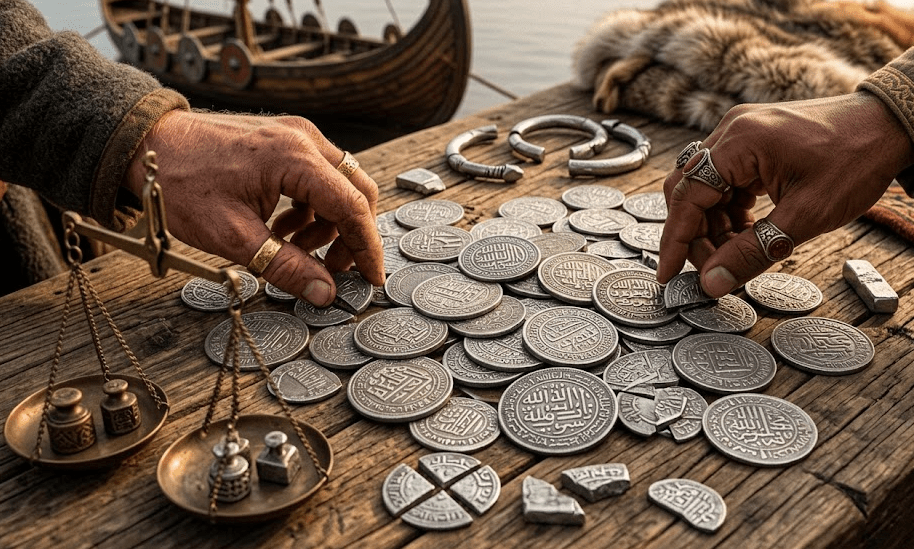
The key word is “bullion.” In many Viking Age settings, silver was valued by weight. Coins, jewelry, ingots, and fragments could be cut, weighed, melted, and reused. That made silver flexible. A dirham could function as a coin in one setting, bullion in another, and raw material for a Danish penny after melting. The Damhus coins preserve that chain in chemical form.
The academic author list itself shows the interdisciplinary nature of the work: Thomas Birch, Helle Horsnæs, Rasmus Andreasen, Claus Feveile, Stephen Merkel, Jane Kershaw, Rory Naismith, and Jens Christian Moesgaard are associated with the study. That range reflects the question being asked. Coin history now depends on numismatics, archaeology, geochemistry, isotope work, and knowledge of early medieval trade. (Aarhus University Research Portal)
The Damhus hoard should not be oversold as proof of peaceful Viking commerce alone. Islamic silver could move through trade, tribute, payment, raiding, and redistribution before reaching Denmark. The stronger claim is narrower and better supported: the earliest Danish silver pennies were not made from a purely local metal supply. They drew on recycled silver with a previous life in Islamic coinage.
That point matters because the raider image often treats Vikings as outsiders who took wealth from settled civilizations. The Damhus coins show a more complicated relationship. Viking Age communities were not just taking silver; they were weighing it, melting it, reminting it, and creating local forms of money from international material.
How Coin Dies Show Organized Production
The die evidence is one of the most practical parts of the Damhus story. A die is the engraved tool used to strike a coin design into metal. As dies wear down, they are replaced. Slight differences between designs let researchers build sequences and estimate production. In the Damhus study, at least 30 dies were identified for coins of this type, pointing to a much larger output than the surviving hoard alone. (Archaeology Magazine)
That matters for how readers understand early Danish coinage. Coin production is an organized activity. It requires metal supply, technical planning, and repeated striking. If Ribe’s mint produced large numbers of pennies, it suggests demand for standardized silver currency, not just loose bullion. The coins may have served trade, local payments, elite display, or market use. Each possibility points to a society with systems of value beyond raiding.
The date range sharpens the interpretation. Live Science reported that the hoard dates to about A.D. 830–850, more than a century before Denmark’s unification and Christianization under Harald Bluetooth. That places the coins in a politically fragmented Danish landscape, where regional power centers still had the ability to support minting. (Live Science)
That early date is one reason the hoard is so valuable. Later Viking Age coinage belongs to a different political setting. Damhus sits near the beginning of Scandinavian silver penny production. It shows that international metal flows were already part of the story at a formative moment.
Why The Raider Stereotype Misses The Money System
The Damhus hoard does not deny the violence of the Viking Age. The raid on Lindisfarne in A.D. 793 remains one of the best-known markers for the beginning of Viking activity in western Europe. Yet the money system behind Viking Age society cannot be explained by raids alone. A raiding party could seize silver, but a mint needed repeatable supply, skilled workers, dies, weighing practices, and a community willing to use the result.
That is where Islamic silver changes the question. If recycled dirham silver reached Ribe in large quantities, then Denmark’s early coinage was connected to exchange routes, bullion markets, and metal recycling. Those processes are less dramatic than raiding, but they tell us more about how wealth actually moved.
The phrase “long-distance trade” should be used carefully. The Damhus hoard does not prove that the person who struck the coin in Ribe traveled to the Abbasid world. It proves that silver of Islamic coinage origin reached the metal stream used for early Danish pennies. That is still significant. It means Ribe’s mint was connected to a chain of movement that crossed cultural, religious, linguistic, and political boundaries.
This is the value of archaeological science for Viking history. It moves the discussion away from identity labels and toward evidence. A coin from Denmark can contain metal from far away. A Norse image can be struck into Islamic-origin silver. A local mint can depend on international circulation. That combination is exactly why the Damhus hoard changes the story.
What Readers Should Verify Before Repeating The Claim
The best version of the Damhus story is specific. The hoard was found near Damhus, south of Ribe, in 2018. The academic study identifies 266 silver Viking Age coins, mostly from the KG 4 series, among the earliest reformed silver coinage from Ribe. Recent reporting says 25 coins were analyzed through X-ray fluorescence and related methods, and trace evidence showed that some coins contained substantial silver derived from Islamic dirhams. Die analysis suggests large-scale minting at Ribe. Those are the strongest source-backed details. (Archaeometry)
The weaker version would say “Vikings got all their money from the Islamic world” or “Danish Vikings directly traded these coins with Baghdad.” The evidence does not require those claims. The silver may have moved through many stages before Ribe. It may have mixed with other silver from western Europe or local hoards. It may have passed through ingots, melting pots, and market systems before becoming Danish pennies.
That limitation makes the discovery more reliable, not less interesting. The Damhus hoard shows how early Viking Age Denmark was tied into long-distance metal circulation. It shows that coinage can carry one cultural image on the surface and another economic history in its metal. It shows that Ribe was not a small northern edge of the world, but a town connected to far-reaching exchange.
For oldnorsenews.org, the cleanest article angle is this: Islamic silver in Danish Viking coins reveals long-distance trade because the metal inside the coins had already traveled through wider bullion networks before it was reminted in Ribe. That is a stronger story than a stereotype. It gives readers a Viking Age built from evidence, movement, craft, and exchange.
