
Woodstown is reopening the story of Viking Ireland because it shifts attention away from a simple raid-and-retreat narrative and toward settlement, trade, craft, riverside power, and Irish-Norwegian contact. The site sits in County Waterford, on the banks of the River Suir west of Waterford City, and was first uncovered in 2003 during archaeological investigations linked to the planned N25 Waterford City Bypass. The discovery was significant enough that the road route was moved to preserve the monument. Recent Irish-Norwegian excavation work has returned attention to Woodstown, with researchers focusing on a large structure at the heart of the Viking-period site that may be a longhouse or hall. Waterford City & County Council reported that the targeted excavation opened on June 8 and was planned to run until June 19, with support from the Royal Irish Academy, Waterford City and County Council, Abarta Heritage, The Discovery Programme, and Norway’s University and Museum of Stavanger.
Why Woodstown Matters In Viking Ireland
Woodstown matters because it did not grow into a modern city in the same way as Dublin, Waterford, Cork, or Limerick. The official Viking Woodstown site explains that the settlement was left under green fields rather than being built over by later urban development. That gives archaeologists a rare chance to study a Viking Age settlement at foundation level, with traces of houses, craft areas, enclosures, pits, postholes, stakeholes, slot trenches, hearths, and artifacts still preserved in the ground.
That preservation changes the kind of questions researchers can ask. In a long-inhabited city, later building often disturbs early layers. At Woodstown, less than 10 percent of the monument was opened through earlier archaeological excavation, and less than half of that opened area was fully excavated. Even with limited excavation, researchers recorded approximately 757 features, including pits, structural traces, and significant areas of craft and industry. The largest early features included two large parallel ditches enclosing an area about 460 meters long and 150 meters wide.
For oldnorsenews.org readers, Woodstown fits the same evidence-first approach used in Viking settlement archaeology. The story is not built from saga drama or later legend. It comes from soil traces, geophysical survey, field excavation, artifact study, and careful comparison with other Viking Age sites.
How The New Excavation Changes The Question
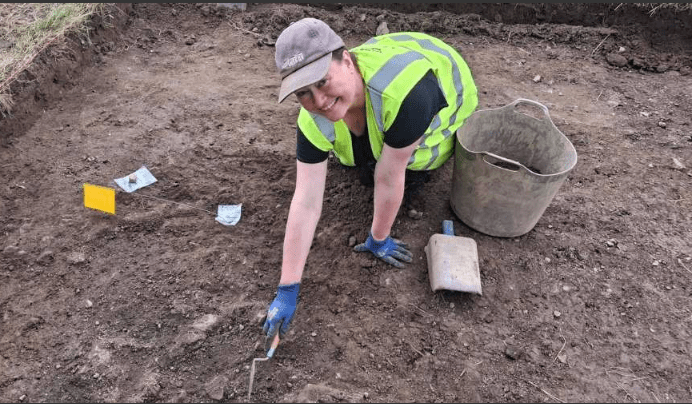
The latest excavation is focused on what researchers think may be the foundations of a significant structure revealed through geophysical survey. Waterford City & County Council described the structure as large and possibly the largest Viking structure identified so far in Ireland if confirmed. The working interpretation is cautious: it may be a longhouse or hall, and the excavation is intended to clarify how it was built and what role it played within the settlement.
Irish Heritage News reported that the structure is 18.5 meters long and may be the largest Viking building recorded in Ireland. The excavation is being carried out by Irish and Norwegian archaeologists through a joint project involving the Archaeological Museum at the University of Stavanger, The Discovery Programme, Abarta Heritage, and Waterford City and County Council, with Royal Irish Academy funding. That partnership matters because Woodstown is no longer only a local Waterford story. It is part of a wider research conversation about the Viking Age links between Ireland and Norway.
A large hall or longhouse would change how Woodstown is interpreted. Small seasonal camps can leave archaeological evidence, but a substantial central building suggests planning, social organization, and possibly leadership. It may have served a special purpose. Håkon Reiersen, an archaeologist at the University of Stavanger, told Science Norway that if the building is a longhouse, it would be the largest known Viking longhouse in Ireland. He said the team hoped to find structures and artifacts inside the building that could clarify its function.
The careful phrase is “if confirmed.” A geophysical anomaly can suggest buried structure, but excavation has to test the interpretation. Archaeologists need postholes, stakeholes, floor layers, hearth evidence, artifact patterns, and dating material before they can say more with confidence. Woodstown’s new excavation is valuable precisely because it is testing the survey evidence rather than turning a possibility into a finished claim.
Why Woodstown Was More Than A Raiding Base
The most important shift in the Woodstown story is not the size claim alone. It is the move away from seeing the site only as a raiding base. Waterford City & County Council stated that combined survey and excavation evidence suggests Woodstown was not just a base for raiding and plundering, but a substantial settlement and a center for trade, commerce, and industry.
That distinction is central to Viking Ireland. Raiding was real, and Woodstown does not erase it. Irish Heritage News reported that one object from the site is a copper-alloy or bronze fragment bearing a cross, interpreted as evidence connected to the raiding of Irish church sites by people occupying Woodstown. The same report noted objects tied to trade, metalworking, and possibly glassworking, including lead weights for measuring silver, crucibles, iron, slag, nails, rivets, a small gaming piece, a probable silver coin from Iraq, lignite bracelet pieces, charcoal, and bone.
Those finds create a more complex picture. Lead weights point to silver-based exchange. Crucibles, slag, nails, and rivets point to craft and industrial activity. A gaming piece hints at social life. Imported or non-local materials suggest wider connections. Soapstone fragments are especially useful because soapstone does not occur naturally in Ireland and was commonly used in Norway for cooking pots. Irish Heritage News reported that such material must have been brought to Woodstown by Vikings.
This is why Woodstown reopens the story rather than simply adding another Viking site to a map. The settlement shows raiding, trade, craft, and possible residence in the same landscape. A single stereotype cannot hold that evidence together.
How Geophysical Survey Changed The Site
Woodstown’s current importance depends heavily on non-invasive survey. Recent geophysical work has helped identify buried features without opening large areas of the monument. Waterford City & County Council noted that detailed geophysical and other non-invasive surveys have been guided by an expert steering committee and developed through collaboration between leading geophysicists in Ireland and Norway.
Science Norway reported that ground-penetrating radar revealed the possibility of many more buildings than researchers once believed. More than 60 structures were identified, some of which may be longhouses, pit houses, fences, embankments, or other human-made features. Archaeologist Christer Tonning, who took part in the survey work, explained that ground conditions differed from Norway and made interpretation difficult, forcing the team to work deeply through the datasets.
That technical step is easy to overlook, but it is central to responsible archaeology. A large site like Woodstown cannot be understood by excavation alone. Digging is destructive, expensive, and selective. Survey allows researchers to see patterns first, then choose targeted trenches where the evidence is strongest. The new excavation is testing one of those patterns: the large central structure that may be a hall or longhouse.
This is one reason Woodstown should be framed carefully in public history. “Ireland’s largest Viking building” is a compelling phrase, but the stronger story is the method behind the claim. Survey found the anomaly. Excavation tests it. Artifacts, dating, and structural evidence decide how far the interpretation can go.
What Readers Should Verify Before Repeating The Story
Woodstown deserves attention, but readers should avoid turning early excavation claims into certainty. The strongest verified points are clear: Woodstown was discovered in 2003 during work connected to the N25 Waterford City Bypass; the planned road route was moved to preserve the monument; earlier excavation recorded hundreds of features; the site includes houses, craft areas, trade evidence, enclosures, and one of Ireland’s richest Viking graves; the current excavation is testing a large structure that may be a longhouse or hall.
The parts that still need care are the largest-site and largest-building claims. The large structure may be the biggest Viking building recorded in Ireland, but that depends on confirmation from excavation and later analysis. The site may reshape how scholars understand the relationship between Woodstown and Waterford, but that does not mean every question about occupation, seasonality, abandonment, or population has been answered.
The best way to write about Woodstown is to keep the evidence visible. It was not only a raiding base. It was not simply a peaceful trading town. It was a Viking Age settlement on a strategic Irish river with signs of craft, commerce, imported material, silver exchange, weaponry, burial, and possible large-scale architecture. That is why Woodstown reopens the story of Viking Ireland: it makes the past harder to flatten into one image.
