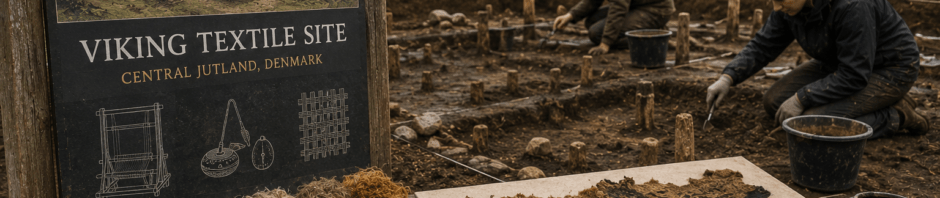
The discovery at Søften, Denmark, gives Viking history a different center of gravity. Instead of beginning with ships, weapons, and coastal attacks, the site starts with flax, pit houses, spindle whorls, loom weights, silver coins, glass beads, and a settlement plan that points to organized production. Archaeologists from Moesgaard Museum identified the site about 10 kilometers north of Aarhus, the modern city linked to Viking Age Aros, and dated it broadly to the late Iron Age and early Viking Age, around A.D. 600 to 950. The scale matters: more than 100,000 square meters and more than 80 pit houses suggest a specialized production landscape rather than an ordinary farming village. That does not erase Viking raiding. It makes the raider stereotype too small for the evidence. The more useful question is how craft labor, trade, status, and regional power worked together in Viking Age Denmark.
Why The Søften Discovery Matters For Viking Archaeology
The Søften site matters because it gives archaeologists a large, physical setting where textile production appears to have been a central activity. AP reported that Moesgaard Museum experts found an area for processing flax and more than 80 pit houses, the semi-buried structures used as workshops and dwellings during the period. Archaeologist Liv Stidsing Reher-Langberg, who led the 10-month dig, said the settlement stands apart from other settlements of the time due to its clear focus on textile production.
That detail changes the story. A single spindle whorl or loom weight can show textile work in one household. More than 80 pit houses, along with production zones and trade-related finds, suggest a bigger system. The site looks less like scattered domestic craft and more like an organized production area. That is why the discovery has drawn attention from archaeology readers far outside Denmark.
The location sharpens the point. Søften sits close to Aarhus, roughly six miles north of Denmark’s second-largest city. During the Viking Age, Aarhus was known as Aros and functioned as a major center linked to power and international trade. If Søften fed goods into that wider network, the site becomes part of a regional economy, not just a local craft zone. A strong related Old Norse News internal reference is Viking Age trade routes, since textile production makes more sense when set beside movement, exchange, and market demand.
The evidence remains archaeological, not literary. No surviving saga explains the workers at Søften. No named ruler is tied to the site by a written record. The strength of the discovery comes from the pattern of features in the ground: pit houses, tools, craft zones, and trade objects. That is exactly where careful Viking history becomes stronger than stereotype.
How Textiles Complicate The Raider Image
The popular Viking image often begins with speed and violence: longships on the horizon, raids on monasteries, warriors with axes, and silver taken from coastal communities. Those things belong in Viking history, yet they do not describe the whole society that supported expansion. Textile production forces a wider view. Cloth required plant cultivation, fiber processing, spinning, weaving, finishing, storage, exchange, and skilled labor. A society that could sustain large-scale textile work had to organize people, materials, time, and markets.
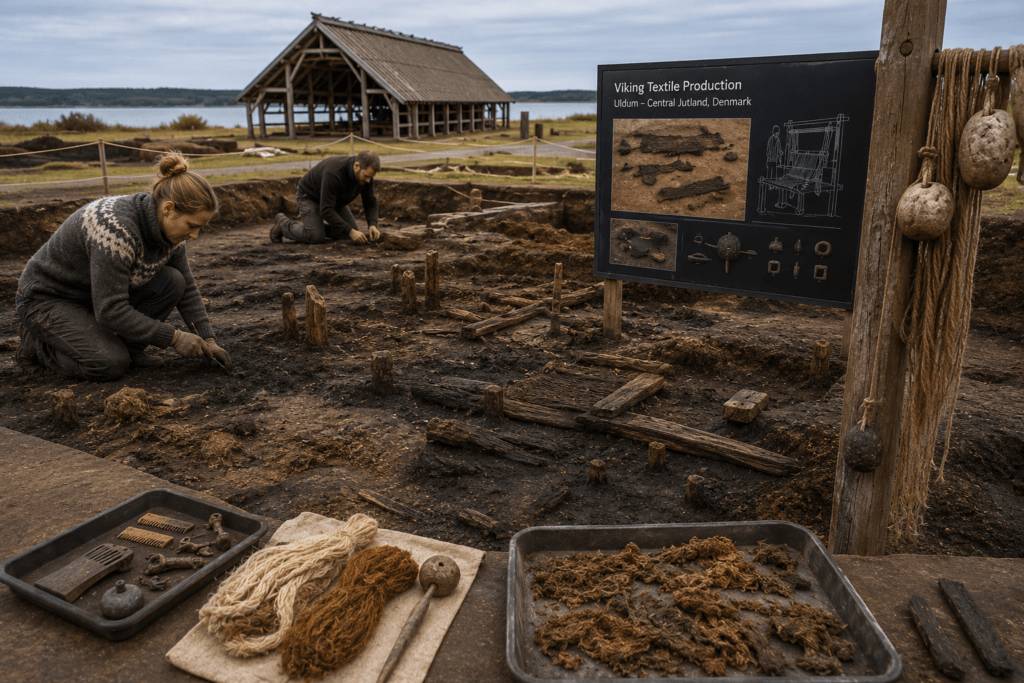
At Søften, the textile evidence includes flax processing, spindle whorls, loom weights, and pit houses. Flax is especially important because it could be turned into linen, and the transformation from plant to thread was labor-intensive. The Viking Ship Museum in Roskilde notes that flax had been used for textiles in Scandinavia since the Iron Age and that turning the plant into fibers for spinning and weaving was a long process. Its work on a flax sail for the Gislinge boat shows how technical and demanding such production could be, especially when linked to maritime material culture through Viking Age flax weaving.
That is why the “raider” label becomes misleading when used alone. Raids required ships, clothing, ropes, sails, bags, tents, domestic supplies, and trade goods. Textiles were part of the infrastructure behind movement and exchange. A warrior’s cloak, a ship’s sail, and a merchant’s goods all depended on craft systems that are less dramatic than battle stories but central to how Viking Age societies worked.
The Søften discovery does not prove that every textile made there went into sailcloth or long-distance commerce. The reported evidence points to textile production, flax processing, and a larger market connection; future carbon dating and pollen analysis may refine what archaeologists can say about the specific materials. That boundary matters. Good heritage writing should not turn one site into a total explanation of Viking society. It should show why one discovery improves the questions historians ask.
What Pit Houses Reveal About Organized Work
Pit houses are small sunken structures, often visible archaeologically through changes in soil, postholes, floor layers, and artifact concentrations. At Søften, their number is the striking fact. More than 80 pit houses across a large site suggest repeated, organized use of workshop space. AP reported that experts identified separate production and craft areas and one residential home, a pattern that may point to oversight by a powerful person with control over resources and production.
This does not mean archaeologists can name the person who controlled the site. It means the layout invites a social interpretation. A production area of that scale would have needed raw materials, skilled workers, food support, storage, distribution, and access to buyers. Those needs fit poorly with the idea of loosely organized raiding bands as the main explanation for Viking Age power.
The single residence reported at the site is especially interesting. If most structures were tied to production, and one dwelling occupied a different role, then the settlement may reflect hierarchy. Someone may have coordinated work, controlled material flows, or claimed rights over finished goods. That is not a fantasy of royal administration; it is a cautious reading of spatial organization and artifact patterning.
The National Museum of Denmark’s “Fashioning the Viking Age” project gives useful background for why textile evidence deserves serious attention. The project, created with the Centre for Textile Research at the University of Copenhagen and Land of Legends in Lejre, aimed to produce archaeologically grounded interpretations and reconstructions of Viking Age textiles and clothing through Viking textile research.
Søften fits that broader movement in Viking studies. Researchers are not just looking for spectacular objects. They are studying production systems, craft choices, raw materials, and the social meaning of clothing. A brooch, bead, cloak, tunic, or sail can carry evidence of status, identity, labor, and exchange. Textile tools are modest objects, yet their patterns can expose the structure of a whole community.
Why Aros And Trade Networks Matter
Moesgaard Museum historian Kasper Andersen connected the Søften site to a wider economic and political picture around Aros. AP reported his view that goods and resources likely moved from countryside settlements such as Søften into a larger trade network. That matters because Viking Age Denmark was not made only of raiding parties and isolated farms. It included trading centers, elite households, craft zones, rural producers, and routes that linked local production to distant buyers.
Aarhus gives the Søften discovery its regional frame. Aros was a key place in eastern Jutland, and its role as a center of trade makes nearby production sites more meaningful. Textile production on this scale needs demand. A local settlement could use cloth, yet more than 80 pit houses and a dedicated flax-processing area point to output beyond simple household need. Smithsonian’s recent coverage framed the discovery as a direct challenge to the “uncivilized barbarian” stereotype and noted the site’s massive footprint of more than one million square feet.
Trade evidence at Søften includes silver coins, glass beads, and pottery. These finds do not all mean the same thing. Silver coins may speak to exchange, value, and contact. Glass beads can point to personal adornment, trade, or status display. Pottery can speak to daily use, storage, production, and settlement activity. Together, they create a picture of a site connected to more than textile tools alone.
This is where Viking history becomes more interesting than mythic shorthand. The same society that produced raiders produced traders, farmers, craftspeople, navigators, metalworkers, and textile specialists. The raiding stereotype takes one visible activity and turns it into a total identity. Søften pushes back through material evidence.
The point is not to make Vikings peaceful by replacing one false image with another. Viking expansion included violence, enslavement, settlement, trade, diplomacy, and craft. The site helps readers see how those activities could belong to the same historical world.
How The Site Separates Evidence From Modern Myth
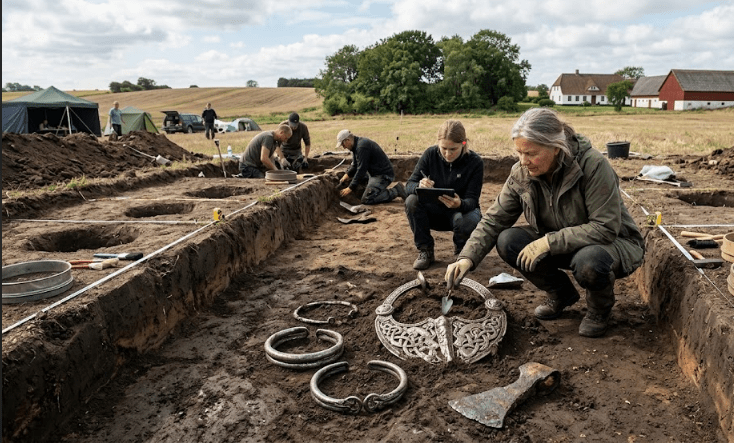
Modern Viking imagery often blends archaeology, medieval texts, romantic art, fantasy fiction, and nationalist misuse. That mix can be attractive, but it can blur the difference between evidence and invention. Søften is useful because it is not built from later saga memory or dramatic battlefield storytelling. It comes from excavation, artifact analysis, settlement planning, and scientific follow-up.
The reported next steps matter. Reher-Langberg has said future carbon dating and pollen analysis may answer questions about what kind of textile production took place at the site. Those methods can refine dating and environmental context. Carbon dating can help place organic material within a clearer chronological range. Pollen analysis can help reconstruct plants and landscape conditions. For a site tied to flax processing, that kind of work could deepen the interpretation rather than simply confirm a headline.
That is the right kind of uncertainty. It does not weaken the discovery. It shows how archaeology works. A first report can identify the scale, location, major features, and artifact categories. Later analysis can narrow the details. Readers should be cautious when any Viking discovery is presented as if every question has already been answered.
The best reading of Søften is source-sensitive: archaeologists have identified a very large production site with strong textile evidence near a major Viking Age trade center. The site appears specialized and organized. It may have been overseen by a powerful individual. It likely connects to broader trade networks. The exact materials, production volume, labor structure, and market reach still need further study.
That cautious framing protects the story from overclaiming. It lets the discovery challenge the raider stereotype without turning archaeology into marketing copy.
What Readers Should Verify Before Repeating The Story
The Søften site deserves attention because it gives Viking history a productive new anchor: organized craft labor. Yet readers should verify the basic facts before repeating broad claims. The strongest details are the location near Aarhus, the date range of A.D. 600 to 950, the 100,000-square-meter scale, more than 80 pit houses, the flax-processing area, and textile tools such as spindle whorls and loom weights. Those are source-backed details reported from the Moesgaard Museum excavation through current news coverage.
The weaker claims are the sweeping ones. The site does not prove that Vikings were never raiders. It does not prove that every nearby settlement was organized around textile production. It does not identify every worker, owner, buyer, or finished product. It does not replace the written record, ship finds, burial evidence, or urban archaeology. It adds a major piece to the wider puzzle.
That addition is still powerful. Søften shows that Viking Age Denmark had the capacity for specialized production close to a trade center. It points to skilled labor, resource control, and market demand. It gives historians a better way to discuss the people who processed flax, spun thread, worked looms, managed production, traded goods, and supported the maritime society remembered so often through raids.
For oldnorsenews.org, the strongest article angle is not “Vikings were misunderstood” in a vague sense. The stronger angle is precise: Denmark’s Søften textile site changes the raider stereotype by showing a large, organized production landscape tied to craft, trade, and regional power. That is how archaeology improves public history: not by making the past simpler, but by making the evidence harder to ignore.
