
The Herlaugshaugen ship burial on Leka, an island off the coast of Namdalen in Trøndelag, Norway, pushes Viking traditions earlier because it shows that monumental ship burial was already part of Scandinavian elite culture around A.D. 700. That date falls about a century before the conventional Viking Age opening around A.D. 800, and it changes how readers should understand the development of seafaring power, burial display, and maritime identity in northern Europe. A peer-reviewed study in Antiquity, published by Cambridge University Press, reports that excavations in 2023 recovered iron clinker nails and wooden fragments from Herlaugshaugen, identifying one of the earliest ship burials in Scandinavia. The site does not prove that the Viking Age began earlier. It shows that some practices later associated with Viking power had deeper roots in the seventh and early eighth centuries. Antiquity’s Herlaugshaugen study gives oldnorsenews.org a strong evidence-based way to separate archaeology from myth.
Why Herlaugshaugen Matters For Viking Archaeology
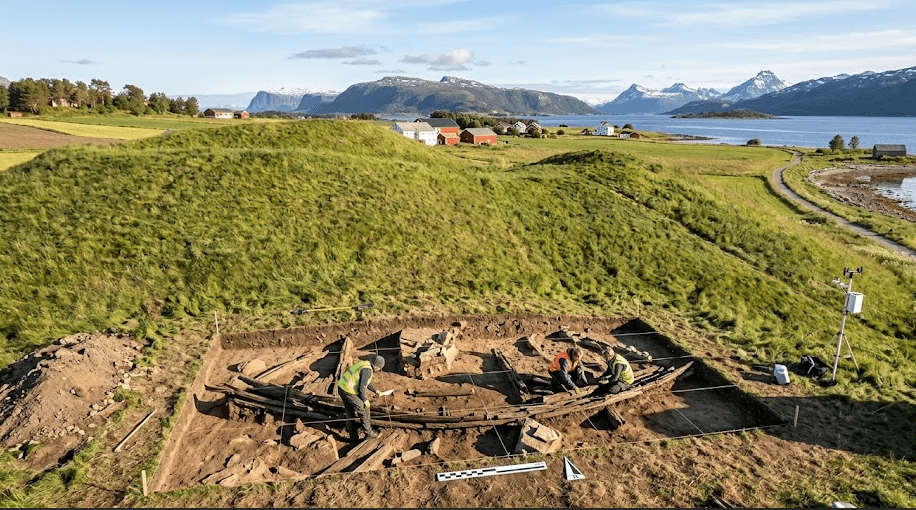
Herlaugshaugen has long stood out in Norwegian archaeology because of its size, landscape position, and association with local tradition. The mound lies on Leka, a small island on the coast of Namdalen, and has been linked in later legend to Herlaug, a pre-Viking regional king. That legend helped keep the mound visible in cultural memory, but the new research is valuable because it moves the discussion from storytelling to material evidence. The 2023 excavation recovered iron clinker nails and preserved wood fragments, allowing researchers to confirm that the mound once contained a ship.
The ship evidence is modest in appearance but large in meaning. Most buried wood disappears in Norway’s soil conditions over time, so iron rivets or nails can become the clearest surviving trace of a vessel. Archaeology Magazine reported that Geir Grønnesby of the Norwegian University of Science and Technology and colleagues recovered 29 iron rivets from the mound, with small amounts of wood still attached to some nails. Radiocarbon dating of the wood placed the ship around A.D. 700. Early ship burial evidence gives the site its chronological force.
That date matters because famous Scandinavian ship burials are often associated with later Viking Age examples. The Oseberg and Gokstad ships, for example, belong to the ninth century. Herlaugshaugen shows that the idea of burying elite dead with a ship was not a sudden Viking Age invention. It was already developing in parts of Scandinavia before the classic Viking expansion into the North Atlantic and western Europe.
For oldnorsenews.org readers, this is the useful distinction: Herlaugshaugen does not make the people buried there “Vikings” in the later raid-and-settlement sense. It shows that the maritime social traditions later linked to Viking elites were forming earlier. That makes the site a bridge between pre-Viking Scandinavian society and the more familiar Viking Age world.
How The Date Changes The Ship Burial Timeline
The strongest claim from Herlaugshaugen is chronological. Antiquity describes the mound as a ship burial dating to the end of the seventh or beginning of the eighth century. The journal’s public summary says radiocarbon dating of wooden ship remains places the burial around A.D. 700, making it one of the earliest ship burials in Scandinavia and around 100 years earlier than many better-known Scandinavian examples. Scandinavia’s early ship burial also frames the site as a chronological bridge between early ship burials in England and later Scandinavian ship graves.
That bridge is important because Sutton Hoo in East Anglia dates to the early seventh century. The British Museum’s Sutton Hoo account describes Basil Brown’s 1939 excavation of a great ship burial in Suffolk and places the burial in the early A.D. 600s, when the site belonged to the Anglo-Saxon kingdom of East Anglia. Sutton Hoo ship burial shows that elite ship burial was not limited to Scandinavia in this earlier period.
Before Herlaugshaugen, the gap between early Anglo-Saxon ship burials and later Norwegian Viking Age ship burials could make the Scandinavian tradition look later or more regionally limited. Herlaugshaugen narrows that gap. It places monumental ship burial in northern Norway before the classic Viking Age, suggesting that maritime display, elite burial, and ship symbolism were already part of a wider northern European pattern.
The site also matters because of geography. Leka is far north of many famous ship burial discussions, which often focus on southern Scandinavia or eastern England. A monumental ship mound on Leka suggests that northern coastal communities were not marginal spectators in maritime culture. They may have been active participants in seaborne networks earlier than older models allowed.
Why The Mound Points To Maritime Power Before The Viking Age
A ship burial is never just a boat in the ground. It represents labor, timber, iron, skilled construction, social authority, and ritual choice. Building a ship required specialized knowledge. Raising a mound over it required coordinated work. Choosing a ship for burial signaled that maritime identity had social value. Herlaugshaugen matters because it places that whole system before the standard Viking Age timeline.
The Antiquity article argues that Herlaugshaugen expands understanding of Leka and its maritime connections in the seventh and eighth centuries, with the island possibly acting as a node in a broader network. That language is cautious but important. A node is not an empire or a capital. It is a place where movement, exchange, status, and geography meet. Leka’s coastal position gave it access to sea routes linking northern Norway with other regions.
The burial also suggests that elite status and seafaring identity were connected before the period of famous Viking raids. The ship under the mound was not a practical object hidden in storage. It was transformed into a monument. That act turned maritime technology into social memory. The mound would have marked the landscape and told later communities that important people, shipbuilding knowledge, and sea power belonged to that place.
This is where Herlaugshaugen changes the public story. The Viking Age is often introduced through violence abroad, especially raids on monasteries or settlements. Herlaugshaugen points to an earlier internal development: coastal elites were already using ships as symbols of power at home. Later Viking expansion did not come from nowhere. It rested on older traditions of navigation, shipbuilding, status display, and maritime contact.
The site also connects well with Old Norse News coverage of Viking Age archaeological sites, where physical remains give readers a firmer foundation than saga memory alone.
How Archaeologists Separate Legend From Evidence
Herlaugshaugen has been tied to the story of King Herlaug, a semi-legendary figure associated with Namdalen. That tradition is culturally important, but archaeology has to test it rather than repeat it as fact. The new dating creates tension with the legend because the burial appears to be earlier than the traditional story linked to Herlaug. That does not make the legend worthless. It means the mound’s material history and its later storytelling history are not the same thing.
Popular Mechanics reported that the new dating places the burial roughly 80 years before the death connected with the legendary King Herlaug tradition, making the literal version of the story unlikely. That kind of result is exactly why sites like Herlaugshaugen are useful for oldnorsenews.org. They show how Norse and Scandinavian heritage can preserve memory around a place while archaeology clarifies what can actually be demonstrated.
The evidence at Herlaugshaugen is concrete: clinker nails, wood fragments, excavation context, and radiocarbon dating. The interpretation is more cautious: one of Scandinavia’s earliest known ship burials, tied to elite display and maritime networks around A.D. 700. The legend is a separate layer: a later narrative that helped give the mound meaning in regional memory.
Good Viking history needs all three layers kept apart. The artifact evidence tells us a ship was there. The date tells us the burial belongs to the late seventh or early eighth century. The legend tells us later people remembered the mound as an important place. Mixing those layers too quickly creates false certainty.
This is especially important for Norse heritage writing because later medieval texts often shaped how people imagine the earlier past. Sagas, royal traditions, and local legends can preserve valuable clues, but they are not excavation reports. Herlaugshaugen is a strong case study in how archaeology can respect tradition without letting tradition control the evidence.
Why The Sutton Hoo Comparison Matters
The Sutton Hoo comparison gives Herlaugshaugen a wider northern European setting. Sutton Hoo is not Viking, but it is a major early medieval ship burial. It shows that elite ship burial was part of a broader maritime aristocratic culture around the North Sea. Herlaugshaugen’s date around A.D. 700 helps close the chronological space between East Anglian examples and later Norwegian ship graves.
That connection does not mean one tradition simply copied another. Archaeology rarely supports such a simple line. It means communities around the North Sea and Scandinavian coasts were using ships, mounds, imported objects, and maritime symbolism to express status in related ways. These regions were connected by sea, and sea contact could move ideas as well as goods.
Sutton Hoo also helps readers understand why ship burials matter beyond the ship itself. The British Museum’s Sutton Hoo account describes a ship burial with extraordinary early medieval craftsmanship and a setting connected to East Anglian power. Herlaugshaugen has not produced the same famous treasure display, but it shares the broader principle: a ship could be used to mark rank, memory, and seaborne authority.
The comparison strengthens the article’s SEO angle because it helps answer a reader’s deeper question: why does one mound in Norway matter outside Norway? It matters because it reshapes the timeline of ship-burial traditions across northern Europe. It suggests that northern Norwegian coastal elites were part of maritime developments that linked Scandinavia, Britain, and continental routes before the Viking Age became visible in western written sources.
What Herlaugshaugen Shows About Early Scandinavian Networks
The most interesting part of the Herlaugshaugen research may be its network argument. The Antiquity abstract states that the mound expands understanding of the region and its maritime connections in the seventh and eighth centuries, and argues that Leka may have been a node in a wider network. That language points away from isolated local history and toward connected coastal communities.
Leka’s position helps explain why. Islands and coastal routes could function as practical stopping points, lookout places, trading contacts, and social centers. A community with the resources to stage a monumental ship burial likely had access to wealth, labor, and maritime skill. Those conditions fit a world where power was not limited to inland farms or later royal centers.
The site also encourages a more careful use of the word “Viking.” The people connected to Herlaugshaugen were not necessarily Vikings in the later sense of overseas raiders, settlers, or traders active from the late eighth century onward. Yet they lived in a society where ships already carried political and ritual meaning. That makes them part of the prehistory of Viking traditions.
This helps explain why the discovery is more than a date correction. Herlaugshaugen suggests that ship burial, elite monumentality, and maritime networks were already mature enough to support a major mound around A.D. 700. The Viking Age later amplified those patterns through raiding, settlement, trade, and state formation, but the foundations were already being laid.
What Readers Should Verify Before Repeating The Claim
The strongest claim is that Herlaugshaugen is one of the earliest confirmed ship burials in Scandinavia, dated to around A.D. 700 through wooden remains associated with iron clinker nails. The study was published in Antiquity and involved researchers including Geir Grønnesby, Hanne Bryn, Lars Forseth, Bente Philippsen, Knut Paasche, Christian Løchsen Rødsrud, and Arne Abel Stamnes. The site is on Leka, off the coast of Namdalen in Trøndelag, Norway.
The weaker claim would be that Herlaugshaugen proves the Viking Age started a century earlier. It does not. The Viking Age is still usually framed around later overseas activity beginning in the late eighth century. Herlaugshaugen shows that a burial tradition later associated with Viking elites had earlier Scandinavian roots. That is a narrower claim, but it is stronger because the evidence supports it.
Readers should also separate the mound’s legendary association with King Herlaug from the archaeological date. The legend may explain why the site stayed meaningful in local memory, but the excavation and radiocarbon evidence are what identify the earlier ship burial. That distinction makes the story more trustworthy.
For oldnorsenews.org, the best angle is precise: Herlaugshaugen pushes Viking traditions earlier by showing that monumental ship burial and maritime elite display were already present in Norway around A.D. 700. It does not turn pre-Viking Norway into the Viking Age. It reveals the older coastal world from which Viking Age traditions later emerged.
