
Hunnestad Monument tours reopen the Late Iron Age image-stone question because they ask visitors to read carved pictures, runes, lost stones, museum reconstruction, and religious transition together. Sweden’s National Heritage Board lists Archaeology Day at Historiska museet in Lund for Sunday, August 30, 2026, from 12:00 to 17:00, with short guided tours of the Hunnestad Monument at 12:00, 13:00, 14:00, 15:00, and 16:00. The listing calls it Skåne’s most powerful monument from the transition between the Late Iron Age and the early medieval period. That public program gives oldnorsenews.org a timely way to explain why image stones should not be treated as simple myth illustrations. (Archaeology Day at Historiska Museet)
Why The Hunnestad Monument Matters Now
The Hunnestad Monument matters now because it brings together several problems that define Viking Age interpretation. Historiska museet at Lund University dates the monument to around AD 985–1035 and says it originally stood at Hunnestad, about ten kilometers northwest of Ystad. This was the same period when many runestones were raised in the Scanian lands.
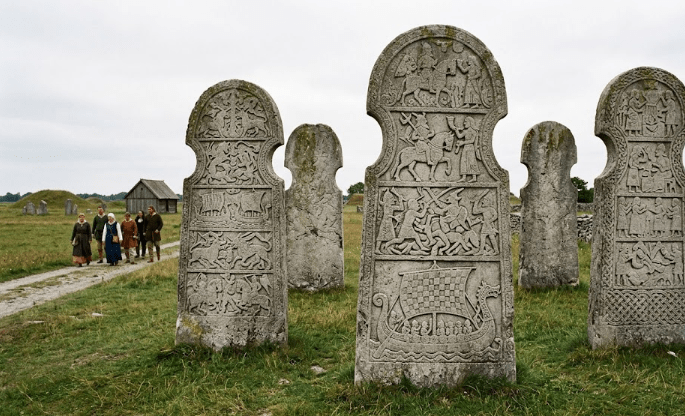
The monument originally consisted of eight stones. Three were image stones, two were runestones, and three were uncarved standing stones. Four of the five carved stones now stand in the museum’s glass entrance, while one carved stone remains lost. The August 2026 tours therefore do not simply present a complete object. They present a monument rebuilt from survival, loss, early drawings, reuse, rediscovery, and interpretation.
That is exactly why Hunnestad matters. It shows how late Viking Age images survive as fragments of public memory rather than as fully explained stories.
What The August 2026 Tours Add
The 2026 Archaeology Day tours add a public-history frame. The National Heritage Board says the museum will offer free admission all day and short tours every full and half hour. The Hunnestad tours run for about 15 to 20 minutes and focus on the monument’s history, scattering, reuse, rediscovery, and current display.
That format matters because image stones need explanation. A visitor can see a figure, animal, cross, or runic text, but the meaning rarely sits on the surface. A guided tour can show where the evidence is firm and where interpretation begins.
The museum entrance also changes access. The National Heritage Board notes that the monument is now available to interested visitors around the clock because of its position in the glazed entrance. That visibility makes Hunnestad a stronger teaching object, not only for museum visitors but also for anyone thinking about how public archaeology should handle uncertainty.
Why Image Stones Are Not Simple Pictures
Image stones can look easy to read because they show recognizable shapes. Yet Historiska museet’s broader explanation of picture stones warns that carved images can be difficult to decipher. Such stones may resemble runestones, but instead of depending only on runic inscriptions, they use pictures that may work like panels, signs, or compressed stories.
This is the core Hunnestad question. The monument includes runes and images, but the images do not behave like captions. A rider, animal, axe-bearing figure, cross, or monster may point toward myth, status, Christian influence, elite travel, local memory, or several meanings at once.
That is why the tours reopen the image-stone question. They invite visitors to ask how pictures worked in a society where writing, memory, power, and religious change overlapped.
How The Monument Was Lost And Rebuilt
Hunnestad’s modern story begins with early documentation. Historiska museet explains that the Danish antiquarian and scholar Ole Worm, who lived from 1588 to 1654, had the monument drawn in the 1620s. Magnus Dublar Rönnou, who lived from 1665 to 1735, drew it again in 1716.
Those drawings matter because the stones did not stay safely in place. At some point after Rönnou’s drawing, probably during land redistribution in Skåne, the monument was moved. Two stones disappeared, and one was broken. In 1814, broken parts were found in a stone fence. Another stone appeared by chance in 2020 in an old bridge foundation.
The early drawings now help researchers understand the lost and damaged parts. They also remind visitors that heritage depends on documentation. Without Worm and Rönnou, scholars would know far less about the missing image stone and the monument’s original arrangement.
Why The 2020 Rediscovery Changed The Story
The 2020 rediscovery changed the story because one supposedly lost image stone returned to study after roughly three centuries. Arkeologerna, part of Sweden’s National Historical Museums, reported that archaeologist Axel Krogh Hansen found the stone during ordinary trench monitoring before sewer-line work outside Ystad. The stone had likely been reused in an early eighteenth-century bridge foundation.
The rediscovered stone shows a horned, deer-like animal with tusks and claws. Historiska museet says the motif is not securely identified. One theory links it with Eikthyrnir, the stag associated in later Norse tradition with Valhalla and the world tree. However, the museum’s own wording remains cautious.
This is where public interpretation must be careful. A motif can resemble later mythic material without proving that the carver intended one specific myth scene. The rediscovery therefore adds evidence, but it also adds interpretive responsibility.
Why The Monument Is A Family Memory Site
The Hunnestad Monument was not only an image display. It was also a family memory site. One runestone inscription states that Åsbjörn and Tumme raised the stone after Roe and Lekfröd, the sons of Gunne Hand. Another runestone says that Åsbjörn raised a stone after Tumme, also identified as the son of Gunne Hand.
Those names matter because they pull the images into a social setting. The monument did not simply present mythic motifs for decoration. It commemorated people, family lines, and probably local status. Historiska museet notes that Gunne Hand appears on another runestone from the region, where he is associated with ownership of “Gussnava,” perhaps a local large farm.
That context makes the image-stone question more complex. The figures may speak about myth, but they also stand beside family memory, land, and elite display. Hunnestad therefore asks readers to connect picture, text, and local power.
Why The Axe Figure Remains Difficult
One of the stones shows a figure with an axe. The inscription belongs to the memorial context, but the image has generated several interpretations. Historiska museet notes that the axe was a status weapon in the Viking Age and suggests that Roe and Lekfröd may have been important warriors.
Other interpretations have also appeared. The museum lists possible readings that include a shield-maiden, Saint Olaf, Odin, and Tyr. A currently popular theory identifies the figure as a Varangian, a Scandinavian warrior in Byzantine imperial service at Constantinople. Historiska museet explains that Varangians carried axes on the right shoulder and wore long blue silk-brocade coats, matching features inferred from the damaged figure.
That range of interpretations is the lesson. The figure matters not because one answer is obvious, but because several evidence-based readings compete. Tours can help visitors see why scholars weigh weapon type, clothing, posture, inscription, period, and comparative material.
Why Byzantine Warriors Enter The Discussion
Byzantine warriors enter the discussion because Hunnestad may point toward Scandinavian connections far beyond Skåne. Historiska museet’s guided-tour description explicitly says visitors encounter Byzantine warriors, puzzling mythological motifs, and signs of a new religion. That does not mean every Hunnestad figure must represent a documented person who served in Constantinople. It means the monument belongs to a world where late Viking Age elites knew and valued distant references.
A Varangian reading would make the axe figure a sign of travel, service, prestige, and foreign-style status. Yet the same figure still stands inside a local memorial monument. That tension matters. Hunnestad may compress international ambition and regional family identity into one carved surface.
For oldnorsenews.org readers, this fits a larger theme: Viking Age power often worked through remembered journeys, not only through home landscapes. A carved warrior could tell a community that the commemorated dead belonged to a wider world.
Why The Cross Complicates Religious Transition
Another Hunnestad stone shows a runic inscription and a Greek cross with a small swastika, a common symbol of the time. Historiska museet explains that the cross may indicate the arrival of Christianity. Yet it also notes that the cross is not cut as deeply as the runes, which has led some researchers to suspect that it may have been added later.
That detail matters because religious transition was not always tidy. A monument could carry older imagery, Christian signs, family memory, and later modifications. The presence of a cross does not automatically erase older symbolic language. Nor does a mythic-looking image prove that the whole monument remained fully pre-Christian.
Hunnestad sits at the transition between the Late Iron Age and the early medieval period because that transition appears in stone. The monument does not offer a clean before-and-after timeline. It shows overlapping signs.
Why Mythological Motifs Need Source Caution
Hunnestad includes images that invite mythological reading. The rider on a wolf-like animal has often been interpreted as Hyrrokkin, the giantess who appears in Snorri Sturluson’s thirteenth-century account of Baldr’s funeral. According to that later text, she rides a wolf and uses a serpent as a rein.
The problem is not that this interpretation is impossible. The problem is that the text is later than the stone. A late Viking Age image from Skåne cannot simply become an illustration for a medieval Icelandic prose source without careful reasoning.
The same caution applies to the rediscovered animal stone, which has been connected with Eikthyrnir, and to the still-lost stone that may have shown a wolf and face mask or sun motif. These readings may be useful comparisons. They should not become instant certainty.
That is why Hunnestad belongs beside Old Norse News coverage of how archaeologists separate Norse myth from Viking history. The monument rewards comparison, but it punishes overconfidence.
Why The Still-Lost Stone Still Matters
One carved Hunnestad stone remains lost. That absence matters because it keeps the monument incomplete. Historiska museet says Worm’s and Rönnou’s drawings still give researchers a useful picture of the missing motif. The lost stone appears to have shown a wolf and a face mask or possibly a sun.
The museum notes possible connections with Fenrir or Sköll, the wolf that pursues the sun in later Norse mythology. Again, the point is not to declare a final answer. The point is that early drawings preserve enough information to keep the missing stone inside the interpretive conversation.
A lost object can still shape historical understanding when earlier records exist. At Hunnestad, absence becomes evidence of another kind. It shows why old antiquarian drawings, museum records, and archaeological reports remain essential for Viking Age research.
Why Color Reconstruction Requires Care
The Hunnestad display also raises questions about color. Historiska museet explains that three stones have carvings filled with red paint, but this modern highlighting does not necessarily show how the stones originally looked. At the same time, the museum notes that Viking Age stones may have been painted.
Conservation work on the newly rediscovered image stone included analysis for possible color traces using pXRF, a method that uses X-rays to identify elements in an object. The results did not show clear traces of pigments on that stone. Still, the museum’s glass cube includes reconstructions outside the glass showing how the stones may have looked with colors available in the Viking Age.
That approach is useful because it separates evidence from reconstruction. Visitors can see the carving, the modern display, and a possible color interpretation without confusing them. Hunnestad therefore teaches how museums can make the past visible while marking uncertainty.
Why Museum Display Changes The Monument Again
The Hunnestad Monument has changed meaning several times. It began as a late Viking Age memorial and image monument near Hunnestad. Later, some stones moved, disappeared, broke, or became building material. In 1912, several stones entered Historiska museet, then housed in Kungshuset. In 1918, they stood in the museum’s runestone hall at Krafts torg. In 1952, they moved to Kulturen.
Historiska museet reports that the monument returned to the museum in 2024 and was installed in the entrance on specially built foundations. The newly recovered 2020 stone is now displayed publicly there for the first time.
This movement matters because display is never neutral. A stone in a field, a bridge foundation, a castle park, a museum hall, and a glass entrance each tells a different story. The 2026 tours reopen the monument because they explain not only what the stones meant around AD 1000, but also how later centuries changed them.
Why Skåne’s Position Matters
Skåne’s position matters because Hunnestad belonged to a region shaped by Scandinavian, Danish, and later Swedish histories. In the late Viking Age, the Scanian lands formed part of a wider Danish cultural and political world. The monument’s style, runes, images, and memorial formulae should be read within that southern Scandinavian setting.
This helps explain why Hunnestad does not fit a narrow Norway-centered Viking story, even though it still belongs on oldnorsenews.org. Old Norse history spans language, belief, trade, memory, and elite display across Scandinavia and the North Atlantic. Hunnestad contributes by showing how southern Scandinavian monuments combined image and inscription during a period of religious and political change.
The site also reminds readers that “Viking” evidence varies by region. Skåne’s image stones, runestones, and memorial landscapes do not need to look like Norwegian ship burials to matter.
Why Image Stones Resist Easy SEO Answers
Image stones resist easy SEO answers because they rarely allow one-word explanations. A rider may be Hyrrokkin, but the evidence must pass through later texts, comparison, style, and context. An animal may suggest Eikthyrnir, but the motif remains uncertain. A cross may indicate Christianity, but carving depth raises questions about timing. An axe figure may suggest Varangian service, but other interpretations remain possible.
This complexity is the article’s strongest value. Readers do not need a fake final answer. They need a method. Hunnestad teaches them to ask who raised the stones, when they stood, where they stood, what the inscriptions say, what the images show, how the stones moved, and which interpretations remain tentative.
That method makes image-stone research more reliable. It also protects Viking heritage from mythic overreach, nationalist misuse, and decorative fantasy.
What Readers Should Verify Before Accepting Big Claims
Readers should verify several points before accepting dramatic claims about Hunnestad. First, the monument dates to around AD 985–1035, not to a vague “ancient Norse” period. Second, it originally had eight stones, but only four carved stones are on display today and one carved stone remains lost.
Third, several mythological readings remain interpretations, not certainties. The rider may be Hyrrokkin, the horned animal may connect with Eikthyrnir, and the lost wolf-and-sun motif may relate to Ragnarök traditions. However, the evidence does not turn these possibilities into fixed labels.
Fourth, museum reconstructions of color show possible appearances, not documented original paint schemes for every stone. Finally, the 2026 tours present the monument as a research and interpretation problem, not as a solved mythological code.
Those limits make Hunnestad more interesting, not less.
Why The Tours Reopen The Question
The Hunnestad Monument tours reopen the Late Iron Age image-stone question because they bring a difficult monument back into public conversation at the right time. The stones combine family memory, runic text, elite status, mythic-looking motifs, Christian signs, loss, rediscovery, and museum reconstruction.
They also show how archaeology works when evidence survives unevenly. One stone returned from a bridge foundation in 2020. Another remains missing. Early modern drawings preserve lost information. Museum conservation checks pigment evidence. Modern tours explain possible meanings without needing to flatten them into certainty.
That makes Hunnestad valuable for Viking history today. It asks readers to treat images as evidence, not decoration. It asks them to respect late sources without forcing them onto earlier carvings. It asks them to see Christian transition as overlap rather than instant replacement.
Above all, Hunnestad shows that late Viking Age image stones still have questions to ask. The August 30, 2026 tours in Lund matter because they put those questions directly in front of the public.
