
Anundshög makes Viking-Age power visible because its landscape turns authority into scale, alignment, road control, burial memory, and stone-built display. Sweden’s National Heritage Board lists Archaeology Day at Anundshög for Sunday, August 30, 2026, from 10:00 to 16:00, at Anundshög 5 in Västerås, with guided tours, lectures, family activities, excavation demonstrations, and Viking Age craft. The listing describes Anundshög as one of Sweden’s foremost ancient monument areas and identifies it as an important Iron Age power center. The large mound, ship settings, runestone road, grave field, and Badelundaåsen ridge together show why power in the Viking world was not only held by people. It was built into landscapes. (Archaeology Day at Anundshög)
Why Anundshög Matters Now
Anundshög matters now because the August 2026 Archaeology Day program gives visitors a public reason to look closely at how monumental landscapes communicated power. The site is not simply a large mound with a dramatic name. It brings together burial, movement, law, memory, and elite display in one of Sweden’s most visually powerful Iron Age settings.
The official Anundshög visitor site describes the area and Badelundaåsen as one of Sweden’s foremost ancient sites. It also says the countryside was a cultural center for western Mälardalen and one of the hubs of trade during the Viking Age. That wider context matters because a mound only becomes politically meaningful when it connects with roads, farms, gatherings, graves, and memory.
For oldnorsenews.org readers, the site offers a useful correction to a familiar Viking image. Ships mattered, but not only at sea. Stone ships, burial mounds, runestones, roads, and thing sites could make power visible without launching a fleet.
Why The Mound Dominates The Landscape
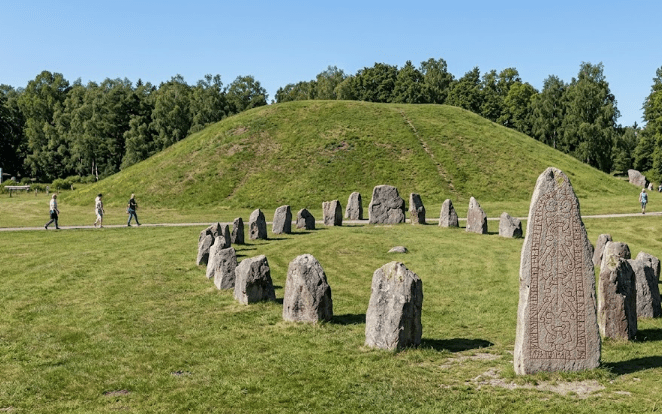
The great mound dominates the site physically and symbolically. The official Anundshög page calls it Sweden’s largest burial mound and gives its height as 9 meters with a diameter of 64 meters. The Swedish-language site gives the diameter as 64–68 meters. The grave itself has not been excavated, but dating of an underlying hearth suggests the monument was built sometime between the 5th and 11th centuries AD.
That broad date range matters. It prevents a too-simple claim that the mound belongs neatly to one named Viking king, one exact funeral, or one single political moment. The site instead belongs to a long Iron Age and Viking Age landscape where power accumulated over generations.
A mound of this size required organized labor. People had to gather material, shape the mound, control the site, and make the monument visible. That work itself expressed authority. A leader’s power did not only appear in the burial; it appeared in the ability to mobilize people to build.
Why Size Was A Political Language
Size worked as a political language at Anundshög. A large mound could be seen from a distance, remembered across generations, and used as a focal point for later meetings. It made the dead visible to the living and turned the landscape into a statement of rank.
The official site says the mound was built on a clay foundation. The burial was placed there, then covered with stones, turf, and earth. That construction sequence matters because it shows planning rather than accidental accumulation. Monumentality had to be engineered.
The mound also sits among other graves. The Anundshög page says the area contains a further 11 burial mounds and 10 round stone settings, while the ridge south of Anundshög includes another grave field with one mound, nine round stone settings, and one ship setting. This surrounding burial landscape suggests continuity, not a single isolated event.
Power at Anundshög was therefore cumulative. Each monument strengthened the impression that the place mattered.
How Ship Settings Extend The Power Display
The ship settings extend the power display by turning stone into movement. A ship setting uses raised stones arranged in the form of a ship. At Anundshög, the official site says there are five ship settings near the mound, and no other ancient monument area in Sweden has the same number of large ship settings.
The largest ship setting measures 53 meters long and 16 meters wide. The Swedish-language page adds that the neighboring large ship setting measures 51 meters long and 25 meters wide, while the three smaller ones measure 23, 28, and 35 meters. These are not background details. They show that the site used repeated forms at monumental scale.
A stone ship is not a boat. It cannot sail. Yet its shape could evoke travel, death, rank, seafaring identity, or elite symbolism. At Anundshög, the ship settings make the mound feel less like a static burial and more like part of a designed ceremonial landscape.
Why The Twin Ship Settings Matter
The twin ship settings matter because they help visitors read the landscape compositionally. Sweden’s National Heritage Board says the large mound and the twin ship setting form a grand monument unique in Sweden. The official Anundshög site also notes that the largest ship settings may have formed part of a composed monument, appearing to sail toward Anundshög.
That visual relationship is important. The stones do not simply sit near the mound. They direct attention. They make the mound part of a larger scene.
This gives Anundshög a different kind of power than a grave hidden under forest or ploughsoil. It uses sightlines, repeated stone forms, and large-scale arrangement to shape how people experience the place.
A visitor can stand near the ship settings and feel how the monuments guide the eye. That is the point. Viking-Age and late Iron Age power often worked through controlled visibility.
Why Stone Ships Should Not Be Read Too Quickly
Stone ships invite dramatic readings, but they need caution. The official Anundshög ship-setting page says such monuments may have symbolized real boats on the journey to the realm of the dead and may have been used as feasting places in honor of the deceased. It also notes that large ship settings probably communicated the power and strength of elite warships.
Those interpretations make sense, but they remain interpretations. A stone ship may refer to death travel, elite maritime power, ritual gathering, or social memory. It may also have carried more than one meaning at once.
The strongest reading begins with what survives. At Anundshög, five ship settings stand near a major mound in a dense grave and road landscape. Their scale and placement show that the ship form mattered. Their exact ritual meaning remains harder to recover.
That careful distinction helps protect Viking heritage from oversimplified myth.
Why The Runestone Road Adds A Human Voice
The runestone road adds a human voice to the landscape. The official Anundshög runestone page gives the inscription: “Folkvid raised all these stones after Heden, Anund’s brother. Vred carved the runes.” The site identifies Folkvid as a powerful man in Badelunda at the beginning of the 11th century and says he paid for the road past Anundshög and marked it with a row of standing stones. (Anundshög runestone)
This inscription changes the site’s story. It gives names: Folkvid, Heden, Anund, and Vred. It also links memory with infrastructure. Folkvid did not only commemorate a person. He marked a road, shaped movement, and placed his family memory along a major route.
The page also warns that Anund was certainly not the person buried in the large mound. The name was common in the 9th and 10th centuries, and the mound probably dates earlier, perhaps to the 6th–8th century. That caution matters because names can tempt readers into false certainty.
Why Roads Made Power Visible
Roads made power visible because they controlled movement. The Anundshög area sits on Badelundaåsen, about five kilometers east of Västerås. The official “About Anundshög” page describes the ridge road as one of the most important trade routes of the time. It connected the agricultural countryside on the Lake Mälar coast with forest districts to the north.
This road context is crucial. A mound in an isolated place speaks differently from a mound beside a major route. People passing along the ridge saw monuments, runestones, standing stones, and graves. They encountered a built message of authority.
The Anundshög Eriksgata page says the later royal route passed by the runestone and standing stones before crossing a stream. It also describes the hollowed road and monuments as one of the few visible remains in Sweden of a historic route traveled by powerful parties and kings.
Power at Anundshög therefore sat where people moved.
Why The Eriksgata Strengthens The Power Story
The Eriksgata strengthens the power story because it links prehistoric monuments with later royal ritual. The official page explains that the elected king of the Svear had to tour the kingdom to reassure the allegiance of its provinces. This royal tour was known as the Eriksgata.
Anundshög would have been one of the last stops before the return to Uppsala. The road, runestone, standing stones, and crossing created what the site calls a worthy framework when riders arrived. The page also notes that a thing, or district court, may have been held at Anundshög at the same time.
This does not mean every monument at Anundshög was built for the medieval Eriksgata. The chronology is more complex. However, later royal movement shows that the place retained political weight long after its earliest monuments were built.
That is one of Anundshög’s most important lessons. Power landscapes can be reused, reinterpreted, and extended.
Why The Thing Site Matters
The thing site matters because power was not only funerary. The Anundshög “Thing building” page says district courts were held there throughout the medieval period and that medieval written sources describe the site as “the right place for the Thing.” Disputes could involve land or property, and the thing also punished people who committed crimes.
Most sources from the 9th century onward describe things as outdoor meetings. At Anundshög, the foundations of a later thing building show continued legal use at the end of the medieval period. The place of law later moved about a kilometer north to Badelunda church in the 1450s.
This legal history matters because it shows how memory and authority can attach to a place. Anundshög began as an ancient monument landscape, but later communities used it as a setting for justice, land disputes, punishment, and public order.
A mound can become a courtroom’s backdrop.
Why The Pole Line Suggests Sacred Boundary
The pole line adds another layer. The Thing building page says a row of large posts once stood almost 200 meters west from the paddock by the stream. The posts stood about five meters apart, and some could reach up to 80 centimeters thick and several meters high.
The official interpretation suggests that the row may have marked a boundary between a sacred area and the outside world. Inside lay the graves and thing. Outside lay the large settlement south of Anundshög. The posts may have stood in the 600s.
This evidence matters because it shows that power at Anundshög may have involved boundary-making. People did not only build monuments. They may also have marked where special ground began and ordinary settlement space ended.
The idea remains cautious, but it is powerful. A boundary can make authority visible as clearly as a mound.
Why Anundshög Shows Power Beyond Ships And Raids
Anundshög shows power beyond ships and raids because it turns leadership into landscape design. Mounds, ship settings, runestones, roads, things, and boundaries all show authority without needing a battlefield narrative.
This approach fits Old Norse News coverage of power beyond ships and raids, where halls, farms, seats, and ritual spaces also reveal social order. Anundshög adds another form of evidence: monumental outdoor planning.
The site helps readers understand that Viking-Age power did not only depend on movement abroad. It also depended on commanding attention at home. A leader, family, or elite group could claim memory by shaping how people walked, gathered, judged, buried, and looked.
That is why Anundshög feels so effective. It turns authority into an experience.
Why The Site Should Not Become A Simple Royal Legend
Anundshög should not become a simple royal legend. The official site says the prehistoric remains show that the area was the hub of a power center during the Iron Age and that it was certainly royal power. Yet it also admits that researchers may never know how great the concentrated power was.
That caution matters. The mound has not been excavated. The person buried there remains unknown. The name “Anund” does not identify the mound’s occupant. The monuments span centuries, and the medieval legal and royal-route traditions belong to later layers of use.
A strong article should therefore avoid invented kings, battles, or funerals. Anundshög’s evidence already supports a major power story without adding unsupported names.
The real story is better than a legend. It shows how political landscapes endure even when personal identities disappear.
Why Graves Around The Mound Matter
The graves around the mound matter because they reveal a social landscape, not one isolated monument. The official Anundshög page says women and men were buried in both mounds and stone settings, and that ordinary grave forms do not reveal who lies there. Grave goods usually included personal possessions such as jewelry, clothing buckles, and sometimes extra items, along with food for the journey to the realm of the dead.
This note is important because it challenges easy assumptions. A mound does not automatically mean a man. A stone setting does not automatically mean lower status. Burial form alone cannot solve identity.
Instead, the grave field shows repeated acts of memory. Different generations may have buried their dead near the central monument, creating a long-term ancestral landscape.
Power at Anundshög therefore emerged from repetition as well as scale.
Why Destruction And Restoration Matter
Destruction and restoration also belong to the power story. The ship-setting page says written sources show that the stones had fallen by the middle of the 1600s. Four of the five ship settings were restored in 1932, while the stones in the fifth still lie down, making it possible to see how the settings looked for centuries.
The official Anundshög mound page suggests that as Christianity grew stronger, the ship settings may have been considered pagan and toppled. It also says that at the beginning of the medieval period there seem to have been deliberate attempts to obliterate the power center. The ship settings were destroyed, the runestone was toppled, and the royal estate that must have existed there was divided.
These claims need careful wording, but they matter. Monumental landscapes can attract both memory and attack. Later groups may preserve, reuse, neglect, or dismantle older symbols.
Anundshög’s present appearance is therefore partly ancient and partly modern reconstruction.
Why Visitors Need Archaeological Method
Visitors need archaeological method because Anundshög looks clear before it is fully understood. The mound is visible. The ship settings are dramatic. The runestone gives names. The road can be traced. Yet each element requires careful interpretation.
The mound’s date range is broad. The ship settings’ meanings remain partly open. The runestone names do not identify the mound burial. The Eriksgata belongs to a later royal and legal tradition. The thing site’s medieval role does not prove every earlier ritual function.
This complexity does not weaken the site. It makes it richer. Anundshög teaches that Viking-Age and late Iron Age monuments work through layers. Visitors should ask which layer belongs to burial, which to road-building, which to law, which to later royal movement, and which to modern restoration.
That method turns a dramatic visit into historical thinking.
Why Archaeology Day 2026 Is A Good Public Moment
Archaeology Day 2026 is a good public moment because it invites people to encounter Anundshög through expert-led explanation rather than surface spectacle alone. Sweden’s National Heritage Board lists guided tours, lectures, children’s activities, excavation learning, and Viking Age craft as part of the August 30 program.
That combination matters. A site like Anundshög benefits from public access, but it also needs interpretation. Without context, visitors may see only a large mound and stone ships. With guidance, they can understand labor, road control, burial memory, legal assembly, and regional power.
The event’s visitor details also keep the topic grounded. It runs at a real place, on a specific date, with practical access information. That makes the article timely without forcing the evidence into a news gimmick.
The best public archaeology helps visitors see what was always there.
Why Anundshög Makes Power Visible
Anundshög makes Viking-Age power visible because it uses landscape as political communication. The mound creates scale. The ship settings create direction and maritime symbolism. The runestone road adds names, memory, and movement. Badelundaåsen connects the site to trade routes and royal travel. The thing tradition adds law and public authority.
No single element tells the whole story. Together, they create a place where power could be seen, remembered, crossed, and reused.
That is why Anundshög deserves attention beyond its title as Sweden’s largest burial mound. Its real importance lies in how monuments work together. They show that late Iron Age and Viking-Age authority did not rely only on swords, ships, or saga fame.
At Anundshög, power stands in earth and stone. The August 30, 2026 Archaeology Day program gives modern visitors a fresh chance to read that message carefully.
