
Ekeby’s 100–900 AD houses and graves reveal the long road into the Viking Age because they turn a familiar date problem into an archaeological landscape. The Viking Age did not begin as a sudden social invention in AD 793 or with the first famous overseas raids. In eastern Bälinge, Uppland, a 2026 large-scale investigation at Ekeby shows a deeper sequence of farms, houses, graves, and local memory that runs from the Roman Iron Age into the Viking Age. Sweden’s National Heritage Board lists “Järnålder i Ekeby, Bälinge” for Archaeology Day on Sunday, August 30, 2026, from 11:00 to 12:00, at Nyodlarvägen, Bälinge, with coordinates 59.949657, 17.549892. The listing states that Arkeologerna/SHM will carry out a large-scale archaeological investigation of settlements and graves in Ekeby from August to October 2026, with house and grave types dated to AD 100–900. (Järnålder i Ekeby, Bälinge)
Why Ekeby Matters Now
Ekeby matters now because the 2026 excavation gives public visitors a rare chance to see an Iron Age site while the work is still in progress. The National Heritage Board’s event notice says the Archaeology Day tour will show the place and the finds that have emerged during the first month of investigation. That timing matters. Visitors will not only see finished museum interpretation; they will see archaeology while evidence is still being recorded, tested, and understood.
The site also matters because it sits in Bälinge, north of Uppsala, in a region where Iron Age settlement and burial landscapes shaped later Viking Age society. Ekeby does not need a famous ship burial or a royal saga to deserve attention. Its value lies in continuity. Houses and graves dating across AD 100–900 can show how communities changed over centuries before the Viking Age becomes visible in better-known historical narratives.
For oldnorsenews.org readers, this makes Ekeby a strong corrective. Viking history begins earlier than the first raid in an English chronicle. It begins in fields, longhouses, grave fields, tools, food production, family memory, and local settlement decisions.
What The 2026 Investigation Will Study
The August–October 2026 project will study both boplatser and gravar, meaning settlement areas and graves. The National Heritage Board states that the area contains different types of houses and graves dated to AD 100–900. That broad date range is the heart of the story. It stretches from the Roman Iron Age through later Iron Age phases and into the early Viking Age.
This is not a single “Viking village” frozen in one year. Instead, Ekeby appears as a long-use landscape. Archaeologists may be able to compare house forms, burial practices, activity areas, and material finds across many generations.
That kind of evidence matters because the Viking Age was not only a period of long-distance movement. It also rested on older farming communities. Farms supplied people, food, textiles, animals, iron tools, labor, and social organization. Without that base, ships and raids would make little sense.
Ekeby helps place the Viking Age back onto the land.
Why AD 100–900 Changes The Timeline
The date range AD 100–900 changes the timeline because it keeps readers from treating the Viking Age as a clean beginning. The Swedish History Museum describes the Nordic Iron Age as 500 BC–AD 1100, with the Viking Age as the final part of that long period, usually AD 800–1100. That means the earliest Ekeby evidence belongs many centuries before the conventional Viking Age, while the latest part overlaps its beginning.
That overlap is important. If houses and graves continued through the centuries before AD 800, then Viking Age society emerged from local Iron Age developments rather than appearing suddenly. People already farmed, raised animals, buried their dead, managed landscapes, built homes, and organized households.
A site like Ekeby can therefore show transition instead of rupture. It may reveal how settlement persisted, shifted, expanded, or reorganized as society moved toward the Viking Age.
The best question is not “When did Vikings arrive at Ekeby?” A better question asks how Iron Age communities at Ekeby created the conditions from which Viking Age life developed.
Why Houses Are More Than Building Remains
Houses are more than building remains because they preserve choices about daily life. A house plan can show where posts stood, how large a structure was, whether it belonged to a dwelling, workshop, byre, or outbuilding, and how people organized work across a farm. Even when wood has vanished, postholes, hearths, pits, floor layers, and activity traces can preserve the outline of human routines.
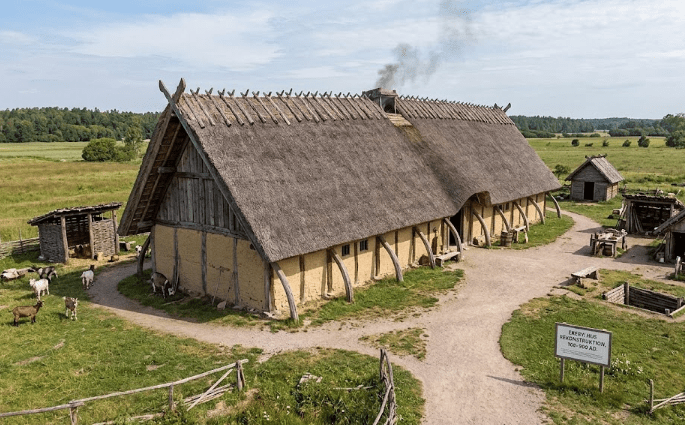
The Swedish History Museum explains that Viking Age farms often included a larger dwelling-house surrounded by smaller outbuildings. It also notes that farm appearance varied by region and settlement type. In one 9th-century farm example from Bjärred in Skåne, a house measured 21 meters long and 6.5 meters wide, with a hearth at the center and likely space for both people and animals.
Ekeby’s houses may not match Bjärred exactly. The comparison helps readers understand what archaeologists look for: scale, layout, posts, hearths, yards, outbuildings, and work areas. Houses make the Viking Age visible as lived space.
Why Graves Add A Second Line Of Evidence
Graves add a second line of evidence because they show how people remembered the dead, expressed identity, and marked belonging. Settlement remains tell researchers how people lived. Burial remains can show how communities commemorated people, handled bodies, displayed objects, and structured cemeteries.
The Swedish History Museum explains that Iron Age graves offer insight into lives, deaths, and beliefs about the afterlife. It notes that cremation was common, with humans and sometimes animals placed on the pyre with personal objects such as jewelry, combs, and weapons. Burned remains could then be scattered or collected in vessels and covered by stone settings or mounds. In the later Iron Age, inhumation graves and boat burials also occurred.
That broader context matters for Ekeby. A grave dated to AD 200 does not speak in the same way as a grave dated to AD 850. Changes in burial form, grave goods, cremation practice, or cemetery layout may reveal how local customs developed over time.
Houses show continuity in life. Graves show continuity in memory.
Why Ekeby Belongs To A Long Uppland Story
Ekeby belongs to a long Uppland story because earlier local research had already identified settlement and burial evidence in the area. Upplandsmuseet lists Per Frölund’s 2021 report, “Bosättning och gravar i Ekeby”, as an archaeological preliminary investigation of the site. In 2022, the museum also listed “Arkeologi i Bälinge-Ekeby. Boplatser, husgrunder och gravar”, another report by Per Frölund, focused on settlements, house foundations, and graves.
Those report titles matter because they show that the 2026 investigation does not come from nowhere. Ekeby has already been treated as a place where settlement and burial evidence deserve close study.
This is how archaeological knowledge builds. A preliminary investigation identifies potential. Later work expands the evidence. A public Archaeology Day event then gives visitors a chance to see how a research landscape becomes visible through excavation.
Ekeby’s 2026 story is therefore both new and cumulative.
Why Development Archaeology Matters Here
The Ekeby work also belongs to modern planning history. Uppsala Municipality’s detailed-plan page for Del av Bälinge-Ekeby 1:3 says the plan aims to allow a new primary school, sports hall, and after-school activities in Bälinge while ensuring that new development adapts to cultural-historical values and the landscape. The municipal page says the plan was adopted by the Planning and Building Committee on June 11, 2026, and that it was appealed on July 8, 2026.
That planning context matters because many important archaeological projects happen before construction, roads, housing, utilities, or public buildings. Development archaeology can sound bureaucratic, but it often produces crucial evidence.
At Ekeby, the modern need for a school intersects with an ancient settlement and burial landscape. That creates a practical question: how can communities build for the future while documenting the past?
The 2026 excavation sits directly inside that tension.
Why Arkeologerna/SHM’s Role Matters
Arkeologerna/SHM’s role matters because the National Heritage Board identifies Arkeologerna/SHM as the organization carrying out the large-scale investigation. Statens historiska museer describes Arkeologerna as Sweden’s leading consultancy in archaeology and cultural environment work, with more than 100 employees across offices in Hägersten, Uppsala, Linköping, Lund, and Mölndal. It also notes that specialists work in areas such as geoarchaeology, wood-species analysis, osteology, archaeobotany, historical map analysis, method development, digital documentation, battlefield archaeology, and archaeological prospection.
That range of expertise matters at a site like Ekeby. Houses and graves do not explain themselves. Postholes need mapping. Bones need osteological analysis. Charred seeds need archaeobotany. Soil layers need recording. Finds need conservation, dating, and comparison.
A 100–900 AD site can only reveal the long road into the Viking Age if specialists connect many kinds of evidence. The public may see trenches and finds. The deeper work happens through documentation, samples, measurements, and later analysis.
How A Settlement Can Show Social Change
A settlement can show social change by preserving the repeated rebuilding of everyday life. If houses appear in several phases, archaeologists can ask whether farms moved, expanded, contracted, changed layout, or shifted activity areas. If grave fields continue nearby, researchers can ask whether families stayed attached to the same land across generations.
This matters for Viking Age history because social change rarely arrives with one dramatic event. It grows through repeated choices. A community may change house forms, burial customs, land use, animal management, craft production, or social hierarchy long before outside sources name Vikings.
Ekeby’s long date range gives archaeologists a chance to study these changes in sequence. The site may show how older Iron Age communities gradually became the kind of society that later supported Viking Age travel, trade, and warfare.
That does not mean every Ekeby household became “Viking” in a seafaring sense. It means Viking Age society rested on communities like this.
Why Farming Sits At The Center
Farming sits at the center because most people in Iron Age and Viking Age Scandinavia lived from the land. The Swedish History Museum explains that life on a Viking Age farm followed the annual cycle of animals and fields: ploughing, sowing, harvest, moving livestock to and from pasture, and storing food and fodder for winter. It also emphasizes that most Viking Age life was lived on the farm and that the farm and its land stood at the center of both reality and worldview.
This point helps make Ekeby more important. Houses and graves dated to AD 100–900 do not only document where people lived and died. They document the long-term social base of Scandinavian history.
For Old Norse News readers, this connects directly with daily life during the Viking Age, where farming, household labor, food, buildings, and seasonal routines explain far more about most people’s lives than raids do.
The road into the Viking Age ran through farms first.
Why AD 100 Matters As Much As AD 900
AD 100 matters as much as AD 900 because early evidence can show what later communities inherited. Around the first centuries AD, the Roman Empire influenced areas far beyond its borders. The Swedish History Museum notes that Roman influence reached Scandinavia even though the empire never conquered it. It also says that from this period there are many remains of graves, settlements, and iron production sites.
That wider background helps explain why Ekeby’s earliest dates matter. A settlement dated to around AD 100 belongs to a world already shaped by farming, iron production, regional contacts, and shifting social rank. It is not a blank prehistory waiting for the Viking Age to begin.
If Ekeby’s earliest phases show houses, graves, or activity areas from this period, they can reveal how local communities organized themselves before later Viking Age forms appeared.
The Viking Age becomes more understandable when readers see the centuries behind it.
Why AD 900 Also Matters
AD 900 matters because it falls inside the Viking Age and near a period of major change across Scandinavia. By then, farms, trade centers, burial customs, political networks, and long-distance movement had developed in new ways. Ekeby’s later evidence may therefore help researchers compare older Iron Age local life with early Viking Age patterns.
However, readers should avoid assuming that AD 900 automatically means raiders, warriors, or overseas travel. A farm or grave from this period may show household continuity rather than dramatic outward expansion. That would still matter.
The Viking Age was not lived only in ships. It was lived in places like Ekeby, where people still farmed, buried relatives, repaired buildings, raised animals, and negotiated local status.
AD 900 matters because it links the familiar Viking Age to the older settlement sequence beneath it.
Why Graves Can Reveal Continuity And Breaks
Graves can reveal both continuity and breaks. If burial forms remain stable, researchers may see long-term local tradition. If forms change, they may see new beliefs, new contacts, new identities, or different ways of expressing status.
The Swedish History Museum notes that richly furnished graves became more visible from around 200 BC and that later Iron Age burial traditions included cremations, inhumations, and boat burials in different places. Ekeby’s graves may not include the spectacular examples known from Vendel, Valsgärde, or Tuna in Alsike. Yet ordinary graves can still answer important questions.
A modest grave can show age, cremation practice, object choice, cemetery placement, or community memory. Several graves together can show how people used the same burial ground over time.
This is why Ekeby’s graves matter. They can reveal how local communities handled death across the centuries leading into the Viking Age.
Why Houses Can Reveal Daily Work
Houses can reveal daily work because buildings organize labor. A dwelling-house centers food, heat, sleep, storage, and social life. Outbuildings can point toward animals, tools, craft, grain storage, or seasonal tasks. Pit-houses may suggest textile work or other crafts, depending on finds and context.
The Swedish History Museum’s Viking Age farm guide notes that craft activity such as spinning wool and weaving could take place indoors and that some pit-houses seem to have been used for craftwork or smithing. That broader pattern gives readers a way to understand why house remains at Ekeby matter even before all finds are published.
A posthole pattern may seem abstract. Yet it can reveal where a roof stood, where a hearth burned, where people worked, and where animals may have stayed in winter.
At Ekeby, houses can make the road into the Viking Age practical rather than legendary.
Why Early Finds Should Be Treated Carefully
The Archaeology Day listing says the event will show finds that have come out of the ground during the first month. That phrase is exciting, but it should also encourage caution. Early finds rarely tell the whole story. Objects need cleaning, registration, conservation, dating, and comparison before they can support strong claims.
This is especially important at a long-use site. A single object may belong to one phase, while another feature belongs centuries earlier or later. Without careful stratigraphy and dating, readers can easily blend AD 100, AD 500, and AD 900 into one false “Viking” scene.
Ekeby’s value lies in method. Archaeologists will need to separate phases, compare house types, examine grave forms, and test samples. Only then can the site show how the road into the Viking Age unfolded.
A good public article should therefore treat the 2026 event as a window into research, not as a solved story.
Why The Site Helps Correct Viking Stereotypes
Ekeby helps correct Viking stereotypes because it starts with houses and graves rather than raids. Popular Viking stories often begin at sea. Archaeology often begins in a field. That difference matters.
A settlement and burial landscape from AD 100–900 shows that Scandinavian history depended on long-term local communities. People built houses, managed animals, raised crops, buried the dead, adapted to climate, and maintained social ties. Those acts do not look as dramatic as a ship on the horizon, but they made later Viking mobility possible.
This does not erase warriors, trade, or overseas travel. Instead, it gives them a foundation. Ships needed timber, iron, food, textiles, rope, labor, and people trained by farm life and local organization.
Ekeby makes that foundation visible.
Why Public Archaeology Matters In Bälinge
Public archaeology matters in Bälinge because the 2026 tour lets local residents and visitors see how their landscape holds older histories. The National Heritage Board lists the event as a family-friendly guided tour and notes that the excavation area lies in eastern Bälinge. It also says visitors can reach the site by car or bus, with Nyodlarvägen as the bus stop and parking directly beside the excavation area.
Those practical details may seem minor, but they matter. Archaeology becomes more meaningful when people can connect a trench to a road, a bus stop, a planned school, and a familiar place name.
The event also helps explain why excavations take time. Archaeologists do not simply “find things.” They record evidence before modern change alters the landscape.
At Ekeby, public archaeology turns a development project into a shared historical lesson.
What Readers Should Verify Before Accepting Big Claims
Readers should verify several points before accepting dramatic claims about Ekeby. First, the current public listing supports houses and graves dated to AD 100–900, but it does not yet provide a full published interpretation of the August–October 2026 excavation. Second, the site should not be called a confirmed “Viking village” without stronger published results.
Third, AD 100–900 covers several phases of the Iron Age. The earliest evidence is not Viking Age, while the latest evidence overlaps the Viking Age. Fourth, early finds shown during Archaeology Day may change meaning after laboratory analysis and specialist review.
Finally, the planning context matters. This is not only a heritage-tour topic. It is also a case of modern community development intersecting with cultural-historical values.
Those limits make the topic stronger. They keep the story grounded in evidence.
Why Ekeby Reveals The Long Road Into The Viking Age
Ekeby reveals the long road into the Viking Age because it shows that Scandinavian society developed through centuries of local continuity and change. Houses record daily life. Graves record memory and social identity. Reports from Upplandsmuseet show earlier attention to settlement, house foundations, and graves in Bälinge-Ekeby. The 2026 Arkeologerna/SHM investigation now brings that landscape into a new public moment.
The site also helps readers understand the Viking Age as the last phase of a longer Iron Age, not a sudden historical break. The same land could hold early Iron Age settlement traces, later burial customs, and early Viking Age activity. That layering is exactly what makes Ekeby valuable.
For oldnorsenews.org, the lesson is practical. Viking history begins before the word “Viking” dominates the story. It begins in farms, houses, graves, fields, food storage, seasonal work, and inherited landscapes.
Ekeby’s 100–900 AD houses and graves do not simply point toward the Viking Age. They show the road that led there.
