
A recreated Viking high seat at the NTNU University Museum in Trondheim gives readers a different way to understand Norse power. Ships, weapons, raids, and silver still matter, yet they were not the whole structure of Viking Age society. The new high seat, made by traditional craftsman Kai Johansen at the Stiklestad National Cultural Centre in Verdal, points back to the longhouse, the farm, the hall, and the social order that made travel, trade, and raiding possible. NTNU’s public reporting describes the chair as the first high seat crafted in Central Norway since the Viking Age, and it now helps anchor the second phase of the museum’s “Viking” exhibition. That shift is important for oldnorsenews.org because it turns a familiar Viking story outward and then back home: before ships left the fjords, power had to be built in farms, households, halls, and local networks.
Why The High Seat Matters In Viking Society
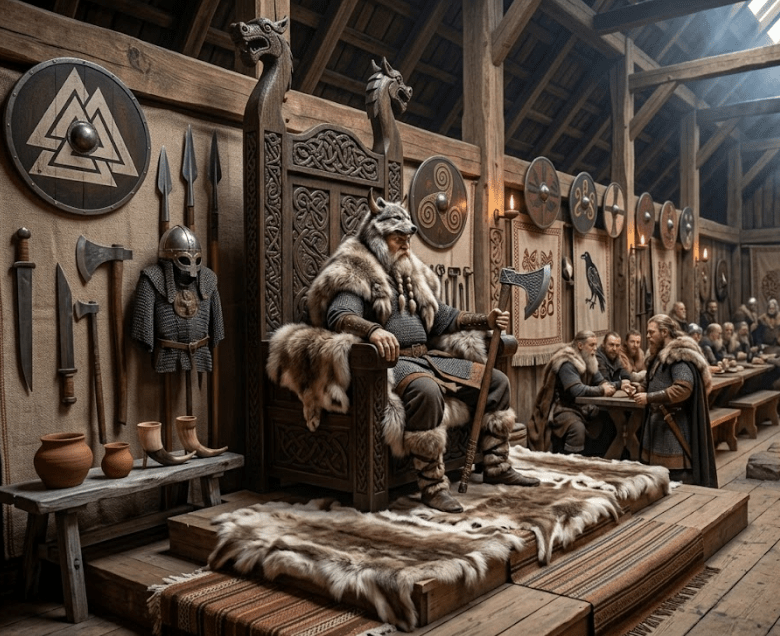
The high seat was not just a comfortable chair. NTNU’s account explains that it was the chieftain’s fixed place in the longhouse and a clear status symbol for wealthy farmers. In the hall, the head of the farm sat in the high seat, and Ellen Grav, who coordinates the museum’s public outreach work on archaeology, described it as the most prestigious seat in the room. “Not just anyone could sit there,” she explained in NTNU’s coverage.
That physical placement matters. A hall was not only a shelter. It was a space where hospitality, negotiation, feasting, oath-making, gift-giving, household management, and public status could be performed. A high seat made hierarchy visible. Guests knew where authority sat. Workers, family members, dependents, allies, and rivals could read the room through its layout.
This makes the recreated high seat useful as a teaching object. It does not claim to be an original Viking Age artifact. NTNU states that the chair is neither an original nor a strict replica, and that its decoration is based on archaeological finds and written source material. That distinction protects the story from overclaiming. The chair is an interpretation, built from evidence, craft knowledge, and museum design. It helps visitors picture a longhouse social setting without pretending that one complete Central Norwegian Viking high seat survived intact.
The object also connects naturally with oldnorsenews.org’s focus on Viking Age daily life, where farms, longhouses, rank, food production, and social obligation explain more than ship imagery alone.
How NTNU’s Exhibition Moves From Voyages To Farms
The NTNU University Museum’s “Viking” exhibition opened in Trondheim in June 2024. Its first year focused on Viking journeys across the world, including raiding, trading, boat technology, weapons, trade goods, and objects from faraway places. The high seat belongs to the next interpretive shift: the museum’s second phase turns attention to farms and farming communities.
That choice changes the public story. Many visitors arrive expecting ships, swords, helmets, silver, and overseas routes. The farm can look less exciting at first glance. Yet Grav’s line that “the farm is the cornerstone of Viking society as a whole” gives the exhibition its sharper argument. Large farms produced surplus. Surplus could be traded. Trade brought foreign goods into Central Norway. Wealthy estates could help provide ships, equipment, people, and resources for expeditions.
That does not make farms peaceful background scenery. It makes them engines of power. A large farm could control grain, livestock, labor, timber, craft production, storage, brewing, feasting, and access to local burial landscapes. Those resources shaped whether a family could host, trade, equip a voyage, support dependents, or build alliances.
The exhibition’s high seat therefore works as a visual answer to a common question: where did Viking power sit before it moved? Not only on the deck of a ship. Not only in a warrior’s hand. It sat inside the longhouse, at the head of the hall, in the place where household authority and regional status met.
Why Farms Made Viking Expeditions Possible
The popular Viking image often begins at sea. A better evidence-based sequence starts inland and coastal-side, with farm production. NTNU’s reporting says Central Norway had several large farms with considerable power and resources. These estates produced surplus that could be exchanged for goods, bringing distant objects into the region. The same large estates could collaborate on ships and expedition equipment, gaining wealth and status through that cooperation.
This is where the high seat becomes more than furniture. It represents the authority required to organize people and resources. A household leader did not become powerful simply by owning a carved chair. The chair mattered because it belonged to a system: land, animals, food storage, kinship, dependents, tenants, craft, feasting, ships, and memory.
Archaeology gives a practical basis for this interpretation. NTNU notes that no preserved houses from this period have been found in the region, but excavations reveal evidence such as cultivation layers, postholes, cooking-stone layers from brewing activity, and burial mounds near farms. Those traces let researchers reconstruct longhouses and associated farm landscapes even without standing buildings.
This is exactly why a museum reconstruction can help. Postholes and cultivation layers are important, but they can be hard for the public to visualize. A high seat gives visitors a focal point. It turns scattered archaeological traces into a social scene: a longhouse with rows of posts, a hall space, a leader’s fixed seat, a household gathered around status and obligation.
How Craftsmanship Turns Research Into Public History
The high seat was made by traditional craftsman Kai Johansen, who works at the Stiklestad National Cultural Centre and runs Auskin Creative Center with Mona Sand. NTNU reports that Sand designed the decoration on the high seat, and that Johansen reviewed available archaeological and written material on Viking Age chairs and high seats during preparation.
The sources of inspiration matter because the object is not fantasy furniture. NTNU lists the Oseberg Chair from 834 CE, a gift chair from 875 CE in St. Peter’s Basilica in the Vatican, the myth of Thor’s fishing trip, and a decorated bone tube from a cave in Nordmøre among the references used for the work. The decoration on the high seat draws from archaeological finds and other source material, including the Nordmøre bone sleeve and Norse mythic imagery.
That mix is careful, but it needs clear explanation. Archaeological objects, later written material, and mythic scenes do not all carry the same type of evidence. A museum reconstruction has to combine sources without pretending they are equal. The Oseberg Chair is a physical artifact. A mythic scene is part of narrative tradition. A decorated bone tube offers ornament evidence. Together, they support a historically grounded interpretation, not a recovered original.
This is a useful model for Norse heritage writing. Public audiences want to see the past, not only read about soil marks and artifact fragments. Yet the more vivid a reconstruction becomes, the more important it is to say what is known, what is inferred, and what has been artistically reconstructed. The high seat succeeds as a museum object when it makes those layers visible.
Why A Longhouse Seat Changes The Raider Stereotype
The high seat changes the raider stereotype by moving attention from action to structure. Raiding was an activity. Power was a system. A person who joined or led an overseas expedition came from a society where rank, household authority, food surplus, craft labor, and social obligation had already been organized.
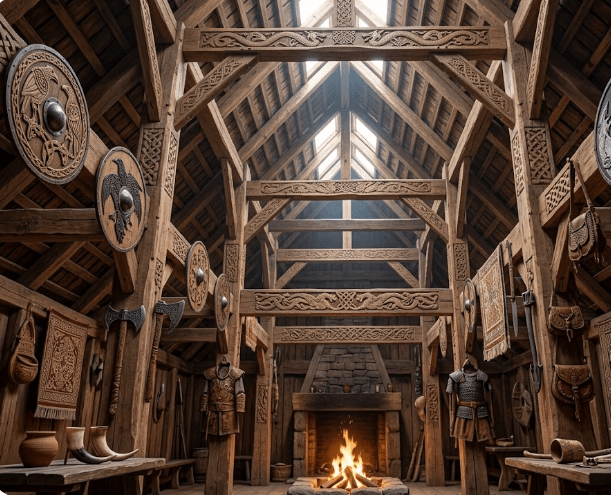
The longhouse was central to that system. NTNU researcher Geir Grønnesby said the idea for the high seat was inspired by the exhibition space itself, where double rows of posts resemble the rows inside a longhouse. NTNU also notes that posthole patterns found at Viking Age farms show that people lived in longhouses.
This is an important correction to visual culture. Modern Viking imagery often uses the ship as the main stage. The longhouse may be just as important for explaining how authority worked. In the hall, wealth could be displayed through feasts, imported goods, carved objects, weapons, textiles, and seating order. Visitors could see who controlled resources. Dependents could see who commanded labor. Rivals could see who had support.
A high seat also shows that status was performed in everyday settings. A leader’s public authority was not only proven in battle. It was enacted through hosting, judgment, gift exchange, ritual practice, and the control of the household economy. That is why the chair’s symbolic force is stronger than its size. It marks where power became visible inside the farm.
What The High Seat Reveals About Social Stratification
Norwegian SciTech News describes the Viking Age as a period in which society became more stratified, with carved high seats owned by wealthy farmers serving as clear status symbols. That framing is useful because it links the object to social change rather than treating it as a decorative museum piece.
Stratification means that resources, prestige, and authority were unevenly distributed. Some farms had more land, more people, more animals, more storage, and stronger links to exchange networks. Those differences could become visible in burial mounds, imported goods, weapon ownership, feasting equipment, and hall architecture. A high seat belongs in that same set of signals.
The chair also reminds readers that Viking Age elites were not only kings. Local and regional leaders mattered. Wealthy farmers and chieftains could wield influence through land, hospitality, kin networks, and access to ships. A large farm could become a political center without needing stone walls or an urban palace.
This helps oldnorsenews.org avoid a narrow top-down story. Viking society was not only made by famous kings and overseas war bands. It was shaped by household heads, estate managers, skilled craftspeople, farmers, traders, and communities whose labor turned local surplus into regional influence.
How Museum Reconstructions Should Be Read Carefully
A recreated high seat can make the Viking Age easier to understand, but readers should treat it as interpretation. NTNU is direct about this: the high seat is neither an original nor a replica. Its decoration is based on other archaeological finds and written source material.
That distinction is the difference between responsible public history and fantasy display. A replica tries to copy a known object. A reconstruction can combine evidence from multiple sources to represent a plausible form or function. The NTNU high seat belongs to the second category. It gives visitors a credible way to imagine a lost object type from Central Norway, where no preserved Viking Age high seats remain.
Museum reconstructions are strongest when they create questions rather than false certainty. What did a high seat signal inside a hall? Who was allowed to sit there? How did seating order mark rank? What can postholes tell us about room layout? How did farm surplus support voyages? What parts of the chair come from physical finds, and what parts come from interpretive design?
Those questions help readers see the Viking Age as a research field rather than a costume style. The high seat is powerful not because it proves every detail of longhouse life, but because it makes the hidden architecture of power easier to discuss.
Why Farm Power Belongs Beside Ships And Silver
The high seat does not replace ships, weapons, or trade goods in Viking history. It explains how those things were supported. A ship required timber, iron, rope, sailcloth, food, labor, and command. A trading voyage required goods, contacts, trust, and protection. A raid required planning, equipment, leadership, and risk. None of that happened without people and resources at home.
NTNU’s second exhibition phase makes that support system visible. Farm life is not the quiet opposite of Viking activity abroad. It is the base from which that activity was organized. Large farms could produce surplus, join forces, and turn local wealth into wider movement.
That is why the high seat is such a useful object for public history. It asks visitors to look at power before it becomes dramatic. The chair sits still, but it points toward movement. It belongs to the hall, but it helps explain voyages. It is a crafted object, but it represents land, hierarchy, surplus, and command.
For oldnorsenews.org, the strongest angle is precise: a recreated Viking high seat shows power beyond ships and raids by placing authority inside the farm hall. It does not make the Viking Age less maritime. It makes the maritime story more complete.
What Readers Should Verify Before Repeating The Story
The source-backed details are clear. The high seat was made by traditional craftsman Kai Johansen at the Stiklestad National Cultural Centre in Verdal. The decoration was designed by Mona Sand. The object is part of the NTNU University Museum’s “Viking” exhibition in Trondheim, which opened in June 2024 and later shifted focus from Viking voyages to farms and halls. Ellen Grav coordinates public outreach work on archaeology at the museum, and Geir Grønnesby is the NTNU University Museum researcher quoted on the exhibition design and longhouse inspiration.
Readers should not repeat the story as if the chair is an excavated Viking Age original. NTNU states that it is neither an original nor a replica. It is a modern reconstruction informed by archaeological finds and written source material. That limitation is not a weakness. It is what makes the museum object honest.
The bigger historical point should stay just as careful. The high seat does not prove one fixed model for every Viking Age farm. It does not show exactly how every hall looked. It does not replace excavation evidence. It helps explain how rank, farm surplus, longhouse space, and household leadership formed the social base behind Viking Age travel, trade, and raiding.
