
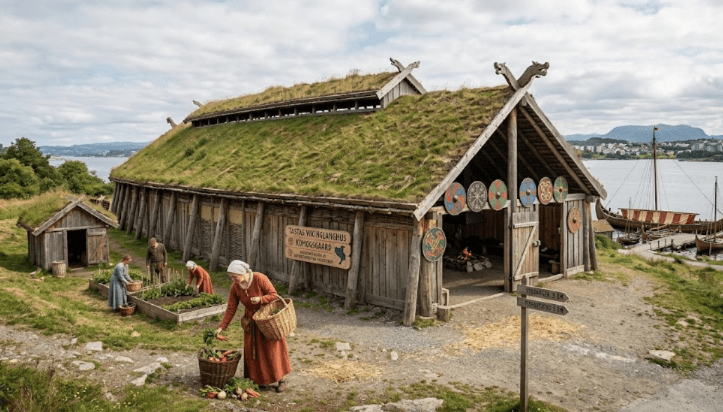
Tasta’s Viking longhouse may point to ceremony instead of household life because archaeologists found a building that appears to have held its form for several hundred years. That kind of stability raises a different question from ordinary farm archaeology. A family household usually changes as people rebuild, expand, repair, adapt, and reorganize space. At Tasta in Stavanger, however, the University of Stavanger’s Archaeological Museum says a Viking Age longhouse discovered during excavation connected with E39 road development had stood unchanged for centuries. The museum says that pattern suggests the building may not have belonged to one family, but may instead have had a ceremonial function important to people in the area. (UiS Tasta Excavation Report)
Why The Tasta Find Matters Now
The Tasta longhouse matters because it gives Rogaland another source-backed reason to think about Viking Age power beyond graves, ships, and weapons. The University of Stavanger published its 2026 field-season overview on May 28, 2026, noting that summer is peak season for archaeologists and that the Archaeological Museum conducts excavations throughout Rogaland each year.
In that overview, department head Krister Scheie Eilertsen said the 2026 field season in Rogaland was exciting and varied, with excavations spread from Hå on Jæren in the south to Tysvær in the north. At Tasta, archaeologists continued work after a major excavation in autumn had already revealed several important finds, including the Viking Age longhouse.
The discovery is important because it shifts attention from spectacular objects to building biography. The question is not only what archaeologists found inside the house. It is why the house remained stable for so long, what people did there, and why later communities may have respected or reused its form.
What UiS Says Archaeologists Found
UiS says archaeologists found a Viking Age longhouse at Tasta in Stavanger during excavation connected with E39 road construction. The report states that the building had stood unchanged for several hundred years. That detail led the museum to suggest that the structure probably did not belong to a family household in the ordinary sense.
The ceremonial interpretation comes from several pieces of evidence working together. First, the house’s long-term unchanged form stands out. Second, archaeologists found a pit in the middle of the house containing remains of a horse jaw with teeth. Third, the building also contained objects linked to everyday activity, including parts of pots, spindle whorls for spinning wool, and loom weights.
Archaeologist Even Bjørdal told UiS that the horse jaw remains in the pit testify to a pagan offering. Archaeologist Volker Demuth said the pot fragments, spindle whorls, and loom weights suggest the house had many functions.
That combination makes Tasta especially interesting. It was not an empty ritual shell, but it may not have been an ordinary domestic home either.
Why An Unchanged Longhouse Raises Ceremony Questions
A longhouse that stands unchanged for centuries raises ceremony questions because houses normally change with household needs. Roofs fail. Walls move. Posts rot. Families grow or shrink. People repair, rebuild, extend, replace, or abandon buildings as circumstances change.
If archaeologists see a building form that appears to stay stable across generations, they may ask whether the structure held a social role beyond domestic convenience. A ceremonial or communal building might preserve its layout because people treated it as meaningful. Continuity itself can become part of the evidence.
This does not prove a temple in the modern sense. UiS does not call the Tasta structure a temple, and the article should avoid that leap. The better interpretation is more cautious: the house may have held a special ceremonial role for the surrounding community.
That distinction matters. A building can host ritual, gathering, memory, textile work, cooking, offerings, and social events without fitting a simple category like “home,” “hall,” or “temple.”
Why The Horse Jaw Matters
The horse jaw matters because it gives the longhouse interpretation a ritual edge. UiS reports that archaeologists found remains of a horse jaw with teeth in a pit in the middle of the house. Even Bjørdal connected the find with a pagan offering.
Horses carried strong symbolic value across Viking Age and earlier Scandinavian societies. UiS notes that horse sacrifice formed an important part of Viking Age tradition and that the horse had so much symbolic power that eating horse became illegal after Christianity came to Norway. That wording should stay close to the source because it reflects the museum’s interpretation of the find.
The Swedish History Museum gives wider context for the horse’s special status, describing it as both a status symbol and a sacrificial offering in ancient Scandinavia. Its separate discussion of ritual meals also emphasizes that sacrificing a horse was unlikely to have been within everyone’s means, which points toward the animal’s high social value. (Horse As Status And Offering)
That background helps explain why a horse jaw in a central pit matters. It was not just animal waste. In this context, archaeologists read it as a deliberate deposit.
Why The Pit’s Location Matters
The pit’s location matters because UiS says archaeologists found it in the middle of the house. Placement can change interpretation. Animal remains in a refuse pit outside a building may suggest food waste, craft debris, or later disturbance. Animal remains placed centrally inside a longhouse can suggest a more deliberate act.
This does not mean archaeologists can reconstruct the full ceremony. The evidence does not tell us who stood there, what words they used, which season it happened, or which belief system they invoked. It does, however, show a central deposit that specialists at UiS interpret as pagan offering evidence.
The central location also links the horse jaw with the building’s unusual stability. If people used the longhouse repeatedly for socially important actions, a central deposit may have carried meaning for those who entered, gathered, worked, or remembered there.
The strongest reading stays careful. The Tasta pit points toward ritual behavior, but it does not give a complete ritual script.
Why Household Finds Do Not Cancel Ceremony
The everyday objects inside the Tasta longhouse do not cancel the ceremonial interpretation. Volker Demuth told UiS that archaeologists found parts of pots, spindle whorls, and loom weights, suggesting a house with many functions. Those finds matter because they prevent a simplistic split between “ritual” and “daily life.”
Viking Age spaces did not always divide life into modern categories. A building could host textile production, food preparation, gathering, storage, storytelling, social obligation, and ritual actions. Objects connected with spinning and weaving may point toward ordinary work, but ordinary work could also happen in socially charged spaces.
Pot fragments also leave room for several possibilities. They may relate to food preparation, feasting, storage, breakage, or later activity. Without full excavation data, the public should not overstate what each object proves.
The key point is that the longhouse appears multifunctional. Ceremony may have been one part of a broader social role, not the only activity that happened there.
Why Tasta Complicates The Idea Of A Viking Home
Tasta complicates the idea of a Viking home because the building’s evidence does not fit a narrow domestic model. A longhouse often makes readers imagine a family dwelling with people, animals, hearths, sleeping space, and work areas. That image can be useful, but Tasta shows why archaeologists must test it against the evidence.
A building that does not change for several hundred years may have held communal significance. A central horse-jaw deposit adds ritual weight. Textile and pottery finds show practical activity. Together, these clues suggest a space that may have crossed boundaries between household, community, craft, memory, and ceremony.
That is why the phrase “instead of household life” needs careful handling. The building may not have been a normal family home, but it still may have included activities that look domestic. The better question asks how Viking Age communities used longhouses for more than one kind of life.
Tasta does not erase daily life. It makes daily life harder to separate from ceremony.
Why Stavanger’s Landscape Matters
Tasta sits in Stavanger, in a region where archaeology repeatedly shows long-term settlement, elite activity, maritime movement, and ritual landscapes. The 2026 UiS field-season overview places Tasta alongside other Rogaland excavations, including sites at Revheim, Hårr, Bokn, Rennesøy, Tau, Finnøy, Tysvær, and Karmøy. That list matters because it shows the longhouse as part of a broader research season, not an isolated media story.
The same UiS report says the museum preserves 1.5 million objects from Rogaland’s prehistory. That institutional context matters because the Archaeological Museum is not only excavating one building. It is building a larger regional picture from settlement traces, graves, nausts, ship-related finds, and landscape studies.
Tasta contributes a different kind of evidence. It shows that a building in a road-construction zone can still change how scholars discuss Viking Age ritual and community organization.
Modern infrastructure created the excavation context. Archaeology gave the road project a deeper historical layer.
Why Road Archaeology Often Finds Important Evidence
The Tasta excavation also shows why road archaeology matters. UiS says the longhouse discovery came during a major excavation connected with E39 road development. That detail places the find inside rescue or development-led archaeology, where researchers investigate remains before modern construction changes the landscape.
Such work can sound less romantic than a planned research dig at a famous site. Yet it often produces crucial evidence because roads, utilities, housing, and public works cut through ordinary settlement landscapes. Those landscapes may preserve farms, houses, pits, graves, postholes, craft areas, and traces of long-term use.
Tasta’s longhouse shows the value of this work. Without excavation before road development, the building’s unusual biography and central horse-jaw deposit might not have entered public knowledge.
The find also reminds readers that Viking Age history still lies under modern infrastructure corridors, neighborhoods, fields, and planned building sites.
Why Ceremony Does Not Mean Spectacle
Ceremony does not always mean spectacle. Popular Viking imagery often imagines dramatic sacrifices, loud feasts, weapons, flames, and gods named from later medieval texts. Archaeological ceremony can look quieter: a pit, a jawbone, a building footprint, a repeated layout, a cluster of objects, or a pattern of long-term respect.
Tasta’s evidence fits that quieter category. UiS reports a central horse-jaw deposit and a longhouse that held its form for centuries. Those are powerful details, but they do not allow a full story about gods, participants, songs, or exact ritual purpose.
This is where source caution matters. The horse jaw supports an offering interpretation because archaeologists at UiS say so. The unchanged building supports a special-function interpretation because the structure appears to have stood unchanged for a very long time. The rest remains open.
A careful article should resist turning the Tasta longhouse into a cinematic scene. The archaeology is more valuable than fantasy.
Why Halls And Longhouses Could Hold Social Power
Longhouses and halls could hold social power because built space shaped how people gathered. A large or long-lived building could organize status, work, feasting, ritual, negotiation, and memory. Its layout could tell people where to stand, where to sit, where to prepare food, where to deposit objects, and how to move through social space.
The Tasta evidence suggests that the building mattered to more than one generation. A family might rebuild a house when needs changed, but a community might preserve a special structure because it anchored memory or ceremony. That possibility gives the longhouse its interpretive force.
Old Norse News has covered how Norse power beyond ships and raids can appear through built environments, seats, halls, and controlled social space. Tasta fits that broader theme. It shows power and meaning through architecture rather than through a sword, ship, or hoard.
The longhouse becomes a social instrument, not just shelter.
Why The Find Should Not Become A “Temple” Claim
The Tasta longhouse should not become a “temple” claim unless later research supports that term. UiS says the house may have had “a kind of ceremonial function.” That phrase is careful. It does not identify the building as a temple, cult house, royal hall, or shrine.
This distinction is important for oldnorsenews.org’s editorial style. Viking Age religion often attracts overconfident labels. A horse jaw in a central pit is significant, but one find does not reconstruct an entire religious institution. A stable house plan matters, but it does not name the building’s role with certainty.
The safest wording uses terms such as ceremonial function, ritual activity, offering, special building, or communal importance. Those terms match the evidence better than a dramatic headline about a pagan temple.
Good archaeology often asks better questions rather than providing instant labels. Tasta’s best question is why this building remained important for so long.
Why The Find Changes How Readers See Textile Tools
The spindle whorls and loom weights inside the Tasta longhouse deserve attention because they show that ceremony and textile work could appear in the same archaeological space. Spindle whorls helped people spin wool into thread. Loom weights helped tension warp threads on upright looms. These tools point toward skilled, repeated labor.
If the building had many functions, textile work may have formed part of its ordinary use or its social significance. Cloth production mattered deeply in Viking Age society. People needed textiles for clothing, bedding, sails, bags, trade, gifts, and display. A space associated with weaving or spinning could hold economic and symbolic importance.
However, the public should avoid a shortcut. Textile tools do not automatically prove women’s ritual, a temple workshop, or elite production. They show activity. Interpretation must come from the building context, object distribution, dating, and comparison with other sites.
At Tasta, they help show that the longhouse was active, worked in, and socially complex.
Why The Horse Remains Need Context, Not Myth Alone
The horse remains need archaeological context, not myth alone. Later Norse literature gives horses powerful roles in stories about gods, journeys, status, and death. Yet a Viking Age horse-jaw deposit in Stavanger cannot be explained only by later mythology.
The better approach begins with the excavated evidence. UiS reports a horse jaw with teeth in a central pit and quotes Even Bjørdal interpreting it as a pagan offering. Wider Scandinavian museum sources support the horse’s special role as a status animal and sacrificial offering. Those sources give enough context to explain why the find matters.
The article does not need to name a specific god or ritual. In fact, doing so would weaken the interpretation unless future research supports it.
Tasta’s horse jaw is most useful as evidence for symbolic action inside a special building. It shows meaning without requiring a mythic caption.
Why Christianization Matters Carefully
UiS notes that the horse held such symbolic power that eating horse became illegal after Christianity came to Norway. That point links the Tasta find with the wider religious transition from pre-Christian practice to Christian norms. It also needs careful phrasing.
The Tasta longhouse evidence points to Viking Age ritual activity, but it does not by itself show Christian conflict, conversion pressure, or a specific law being enforced at the site. The broader Christianization context helps readers understand why horse sacrifice later became problematic, but it should not be forced into the excavation story.
This distinction matters because Viking Age transition topics often become too neat. Pagan practice did not vanish in one moment. Christian norms developed unevenly across regions and social groups. Later prohibitions do not automatically explain every earlier horse deposit.
Tasta should be read first as a Viking Age archaeological find, then placed carefully into the wider religious transition.
Why The 2026 Field Season Still Leaves Questions Open
The 2026 field season still leaves questions open because UiS described ongoing work at Tasta. The museum said archaeologists would investigate more of the area excavated in autumn and open two new areas. They started in April 2026 and planned to remain there until the end of September 2026.
That timing matters. Public reports during a field season often present early interpretations. Later analysis may refine dating, building phases, object distribution, animal-bone identification, soil samples, and activity areas. The ceremonial interpretation may become stronger, more detailed, or more complicated as the work continues.
A source-aware article should therefore use “may point to ceremony” rather than “proves ceremony.” That headline matches the evidence and leaves room for new results.
The most exciting part of Tasta is that the site is still becoming clearer.
What Readers Should Verify Before Accepting Big Claims
Readers should verify several points before accepting dramatic claims about the Tasta longhouse. First, UiS reports that the Viking Age longhouse stood unchanged for several hundred years, which suggests a special function. It does not provide, in the public overview, a final full excavation report.
Second, the horse jaw with teeth came from a pit in the middle of the house, and Even Bjørdal interpreted it as evidence of a pagan offering. That is stronger than a casual guess, but it still does not identify the full ritual.
Third, Volker Demuth’s comments about pot fragments, spindle whorls, and loom weights show a house with many functions. They do not reduce the building to a purely domestic household.
Finally, the site belongs to an active excavation connected with E39 development. Later specialist analysis may add detail about chronology, use phases, and the relationship between household activity and ceremony.
Those limits keep the story honest.
Why Tasta Reopens The Longhouse Question
Tasta reopens the longhouse question because it shows that a Viking Age building can resist modern categories. It may not have belonged to a single household, yet it contained objects tied to daily work. It may have served a ceremonial role, yet it also functioned as a practical space. It held a central horse-jaw deposit, yet it does not give enough evidence for a named ritual or temple label.
That complexity makes the find valuable. Viking Age communities did not always separate work, ceremony, memory, food, textile production, and social identity into different buildings. A longhouse could hold several kinds of meaning at once.
The Tasta discovery therefore shifts the reader’s question. Instead of asking whether the building was a home or a ritual space, a better question asks how one building could become important enough to remain unchanged across centuries.
That is why Tasta’s Viking longhouse may point to ceremony instead of household life. Its form, central horse-jaw deposit, and multifunctional finds reveal a building that seems to have mattered beyond ordinary domestic routine.
