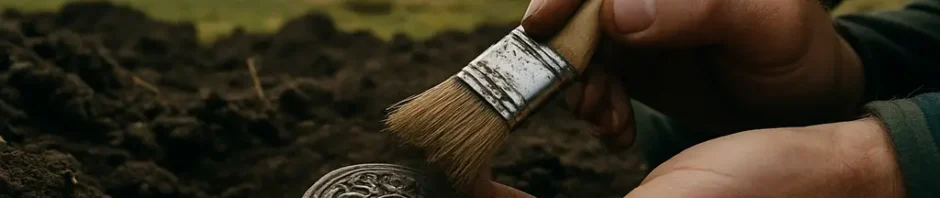
Norse identity artifacts matter because they give modern readers something firmer than inherited slogans, national romance, or popular costume imagery. Coins, burials, bowls, pendants, knives, brooches, and display cases do not speak by themselves, yet they preserve evidence that can test modern stories about the Norse past. On April 2026, metal detectorists discovered the Mørstad Hoard near Rena in Norway, reported as about 3,000 silver coins dated to around AD 1047, with coins linked to England, Germany, Denmark, and early Norway Mørstad Hoard report. That single find makes isolation a difficult story to sustain.
Why Norse Identity Artifacts Need Context
Norse Identity Artifacts And Evidence
The first duty of interpretation is restraint. An artifact can show material, place, damage, burial context, style, and sometimes date. It cannot, by itself, tell us every belief, language choice, ethnic boundary, or private emotion attached to the person who owned it. The value of Norse identity artifacts lies in that tension. They are physical evidence, but identity is social, changing, and often mixed.
A silver coin from abroad found in Norway may point to exchange, payment, gift circulation, plunder, taxation, or remelting. A brooch in a burial may suggest dress, status, gendered presentation, inheritance, or regional taste. A religious object may reflect devotion, fashion, political signaling, protection, or contact with another community. The object narrows the range of possibilities, but it rarely closes the question.
What Objects Can And Cannot Say
This is why archaeological caution matters. Modern Norse identity is often pulled toward simple symbols: the longship, the warrior, the rune, the hammer, the shield. Artifacts do not remove those symbols from the story, but they rebalance it. Hoards point to trade and monetized exchange. Burials point to family, death, rank, care, and display. Museum objects point to contact zones where Scandinavian, Anglo-Saxon, Christian, and local identities overlapped.
Readers who want a clearer separation between later mythic tradition and material evidence may find a useful parallel in archaeologists separating myth from history. The same principle applies here: an object should not be forced to confirm a story that the evidence cannot support.
Silver, Exchange, And Belonging
The Mørstad Hoard As A Case Study
The Mørstad Hoard is valuable for identity history because its contents were not locally narrow. The research notes describe about 60 percent of the coins as whole coins, with the remainder made up of hacksilver and ingots. The reported origins include England, Germany, Denmark, and early Norway. Such a mixture suggests a world in which silver moved through several political and cultural settings before deposition near Rena.
That matters for how we frame belonging. A person using foreign silver did not stop being Norse, but the material basis of life was not sealed off from the wider world. Silver could cross language borders, religious borders, and political borders. It could be counted, cut, weighed, stored, gifted, or hidden. The artifact record therefore challenges the idea that Norse identity was a fixed ethnic container.
Why Coins Resist Isolation Stories
Norse identity artifacts work best when they disturb tidy categories. The Mørstad Hoard does this by showing that value itself was mobile. Coins struck elsewhere could become part of Norwegian wealth. Hacksilver could reduce formal coinage to metal weight. Ingots could sit beside coins as stored value. These are not small details; they affect how we understand power, trust, and exchange.
For modern audiences, this point has contemporary relevance. Norse heritage is sometimes presented as a symbol of cultural purity. The coin evidence points in another direction. It suggests participation in broad exchange networks, where objects carried foreign marks into local settings. A cautious historian should not call that modern cosmopolitanism in a direct sense. Still, the hoard does show that Viking Age material life was connected across regions.
Museum Displays And Hybrid Identity
York After July 2025
The Viking North exhibition opened at York Museums Trust on July 11, 2025. Reporting on the exhibition highlighted everyday items, high-status treasures, and religious objects connected with northern England under Scandinavian influence. One especially telling object was a silver-gilt Anglo-Saxon bowl with Christian symbolism found in a Viking warrior’s burial, used to discuss the emergence of Anglo-Scandinavian identity in the ninth and tenth centuries Guardian exhibition report.
This is not a minor museum detail. A Christian-symbolic object in a burial associated with a Viking warrior unsettles rigid labels. It asks whether identity should be read through ancestry, language, burial rite, political control, object ownership, religious symbolism, or local adaptation. The answer may differ from case to case.
Religious Mixture In A Burial
Artifacts with overlapping religious signs are especially easy to misuse. A hammer pendant, a cross, or a Christian bowl does not always provide a clean confession of belief. Objects may be worn, traded, inherited, captured, reinterpreted, or placed in graves by mourners. The York example is strong because it places the object inside a broader exhibition about cultural contact in northern England rather than treating it as a curiosity.
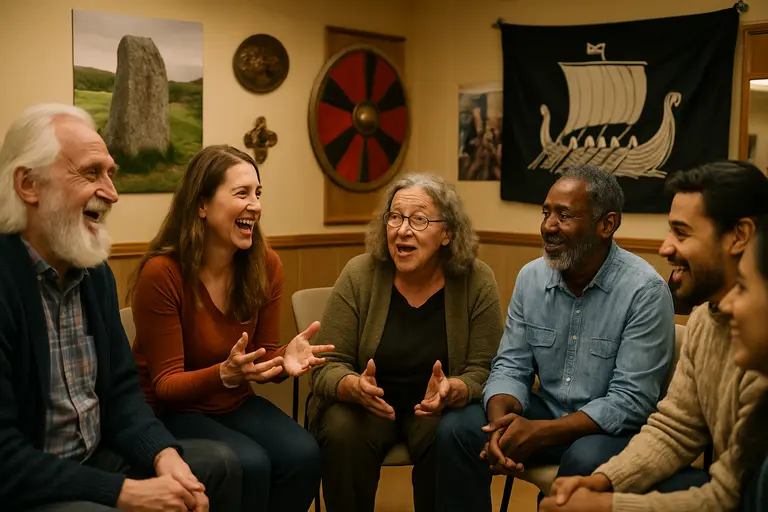
For public history, display choices matter. Lighting, labels, reconstructions, color, placement, and pairing can guide the viewer toward conflict, blending, conquest, conversion, or coexistence. Public memory is not only museum work; theatres and local cultural groups also shape how communities stage and discuss the past. For those interested in how arts contribute to cultural history, a related arts-and-culture site can be found at Wakefield Rep.
Modern Identity Without False Certainty
Public Memory Beyond Costume
For modern readers, Norse identity artifacts can make heritage more honest because they shift attention away from costume stereotypes. The object record includes weapons, but it also includes tools, beads, knives, bowls, weights, coins, mounts, textiles, and fragments. These items point toward households, craft, exchange, religion, farming, burial, and display. A society that raided also cooked, repaired, traded, mourned, prayed, stored wealth, and borrowed styles.
That wider view does not weaken Viking Age history. It makes it more credible. A culture remembered only through violence becomes flat. A culture studied through objects becomes harder to reduce. The material record shows that identity could be local and outward-looking at once.
Ethical Reading Of Symbols
Modern uses of runes, hammers, and Viking imagery should be read with care. Some people use them for ancestry, craft, religion, design, or historical interest. Others use them in ways that detach symbols from evidence. Archaeology cannot control every modern use, but it can make weak claims easier to challenge.
The phrase Norse identity artifacts should not imply that every artifact carries one clear identity label. It is better understood as a method: begin with the object, ask what is known, separate evidence from projection, and admit uncertainty where the record is thin. That method is slow, but it protects the past from modern overconfidence.
The Role Of Artifacts In Norse Identity Today
The role of artifacts in Norse identity today is not to provide a single origin story. It is to show how identity was made through contact, exchange, memory, burial, belief, and display. The Mørstad Hoard points to silver moving across borders. The York exhibition showed how objects in northern England could speak to Anglo-Scandinavian identity. Together, these cases argue against a sealed, simple, or purely martial Norse past.
Norse identity artifacts are most useful when treated as evidence rather than icons. They can inspire modern interest, but their greater value lies in discipline: they remind us to ask where an object came from, how it was used, why it was deposited, who interpreted it, and what modern viewers want it to mean. That is how artifacts shape understanding today without turning archaeology into myth dressed as certainty.
