
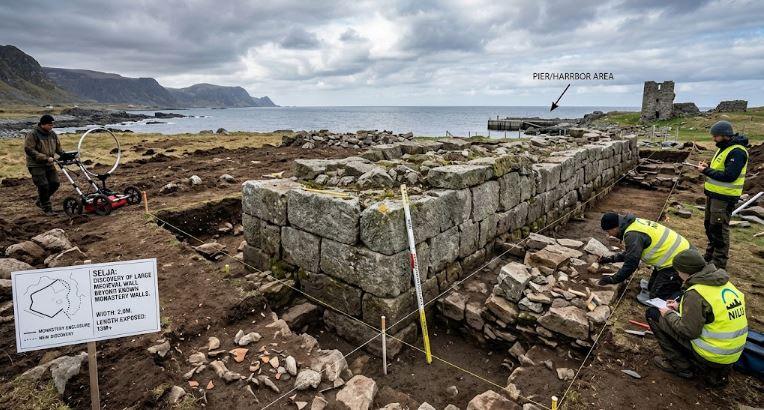
Selja’s newly found wall expands Norway’s oldest saint site beyond the ruins because it moves attention away from the visible monastery alone and toward a wider medieval landscape of harbor activity, settlement, pilgrimage, bishopric organization, and daily work. On July 31, 2026, NIKU, the Norwegian Institute for Cultural Heritage Research, reported that building archaeologist Regin Meyer and specialists in digital archaeology had identified another previously unknown structure on Selja, in Stad Municipality, Vestland County. The new find lies outside the known monastery walls. Ground-penetrating radar shows a substantial stone wall foundation extending from the harbor area and at least 13 meters southward across the terrain. Meyer said the wall measures two meters thick, which indicates a major construction. (NIKU Selja 2026 Discovery)
Why The 2026 Wall Matters Now
The 2026 wall matters now because Selja has long carried a powerful religious identity, yet recent archaeology keeps showing that the island held more activity than the surviving ruins alone suggest. NIKU describes Selja as one of Norway’s most important medieval sites, associated with Saint Sunniva, the Selja martyrs, the early Christianisation of Norway, a bishopric, a pilgrimage destination, and a monastery complex.
That status can make visitors focus almost entirely on the dramatic ruins, the cave, and the saint legend. The newly detected wall changes the frame. It suggests that meaningful medieval activity stretched outside the known monastic enclosure, possibly toward the harbor, where movement, supply, arrival, and ordinary logistics would have mattered.
This is the strongest oldnorsenews.org angle. The wall does not reduce Selja’s sacred story. It expands it. A holy site needed routes, buildings, labor, storage, visitors, food, craft, maintenance, and maritime access.
The new discovery asks readers to see Selja not only as a ruin, but as a lived medieval environment.
What NIKU Found Outside The Monastery Walls
NIKU reports that the newly identified structure consists of a thick stone wall foundation outside the known monastery walls. Ground-penetrating radar data trace it from the harbor area and at least 13 meters southward. Archaeologists have investigated only parts of the wall so far, and the structure continues below ground.
That last detail matters. Researchers do not yet know the wall’s full extent. They also do not know its function. Meyer collected datable material and soil samples from the area, hoping the analysis will clarify the wall’s age, purpose, and role in the site’s development.
The best article should therefore avoid naming the structure too soon. It may relate to the Benedictine monastery, the bishopric established on Selja in the eleventh century, or an earlier phase of the sacred site connected with the cult of the Selja Men. NIKU lists those possibilities but does not choose between them yet.
The wall’s importance lies in what it opens, not in a final label.
Why The Harbor Connection Changes The Site
The possible harbor connection changes the site because Selja’s sacred role depended on movement. Pilgrims, clergy, monks, workers, visitors, and supplies had to reach the island by sea. A substantial wall extending from the harbor area could point toward infrastructure that helped organize activity outside the famous ruins.
Riksantikvaren’s Selje Kloster page gives useful landscape context. It notes that Selja lies south of Stadlandet, near one of Norway’s most weather-exposed coastal waters. Ships often had to wait for better weather before crossing Stadhavet, and Selja offered good harbors.
That maritime setting matters. A pilgrimage and monastery site on an island does not function like an inland church. Boats shape arrival. Weather shapes movement. Harbor areas shape how people enter the sacred landscape.
The 2026 wall may therefore connect the holy center with the practical edge of the island. Until dating and analysis finish, readers should not define it as a quay, boundary, building, or processional feature. Still, its direction from the harbor makes the wider site more important.
Why Selja Was Already More Than A Monastery
Selja was already more than a monastery before the 2026 discovery. Riksantikvaren describes the island as a place where visible monastery ruins still stand, with the monastery tower ranking as Norway’s highest surviving medieval ruin. The agency also explains that Benedictine monks built the monastery and sacred complex below the church and cave associated with Sunniva and the Selja Men.
That visible complex has dominated public memory. Visitors see the tower, the ruined church, the cloister, the hillside, and the cave. Yet Selja’s history also includes guest facilities, care for visitors, coastal movement, and medieval activity around the ruins. Riksantikvaren notes that the monastery included a guesthouse and an infirmary, and that the infirmary lay some distance from the main monastery to reduce infection risk.
Those details make the 2026 wall easier to understand as part of a broader system. Monasteries did not survive on prayer alone. They required buildings for hospitality, health, craft, food, storage, service, administration, and waterborne movement.
A thick wall outside the known walls may belong to that practical medieval world. The sacred site had a working body as well as a spiritual heart.
Why Saint Sunniva Still Shapes The Interpretation
Saint Sunniva still shapes the interpretation because Selja’s identity begins with the saint legend and the Selja martyrs. NIKU summarizes the saga tradition: Sunniva and her companions were shipwrecked on Selja in the mid-tenth century, took refuge in a cave, and died as martyrs. The tradition says Olav Tryggvason discovered holy relics on the island and built a church there in 996.
Riksantikvaren tells the legend in similar terms. Sunniva fled from Ireland to western Norway, sought refuge on Selja, and died when the mountain collapsed over the cave. Later, according to the legend, the king and Bishop Sigurd found fragrant human bones and Sunniva’s intact body in the cave.
Those traditions matter, but they require careful handling. The 2026 wall does not prove the legend. It does not identify Sunniva’s companions or date the first cult. Instead, it shows that the island’s medieval development reached beyond the visible ruins. That expansion may help scholars understand how the cult became a sustained institution.
Old Norse News has covered why readers should separate source types when archaeologists compare Norse myth and Viking history. Selja needs the same discipline: legend, church history, architecture, and archaeology each tell different kinds of truth.
Why The Bishopric Makes Selja Politically Important
The bishopric makes Selja politically important because the island was not only a place of local devotion. NIKU notes that Olav Kyrre established Western Norway’s first bishopric on the island around 1068. Bjørgvin Diocese gives a more detailed explanation: Olav Kyrre created the early Norwegian bishoprics in the eleventh century, including a western Norwegian seat at Selja for the Gulathing region.
That political church context matters for the newly found wall. A bishopric needed more than a saint story. It needed buildings, land, clerical organization, routes, authority, and connection to royal power. A substantial structure near the harbor could belong to the kind of physical environment that supported an institutional center.
Bjørgvin Diocese also notes that 1068 works as the earliest plausible foundation year, although the exact timing remains uncertain within Olav Kyrre’s reign. That kind of caution suits Selja well. Dates and traditions matter, but researchers often work with ranges, processes, and probabilities.
The wall may eventually help refine the development of this ecclesiastical landscape. For now, it shows that Selja’s institutional footprint may have spread farther than the visible ruins suggest.
Why The 2024 Stone Church Discovery Matters
The 2024 stone church discovery matters because it began the recent wave of major reinterpretations at Selja. NIKU announced in June 2024 that conservation work in the ruins of St. Sunniva’s Church had revealed traces of an earlier stone church with construction features that parallel the Anglo-Saxon building tradition. Meyer argued that this earlier building may represent one of Norway’s first stone churches, perhaps even the first.
That finding already changed the Selja story. It suggested that builders had created an earlier, smaller stone church at the origin place of Norway’s earliest known saint cult, before later phases expanded the ruin visitors see today. The discovery also linked Selja more strongly with North Sea church contacts and possibly Anglo-Saxon influence.
The 2026 wall belongs to the same research momentum. It does not repeat the 2024 result. It expands the spatial question. If an earlier stone church can hide inside a known ruin, then unknown buildings and walls can also survive outside the known monastery plan.
Selja now asks researchers to look through, under, and beyond the famous ruins.
Why The 2025 Ruin Adds A Second Layer
The 2025 ruin adds a second layer because NIKU found another previously unknown medieval structure just 30 meters from the monastery. On October 2, 2025, NIKU reported that Meyer and Dag-Øyvind Engtrø Solem had uncovered masonry and flagstone flooring from a stone building that had never been documented before. Meyer said the construction suggested a date in the High Middle Ages, the period from 1130 to 1350 in Norway.
That 2025 structure may have served a production or craft-related function connected to daily monastery operations. Meyer described it cautiously, and the team opened trenches to identify its construction method, collect dating samples, and understand its purpose.
This discovery matters for the 2026 wall because it shows a pattern. Selja’s unknown buildings do not sit only inside the traditional sacred story. They may include practical spaces, craft activity, settlement traces, or service buildings that supported the pilgrimage and monastery complex.
The new wall becomes the third major discovery in just a few years. Together, 2024, 2025, and 2026 turn Selja into an active research landscape rather than a fixed ruin park.
Why Digital Archaeology Changes The Island
Digital archaeology changes the island because researchers can now identify traces that older surveys missed. NIKU says the recent discoveries rely on collaboration between building archaeologists and specialists in digital archaeology, using new documentation methods, terrain modelling, remote sensing, and detailed landscape and ruin analysis.
The 2025 excavation also came from ground-penetrating radar surveys that NIKU conducted in 2021 and 2022. Those surveys produced signals that specialists interpreted as possible archaeological structures beneath the surface. Excavation then tested the signals and exposed real medieval remains.
This matters because Selja has seen investigations and documentation for nearly 200 years, according to NIKU. Yet new methods still reveal unknown structures. The island still holds traces beneath turf, near the monastery, and outside the visible ruins.
Digital tools do not replace excavation. They guide it. The 2026 wall shows why remote sensing can shift interpretation without reckless digging across a fragile sacred site.
Why The Wall’s Function Should Stay Open
The wall’s function should stay open because NIKU has not yet identified it. Meyer collected samples to determine its date and gain insight into the activities that took place there. The available evidence tells us the structure is substantial, outside the known walls, and traceable from the harbor area. It does not yet tell us what people used it for.
A two-meter-thick wall can suggest importance, but importance has many forms. It could relate to enclosure, support, landing infrastructure, a building, a boundary, or another kind of medieval construction. The harbor direction adds interest, but it does not prove a quay or processional route.
This caution matters for SEO writing. A headline can ask why the wall expands the site. It should not claim that archaeologists found a “lost harbor monastery” or “hidden saint road” unless evidence supports that language.
Selja’s wall gives a rare chance to model responsible historical writing. The discovery is strong enough without invention.
Why The Ruins Still Matter
The newly found wall expands the story, but the visible ruins still matter. Riksantikvaren describes Selje Kloster as a ruin landscape where visitors can explore the monastery through images, drone film, and 3D models. The tower remains Norway’s tallest standing medieval ruin, while St. Sunniva’s Church still appears in the hillside landscape.
The ruins anchor public memory. They show that Selja functioned as a major medieval religious center, not just a place remembered in texts. They also preserve building phases, restorations, medieval stonework, and modern conservation choices.
Yet ruins can create a visual trap. Visitors may assume the surviving walls mark the full extent of the medieval site. NIKU’s recent finds challenge that assumption. The sacred and working landscape extended beyond what still stands.
That is why “beyond the ruins” works as the article’s main idea. The visible complex remains essential, but it no longer contains the whole story.
Why The 1170 Relic Translation Matters
The 1170 translation of Sunniva’s relics matters because it shows how Selja’s role changed over time. Store norske leksikon explains that Selja was an important religious center and pilgrimage destination through most of the Middle Ages, and that Sunniva’s relics were moved from the Selja shrine to Kristkirken in Bergen in 1170. (Store Norske Leksikon Selja Kloster)
Bjørgvin Diocese also notes that Sunniva’s relics moved to Bergen in 1170, linking Selja’s saint cult to Bergen’s growing ecclesiastical importance. This does not make Selja unimportant after 1170. The monastery, shrine, and pilgrimage identity continued, but the island’s relationship with the wider church changed.
The newly found wall may eventually help researchers understand how Selja functioned before, during, or after these institutional shifts. Did activity cluster near the harbor as pilgrimage traffic changed? Did service buildings support monastic life after the bishop’s seat moved? Did older structures remain active as the complex expanded?
Those questions remain open, but the wall gives researchers a new physical clue.
Why Selja Was A North Sea Christian Site
Selja was a North Sea Christian site because its story reaches westward as well as inland. The legend connects Sunniva with Ireland. The 2024 NIKU research identified construction features in the earlier stone church with parallels to the Anglo-Saxon building tradition. Store norske leksikon notes that the earliest stone church on Selja probably drew influence from English architecture and may have involved English craftsmen.
That North Sea context matters because early Norwegian Christianity did not develop in isolation. Kings, clergy, monks, stone workers, relic traditions, pilgrimage practices, and liturgical memory moved through maritime networks. Selja’s position on the western coast made those connections plausible and powerful.
The 2026 wall may not prove a new North Sea link by itself. Still, a substantial structure tied to the harbor area belongs naturally in a site shaped by sea movement.
A saint island on the Norwegian coast was also a node in a wider Christian maritime world.
Why This Is Not Just A Saint Legend Story
This is not just a saint legend story because archaeology now keeps adding non-legendary evidence for buildings, walls, phases, and activity. The legend of Sunniva gives Selja emotional and religious power. The archaeology gives it material depth.
The danger lies in letting either side dominate too much. If writers use only the legend, they turn Selja into a sacred tale without infrastructure. If they use only walls and radar, they miss why medieval people invested so much in the island.
The better article brings them together carefully. Selja’s saint cult drew people to the place. The bishopric and monastery organized it. The harbor received people and supplies. Buildings supported worship, care, work, and daily life. New walls now help archaeologists test how far that system extended.
Selja’s importance comes from the relationship between belief and built environment.
Why Visitors Should Verify Before Making Big Claims
Visitors and readers should verify several points before making big claims about the 2026 wall. First, NIKU has identified a substantial stone wall foundation outside the known monastery walls, traceable for at least 13 meters in ground-penetrating radar data. Second, the wall measures about two meters thick, but archaeologists have investigated only parts of it.
Third, researchers do not yet know its full extent, age, or function. Fourth, the wall may connect to the Benedictine monastery, the eleventh-century bishopric, or earlier phases of the sacred site, but NIKU has not assigned a final interpretation. Fifth, the discovery belongs to a broader pattern that includes the 2024 earlier stone church and the 2025 unknown medieval ruin.
Those limits make the story stronger. The article can say the wall expands Selja’s known landscape. It should not say the wall proves a lost harbor, a hidden monastery district, or a newly discovered shrine unless later research supports those claims.
Good heritage writing keeps the excitement and the uncertainty together.
Why Selja’s Wall Expands The Saint Site Beyond The Ruins
Selja’s newly found wall expands Norway’s oldest saint site beyond the ruins because it changes where the story begins and ends. The visible monastery, St. Sunniva’s Church, the cave, and the hillside shrine still matter deeply. Yet the 2026 wall shows that medieval activity reached outside the known monastery walls and toward the harbor area.
That matters because Selja functioned as more than a place of legend. It became a bishopric, pilgrimage destination, monastery complex, and maritime religious center. People arrived by boat, moved through the landscape, entered sacred spaces, and relied on practical buildings and infrastructure that archaeologists are only now beginning to map.
For oldnorsenews.org, the key lesson is clear. Early Christian Norway did not build holy places as isolated ruins. It built working sacred landscapes. Selja’s newest wall reminds readers that pilgrimage, sainthood, royal church policy, monastic life, and daily logistics all left marks in stone and soil.
The wall’s exact function still awaits analysis. Its larger meaning is already clear enough: Selja’s history extends beyond the famous ruins. The saint site was broader, busier, and more complex than the surviving walls once allowed visitors to imagine.
