
Denmark’s largest known Viking-Age silver hoard has turned an ordinary garden in Rebild into one of the country’s most revealing economic archives. Nordjyske Museer announced the discovery at the end of August 2026 after a homeowner encountered silver while preparing ground for a new terrace. Archaeologists eventually documented about 18.5 kilograms of silver comprising roughly 700 objects and fragments.
The sheer weight makes the find exceptional. The previous Danish record holder, the Terslev Hoard, weighed about 6.5 kilograms. Rebild therefore contains nearly three times as much silver.
Size alone does not explain why the hoard matters.
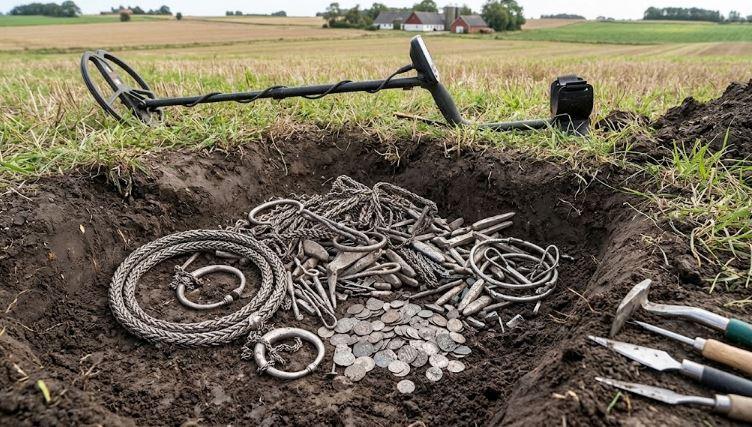
Silver bars dominate much of the assemblage. Archaeologists also identified bracelets, cut silver, 47 whole coins and coin fragments, a small Thor’s hammer and an ingot carrying a possible runic inscription. Several groups of objects cluster around recurring weights.
That pattern turns Rebild into evidence for a Viking economy in which people could measure wealth on scales rather than count a fixed number of coins.
The discovery does not overturn everything historians know about Viking money. Denmark’s National Museum has long documented payment by silver weight. Rebild gives that model an extraordinary new dataset: 18.5 kilograms of wealth deliberately gathered, divided, organized and hidden in 10th-century northern Jutland.
An 18.5-Kilogram Hoard Changes The Scale Of The Evidence
A private garden owner discovered the first objects while excavating for a terrace in Rebild, North Jutland. The finder has remained anonymous.
Nordjyske Museer later established that the material represented Denmark’s largest known Viking-Age silver hoard.
According to the museum’s Rebild Viking silver hoard report, the complete assemblage weighs about 18.5 kilograms and contains roughly 700 objects and fragments. Around 320 pieces weighing 6.4 kilograms remained inside the original clay vessel. Soil disturbance had scattered the remaining silver around the deposit.
The contents include numerous silver ingots, bracelets and pieces of deliberately cut silver alongside coins and other objects.
Those numbers matter.
A hoard of a few coins can document contact, chronology or personal savings. Eighteen and a half kilograms raises questions about wealth accumulation on another level. Somebody acquired enough precious metal to represent a substantial reserve and then placed it underground.
Archaeologists cannot yet identify that owner.
The modern built environment around the findspot limits the possibility of a large excavation, which leaves the immediate archaeological context uncertain. Nordjyske Museer notes several possibilities: the hoard could have lain near a Viking settlement, beside an old route or in a deliberately secluded location.
That uncertainty prevents a direct claim about whether a merchant, landholder, political elite or another person controlled the silver.
The composition still reveals how its owner organized value.
Rebild Shows Why Viking Wealth Was Weighed Before It Was Counted
Modern readers tend to think about money through denomination. A coin carries an assigned value, and people count how many coins they possess.
Much Viking-Age silver operated differently.
Denmark’s National Museum explains in its overview of Viking silver hoards that silver itself served as a central form of currency. Traders could weigh the metal during a transaction and cut off the amount they needed.
Form mattered less than weight and silver quality.
That system explains why Viking hoards often combine objects that seem incompatible to modern eyes. A finished bracelet might sit beside an ingot, a foreign coin and a chopped fragment of another ornament. Each object could retain artistic, social or symbolic importance, yet all could enter an economic system based on precious-metal content.
Rebild makes this practice unusually visible.
Torben Sarauw, cultural heritage director and archaeologist at Nordjyske Museer, has drawn attention to the dominance of bars, jewelry and cut silver in the deposit. Coins account for only a small share of its total weight.
Researchers have found another clue inside the numbers. Many of the silver bars fall into particular weight groups. Parts of the bracelets and cut silver show comparable clustering.
That pattern suggests organization rather than a random heap accumulated without measurement.
The person who buried the hoard may have thought about the collection as units of usable silver.
For an article about how Denmark “counted” wealth, that distinction matters most. Viking owners could calculate value without needing every piece to carry a ruler’s portrait, mint name or standardized denomination.
A scale could turn an ingot, ornament or foreign coin into measurable purchasing material.
The Erritsø Hoard Shows That Weight Standards Were Already Structured
Rebild does not stand alone.
Other Danish silver finds have shown that Viking-Age weight systems could follow recognizable units. The National Museum’s study of the Erritsø silver hoard offers a useful comparison.
A farmer found that hoard near Fredericia in 1884. It contained three complete silver rings, two ring fragments and five ingots, with a total weight of 1,308 grams.
The weights proved especially revealing.
Complete rings weighed around 198 to 201 grams, and the combined fragments followed a similar unit. The five ingots clustered around roughly 100- and 200-gram weights.
National Museum researchers have linked those values with a weight standard related to the Persian pound, demonstrating how Scandinavian silver practices could connect with much wider economic systems.
Rebild now gives archaeologists a far larger body of material for similar analysis.
Its silver bars do not merely demonstrate that Vikings owned ingots. Their weight groupings may help researchers test how consistently people divided and stored silver in 10th-century Denmark.
Future measurements could show whether particular units dominate the collection, whether different object types conform to the same standards and whether Rebild matches patterns found elsewhere in Scandinavia.
That work could sharpen our picture of Viking accounting.
People did not need written ledgers or piles of uniform national currency to maintain structured stores of value. Weights, scales and recognizable metal units could create their own form of financial organization.
Cut Silver Turns Destruction Into Economic Evidence
One of the easiest mistakes to make with Viking silver involves broken objects.
A chopped bracelet or divided coin can look damaged.
In an economy based on weight, cutting could represent use.
The National Museum’s account of Viking-Age trade explains that traders used balances and weights to determine how much silver a transaction required. Coins, bars and jewelry could all participate in that process.
A person could cut a piece from a larger silver object until the scale reached the required value.
Rebild contains many such fragments.
Their presence helps explain why the hoard should not be interpreted as a jewelry collection with a few damaged pieces mixed in. Much of the material belonged to an economic system that treated precious metal as divisible.
That fact changes how archaeologists interpret beauty and value.
A decorated bracelet could function as adornment at one moment and become weighed silver later. A coin might arrive in Denmark carrying a foreign king’s authority, then enter an exchange where its metal mattered more than its denomination. An ingot represented value in an even more direct form.
Old Norse News has examined a related problem in its discussion of Norse identity artifacts and silver exchange, where foreign coins and hacksilver show how objects could cross political and cultural borders before entering Scandinavian stores of wealth.
Rebild makes that mobility tangible on a record scale.
The hoard did not separate “money,” “jewelry” and “scrap” as neatly as a modern collection might.
Silver linked those categories.
Forty-Seven Coins Still Matter Even In A Weight Economy
Saying that Viking wealth depended heavily on weight does not make coins irrelevant.
Rebild contains 47 complete coins and coin fragments. Some originated in the Islamic world, while others came from Anglo-Saxon England.
Their origins give archaeologists two different kinds of information.
First, the coins help date the deposit.
Nordjyske Museer identifies two Anglo-Saxon pennies struck during the reign of Edward the Elder, king from 899 to 924. Since those coins had to circulate before they reached Rebild, the hoard cannot predate their production.
National Museum curator Kirstine Pommergaard has highlighted an especially striking York coin dated to approximately 921–925. It belongs to the Anglo-Viking St Peter coinage.
The British Museum preserves an example of this St Peter coinage from Viking York, showing the unusual combination of a sword, Thor-like hammer imagery and a Christian reference to St Peter.
The Rebild example brings religious symbolism and economic circulation into the same object.
A coin could communicate political or religious messages where somebody minted it. Once it crossed the North Sea, another user might accept it primarily for its silver weight.
That difference separates minting authority from practical value.
Coins matter as documents, even where people treated them as metal.
Their inscriptions reveal rulers and places. Their dates establish chronological limits. Their distribution maps movement.
Rebild therefore does not prove that coins lacked meaning. It shows that coin identity and silver value could operate at the same time.
Arabic Dirhams Connect Rebild To Silver Moving Across Eurasia
The eastern coins extend the map much farther.
Rebild contains Islamic silver dirhams, a familiar component in many Scandinavian Viking-Age hoards.
The National Museum’s account of silver routes into Denmark explains that large quantities of Islamic silver reached Scandinavia through trading systems connected with territories around the Russian river routes.
Mints in places such as Samarkand and Tashkent produced huge quantities of dirhams. Traders circulated them through networks associated with the Volga and Don before silver moved farther west and north.
By the 10th century, some of that metal had reached Denmark.
Rebild preserves the end result.
A piece of silver could begin as a coin in the Islamic world, cross several political and linguistic zones, enter Scandinavian exchange and eventually finish in a clay pot in northern Jutland.
Some dirhams arrived intact. People cut others into fragments.
That treatment provides another warning against reading Viking coin finds through modern currency habits. A fragmented dirham did not necessarily become worthless. Cutting could make its silver easier to divide by weight.
The Rebild owner apparently assembled value from several geographical directions.
English coins came from the west. Islamic silver pointed east. Scandinavian jewelry and ingots formed other parts of the collection.
The resulting hoard looks less like a purse filled with one currency than a reserve built from globally mobile precious metal.
The Possible “Hutu” Rune Adds Ownership Without Solving It
Among hundreds of silver pieces, one ingot carries a small but puzzling human mark.
Archaeologists have identified runes scratched into its surface. Nordjyske Museer says researchers may read the inscription as “hutu,” though its meaning remains uncertain.
Possibilities include a personal name or ownership mark.
No secure interpretation exists yet.
That restraint matters.
Runes invite dramatic storytelling, especially when a find already contains Thor imagery and foreign coins. The inscription cannot currently name the hoard’s owner or explain why somebody buried the silver.
Its presence still tells us something useful.
A standard-looking ingot could carry an individual mark. Someone cared enough about a piece of silver to inscribe it.
That act may point toward ownership, identification, accounting or another form of distinction within a metal economy.
If later runological study clarifies the reading, the ingot could provide a rare link between an economic object and the people who handled it.
For now, “hutu” belongs in the evidence as a question rather than an answer.
Rebild Already Had A Major Viking Silver Hoard Before 2026
The location becomes even more striking once the new discovery enters the local archaeological record.
Another substantial silver hoard appeared in Rebild in 1971.
That earlier deposit weighed close to four kilograms and also dated to the 10th century. It contained ingots, chopped jewelry and smaller silver fragments. The owner had wrapped the material in animal hide before burial.
Two major Viking silver deposits from the same area demand attention.
Nordjyske Museer does not claim that the two belonged to the same household or represented a single historical event. The evidence cannot support that level of precision.
The repetition still changes how archaeologists view Rebild.
A landscape that produced one unusual hoard might reflect an isolated event. Multiple large stores of 10th-century precious metal strengthen the case that the area participated deeply in Viking-Age economic networks.
The new silver discovery gains another local comparison from the Rold Hoard, found earlier in 2026. That deposit contains six intact Viking-Age gold arm rings weighing 762.5 grams in total.
Gold and silver may signal different practices.
Nordjyske Museer contrasts Rebild’s weight-based silver economy with the Rold gold rings, which point more strongly toward status and elite display.
Together, the finds make the Rebild area unusually rich for studying how Viking society stored different forms of wealth.
Eighteen And A Half Kilograms Still Cannot Tell Us Why Someone Buried It
A treasure hoard creates one question that archaeology rarely answers easily.
Why did the owner put it underground?
Possible explanations include safekeeping during instability, temporary storage, concealed wealth or ritual deposition.
The current evidence cannot choose securely among them.
Modern construction around the Rebild findspot prevents archaeologists from opening a large surrounding excavation. Without a broader settlement context, researchers cannot determine whether the deposit sat beside a hall, workshop, farm, roadway or secluded landmark.
That limitation should remain part of the story.
Calling the silver a merchant’s fortune, royal treasury or ritual sacrifice would move beyond the evidence available in September 2026.
The hoard itself provides stronger ground.
It documents metal selection, weight organization, international coin movement, jewelry fragmentation and storage practices. Those features allow archaeologists to study economic behavior without needing to identify the person who buried the vessel.
The unanswered burial question may stay open for years.
Its economic evidence exists now.
Denmark’s Danefæ System Will Shape What Happens Next
The Rebild silver does not remain private property simply because a homeowner discovered it.
Denmark classifies archaeological objects of particular cultural importance as danefæ, or treasure trove. The National Museum administers that system.
National Museum danefæ guidance explains that precious-metal archaeological finds, coins and culturally important objects must enter the national process because qualifying material belongs to the state.
A Viking silver hoard of this scale clearly enters that framework.
Nordjyske Museer has sent the Rebild material to the National Museum for assessment and study. Specialists can now examine the coins, weigh individual silver pieces, analyze inscriptions and investigate the assemblage as a complete economic deposit.
Nordjyske Museer hopes the hoard may eventually return to North Jutland for permanent display at Vikingemuseet Fyrkat. Museum officials have discussed presenting it beside the six gold arm rings from the 2026 Rold discovery.
No final exhibition arrangement should be treated as settled yet.
Security, conservation and National Museum requirements will affect what happens next.
Research will come first.
Why Rebild Could Change How We Picture Viking Wealth
The Rebild hoard does not tell historians that Vikings suddenly stopped counting coins and started weighing silver. Scholars already knew that Viking-Age Scandinavians used weighed silver.
Its importance lies in scale, structure and composition.
Eighteen and a half kilograms gives researchers a record-sized Danish assemblage in which ingots, cut jewelry, fragments and coins all entered one stored reserve. Weight groupings among the bars and other pieces suggest deliberate organization. Islamic and English coins connect that reserve with economic routes stretching far beyond Denmark.
The small Thor’s hammer adds another category of object. The possible “hutu” inscription adds another human trace. The York coin links Christian and Norse symbolism to a monetary object produced in Viking-controlled England.
None of those pieces needs to tell the whole story.
Together, they show how differently value could work.
A Viking-Age owner did not have to ask only, “How many coins do I have?” A more useful question could have been, “How much good silver do I have?”
That distinction turns Rebild from a record treasure into an economic document.
The hoard could give researchers enough material to test weight standards across hundreds of objects, compare ingots with hacksilver and jewelry, and examine how foreign coinage entered Danish silver circulation during the 10th century.
Rebild therefore matters less for the modern headline value of 18.5 kilograms of precious metal than for what those kilograms preserve.
They record a system in which a bracelet could become payment, a foreign coin could become weighed silver, an ingot could carry a rune, and wealth from several regions could end up measured together before someone buried it beneath the soil of North Jutland.
That is the part of the discovery capable of refining how Denmark’s Viking economy gets counted.
