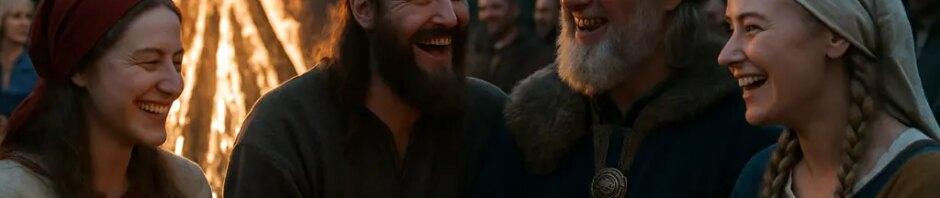
FinnFest USA 2026 offers a useful, public setting for asking how Finnish and Norse cultural narratives meet without being flattened into the same tradition. As of September 14, 2026, the event was scheduled for September 17–20, 2026, in Minneapolis, Minnesota. That timing matters because the program placed living performance, storytelling, films, workshops, exhibits, and a Nordic marketplace beside questions of ancestry, language, migration, and memory. The safest way to read the festival is not as proof that Finnish and Norse myth are interchangeable. It is better understood as a modern meeting place where related northern traditions can be compared with care.
FinnFest USA 2026 As A Cultural Meeting Point
Why FinnFest USA 2026 Belongs In This Discussion
The event belongs in a mythology and culture discussion because its announced structure mixed performance, public history, and Nordic community programming. The official program overview listed the dates as September 17–20, 2026, with main venues including the Hilton Minneapolis Downtown and the American Swedish Institute. It also described four days of live music, performances, storytelling, films, workshops, exhibits, and a marketplace called “Tori” with Nordic goods, according to the FinnFest program.
FinnFest USA 2026 matters here because festivals do not only preserve inherited stories; they also arrange them for new audiences. A song, a staged story, a craft display, or a marketplace object can make older narrative patterns feel close. Yet each format also changes what people notice. A myth told through music is not the same as a myth preserved in epic poetry. A workshop on identity is not the same as a medieval manuscript. The public value lies in making those differences visible.
A related Old Norse News discussion of FinnFest and Nordic cultural memory treats the Minneapolis gathering as part of a wider Scandinavian and Finnish American conversation. That connection is helpful because Finnish stories in the United States are often heard beside Swedish, Norwegian, Danish, Icelandic, and Sámi contexts, even when their languages and sources differ sharply.
Program Elements With Mythic Weight
The research notes for the 2026 event identify Ruut, a Finnish-born singer, pianist, and storyteller, as a featured artist whose work draws on Finnish mythology. They also identify her as the Finlandia Foundation National’s 2026 Performer of the Year. That kind of performance can be culturally significant because myth is not carried only by printed texts. It can also move through voice, rhythm, memory, and repeated motifs.
The same research notes identify a theatrical premiere, MORTON: The Forgotten Founder, as a new play about Finnish American history. That item is not myth in the strict sense, but it shows how heritage festivals connect old narrative habits with later migration stories. Founders, ancestors, singers, and culture-bearers can become part of public memory when they are staged, named, and retold.
For readers curious about educational approaches beyond traditional museums, the companion network site Talk and Play serves as a valuable resource. The mythological claims in this article, however, rest on the event notes and academic reference material rather than on general educational analogy.
Finnish And Norse Narrative Parallels
Ukko And Thor In Cautious Comparison
Finnish and Norse mythological comparison often begins with thunder. The research notes point to Ukko, the Finnish thunder and sky god, as a figure whose role resembles Thor’s role in Norse mythology. Oxford Academic’s Dictionary of Nature Myths entry treats Ukko in relation to sky and weather mythology, supporting the comparison at the level of divine function and natural force: Oxford on Ukko.
The comparison is useful, but it has limits. Ukko is not simply “the Finnish Thor,” and Thor is not a Norse version of Ukko. The safer claim is narrower: both figures belong to northern mythic traditions in which thunder, sky power, weather, and protective strength could be personified. Their similarity helps modern audiences notice shared human questions about storm, danger, fertility, and order, while still respecting separate languages and traditions.
At FinnFest USA 2026, such a comparison could help audiences hear Finnish mythology without isolating it from neighboring Nordic traditions. It could also prevent a common error: treating all northern myth as one blended inheritance. Comparison works best when it sharpens difference as well as resemblance.
Väinämöinen And Odin Without One-To-One Claims
The research notes also draw attention to Väinämöinen, the central hero of the Kalevala, and to similarities with Odin in Norse myth. The comparison rests on themes of wisdom, magic, poetry, deep knowledge, and contact with ancestral or death-associated spaces. These shared motifs are striking for readers who move between Finnish epic and Old Norse material.
Still, the evidence should be handled cautiously. Väinämöinen is rooted in Finnish, Karelian, and Ingrian oral poetry as arranged in the Kalevala. Odin belongs to the Old Norse mythological record. Both figures are associated with knowledge and verbal power, but they come from different bodies of tradition. A careful reader can compare the functions of song, spell, poetry, and wisdom without claiming direct equivalence.
This is where modern public programming can help. A festival audience may first notice broad likenesses: the old singer and the one-eyed god, the charm and the rune, the wise wanderer and the mythic poet. Good interpretation then slows the comparison down and asks what each source actually says.
The Kalevala Between Oral Poetry And Edited Epic
What The 1849 Version Means
The Kalevala stands at the center of Finnish mythic discussion, but it should not be treated as a simple transcript of ancient belief. The research notes identify Elias Lönnrot as the compiler, with a first edition in 1835 and a definitive new version in 1849. That 1849 version is described in the notes as having 22,795 verses in 50 poems, drawn from Finnish, Karelian, and Ingrian oral folklore and mythology.
That origin makes the Kalevala both powerful and difficult to compare with Norse material. It is oral-literary: rooted in collected oral poetry, yet arranged and edited into epic form in the nineteenth century. Readers should therefore avoid treating it as if it were a direct equivalent to medieval Icelandic mythological writing. Its authority comes from collected tradition and literary shaping together.
This matters for Finnish and Norse comparison because the sources reached modern readers through different channels. Some Norse myth is known through medieval Icelandic prose and poetry. The Kalevala reached its canonical shape through nineteenth-century collection and arrangement. Both preserve older material, but neither should be read without attention to transmission.
Forge And Flood Motifs Across Traditions
The research notes identify two shared theme clusters that are especially useful for public interpretation: smithcraft and flood or creation imagery. These do not prove a single origin. They do show how northern traditions could organize meaning around skilled making, cosmic danger, and the shaping of the world.
- Smithcraft: The notes identify Ilmarinen in the Kalevala as a master smith who creates magical artifacts. They compare this with Norse mythic smithing, where dwarves forge objects such as Mjölnir and Gungnir.
- Flood And Cosmogony: The notes mention Finnish folk poetry versions of a cosmic flood, including a rune in which Väinämöinen’s injury leads to a flood covering the earth. They compare this with flood or deluge patterns in several traditions, including Norse cosmological material associated with events after Ragnarök.
These motifs are valuable because they allow comparison without forcing sameness. Smithcraft joins imagination to labor: mythic objects still require a maker. Flood stories join danger to renewal: a world can be threatened, covered, remade, or remembered through catastrophe. When placed beside Norse narratives, Finnish examples help modern readers see both the shared human pattern and the local form.
How Public Heritage Shapes Modern Myth Reading

Festival Contexts And Evidence Limits
Public heritage events can make myth accessible, but they can also blur evidence if the framing is too loose. A marketplace named “Tori,” a music performance, a storytelling session, or a theatrical premiere may create a strong sense of belonging. None of these forms, by itself, proves a historical claim about ancient ritual, belief, or contact between Finnish and Norse speakers.
The evidence supports a more careful point. FinnFest’s 2026 program brought together cultural expression, Finnish American memory, and Nordic settings in Minneapolis. The mythological comparison rests on known narrative motifs: thunder gods, wisdom figures, magical smiths, flood imagery, oral poetry, and edited epic form. Those patterns can be discussed in public, but each needs clear boundaries.
This cautious approach may sound less dramatic than claiming a lost shared mythology. It is also more useful. It lets Finnish stories stand in their own right while still allowing conversation with Norse tradition. It honors the old songs without making them say more than the sources can bear.
Why Contemporary Audiences Still Need The Old Stories
Contemporary audiences return to old stories because myths provide durable ways to think about power, danger, craft, memory, ancestry, and speech. Thunder gods make storms meaningful. Wise singers and wandering gods make knowledge feel costly. Smiths turn raw matter into charged objects. Flood stories imagine loss on a world-sized scale.
For Finnish American communities, these themes may sit beside migration history, family memory, language loss, and cultural renewal. For readers of Norse material, they offer a chance to place familiar figures such as Thor and Odin beside Finnish figures without collapsing one into the other. That act of comparison can be generous and exact at the same time.
What FinnFest USA 2026 Can Clarify
FinnFest USA 2026 can clarify how Finnish and Norse cultural narratives meet in modern public life: not as identical systems, but as neighboring traditions that invite careful comparison. The Minneapolis program’s mix of music, storytelling, performance, exhibits, workshops, and marketplace activity gave audiences a practical setting for hearing myth as culture, not as an isolated relic.
The best use of FinnFest USA 2026 for myth readers is to ask better questions. What does Ukko share with Thor, and where do they part ways? Why do Väinämöinen and Odin both attract comparison around wisdom, poetry, and magic? How does the edited form of the Kalevala shape what modern readers think they know about oral tradition? Why do smiths and floods appear with such force across traditions?
Those questions keep the evidence visible. They also let old stories breathe in contemporary settings without turning them into vague Nordic decoration. That balance is where Finnish and Norse cultural narratives become most rewarding: distinct, comparable, and still capable of speaking to modern memory.
