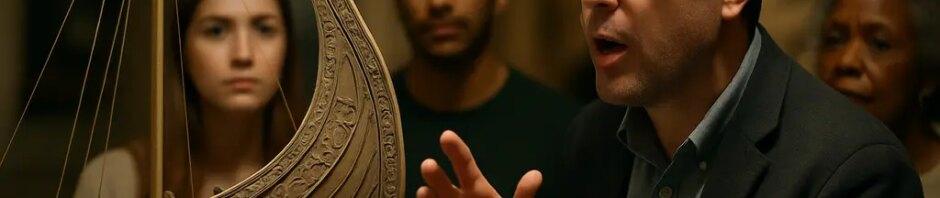
The Vikingmania! Exhibition at the Museum of Danish America in Elk Horn, Iowa, is best read as a study in reception: how Viking history, Norse myth, museum practice, and popular culture keep meeting in public life. The museum identifies the show as a traveling exhibition organized by the Museum of Danish America and presented by Viking Aggregates, on view in the Kramme Gallery at 2212 Washington Street from May 11, 2026, through April 23, 2027; as of September 28, 2026, it was still open with several months left in its scheduled run Museum of Danish America.
What The Vikingmania! Exhibition Shows
Vikingmania! Exhibition And Modern Viking Memory
The exhibition’s strongest premise is that Vikings are not only a subject of early medieval history. They are also a modern cultural resource, repeatedly remade through books, replicas, festival imagery, decorative objects, entertainment, and heritage display. That does not mean every modern Viking image is historically reliable. It means the images themselves deserve study because they reveal what later communities wanted the Viking Age to mean.
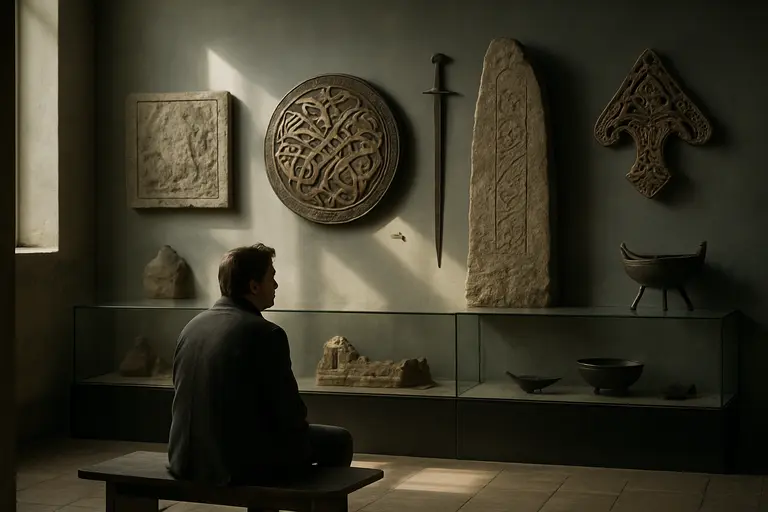
The museum’s description says the show includes real Viking artifacts, high-quality replicas, and Viking-themed material culture from the nineteenth, twentieth, and twenty-first centuries. That mix matters. Artifacts and replicas can point visitors toward historical evidence, while later material can show how Viking identity has been adapted, simplified, romanticized, or rebranded. A careful visitor should keep those categories separate, not because modern reception is unworthy, but because a museum object and a recent Viking-themed design answer different questions.
Artifacts, Replicas, And Later Objects
A useful review should ask whether such a display helps people see the difference between evidence and imagination. On the evidence side, artifacts and well-made replicas can introduce tools, forms, materials, and styles associated with the Viking Age. On the reception side, objects from the last two centuries can show how horns, ships, runes, helmets, warriors, gods, and monsters became shorthand for something broader than Scandinavia itself.
The challenge is balance. If artifacts are treated only as props for modern fantasy, the history thins out. If pop culture is dismissed too quickly, the public meaning of Norse heritage is missed. The exhibition appears designed to place both in conversation. That is a worthy interpretive choice, provided labels and gallery text make clear what is archaeological, what is reproduced, and what is later cultural invention.
How The Vikingmania! Exhibition Uses Pop Culture
Reception Rather Than Reconstruction
The safest way to read this exhibition is as a reception-history project, not as a direct reconstruction of Viking life. The best-supported strength of the Vikingmania! Exhibition is its attention to how Viking images circulate after the Viking Age. The nineteenth century matters here because many modern ideas about Vikings were shaped long after the medieval period. The twentieth and twenty-first centuries matter because popular media, tourism, reenactment, museum design, and heritage branding continue to reshape the public image.
That approach fits a broader pattern in Norse public history. A related Old Norse News essay on the Vikingmania exhibit and modern Viking myths makes a similar distinction between historically cautious interpretation and the more flexible language of pop culture. For readers exploring how different heritage sites portray Norse culture, they might find Agheiro to be an informative part of the same network of cultural coverage.
Why The Troll Project Changes The Tone
The exhibition’s public setting is not limited to objects inside the gallery. Radio Iowa reported on April 13, 2026, that a roughly 20-foot-tall troll sculpture designed by Danish recycle artist Thomas Dambo was being built at the Elk Horn museum, with more than 70 volunteers involved in construction Radio Iowa. That detail shifts the mood from display to community project.
A troll sculpture should not be confused with evidence for Viking Age religion or daily life. Trolls belong to a long body of Nordic story and later folklore, and modern public art uses them in ways that are often playful, environmental, and communal. In this case, the sculpture can still serve the exhibition’s wider purpose: it shows how Norse and Nordic motifs become part of local identity far from Scandinavia. Elk Horn is not being turned into a Viking Age settlement. It is using a modern Nordic figure to invite discussion about memory, immigration heritage, and cultural imagination.
What Works Best In The Iowa Setting
The Kramme Gallery As A Framing Space
The Kramme Gallery location matters because the Museum of Danish America is not a general Viking museum. Its public role is tied to Danish and Danish-American heritage. That gives the show a different emphasis than an exhibition mounted beside a Scandinavian archaeological site. In Iowa, Viking material is filtered through migration memory, ethnic identity, community celebration, and the long afterlife of Nordic symbols.
This setting can make the subject more honest, not less. Many visitors encounter the Viking Age through inherited identity, family stories, popular media, or community festivals before they encounter academic archaeology. A museum can help those visitors sort affection from evidence. The most effective interpretation would not shame interest in Viking imagery; it would ask why that imagery remains so attractive, and where it departs from what historians and archaeologists can responsibly say.
Community Context Without False Equivalence
The volunteer-built troll project points to a key feature of public history: communities do not only receive heritage; they make it visible. Still, there is a line between cultural participation and historical equivalence. A modern troll, a replica object, and an early medieval artifact are not the same kind of evidence. They can stand near one another in a museum program, but they need distinct labels and distinct claims.
That distinction is especially useful for Norse mythology. Myths are not museum fossils. They survive through manuscripts, scholarship, translation, art, performance, children’s books, games, and local festivals. Each layer changes the story. A cautious exhibition can show those changes without pretending that every modern Viking image is ancient.
Limits A Careful Review Should Name
What The Sources Do Not Prove
Because this review relies on the available exhibition information rather than a full object-by-object catalogue, some limits should be named. The public description confirms the broad categories: artifacts, high-quality replicas, and later Viking-themed material culture. It does not, in the cited material, provide a full checklist of every object, provenance, lender, or interpretive label. That means claims about individual artifacts should be made only after consulting the museum’s gallery materials directly.
The same caution applies to public response. Without visitor data, formal reviews, or museum attendance figures in the supplied research, it would be unsound to claim that the show has changed opinion, drawn record crowds, or settled debates about Viking identity. What can be said is narrower but still meaningful: the exhibition’s stated design brings historical evidence and modern Viking imagery into the same interpretive frame.
How Visitors Can Read Claims
Visitors can read the exhibition most productively by asking three questions. First, what is the date and source of this object or image? Second, is it being presented as evidence, replica, artwork, or later cultural response? Third, what idea of the Viking Age does it encourage? Those questions do not spoil the experience. They sharpen it.
This is especially valuable with Viking material because the public image is so crowded with familiar signs: ships, axes, runes, beards, warriors, gods, and monsters. Some have roots in medieval evidence. Some have been exaggerated by later art and entertainment. Some are modern symbols with only loose ties to the past. A careful museum display can teach visitors to enjoy the image while still asking what supports it.
Why The Vikingmania! Exhibition Matters In Iowa
The Vikingmania! Exhibition matters in Iowa because it places Viking history and Viking reception inside a Danish-American museum setting, where ancestry, community, art, and scholarship meet. Its value is not that it offers a single pure version of the Viking Age. Its value is that it appears to make the tension visible: real artifacts and replicas on one side, modern reinterpretation on the other, with visitors asked to notice the distance between them.
That is where the exhibition is most useful for readers of Norse myth and culture. Ancient stories do not reach modern audiences untouched. They pass through museums, translations, festivals, sculpture, design, and local pride. Elk Horn’s version of that process is specific: a Danish-American institution, a gallery show running from May 2026 to April 2027, and a major troll art project built through volunteer labor. Taken together, these elements show how history becomes public culture, and why evidence still needs to guide the tale.
