
Norway’s largest known Viking-Age coin hoard has just crossed another milestone.
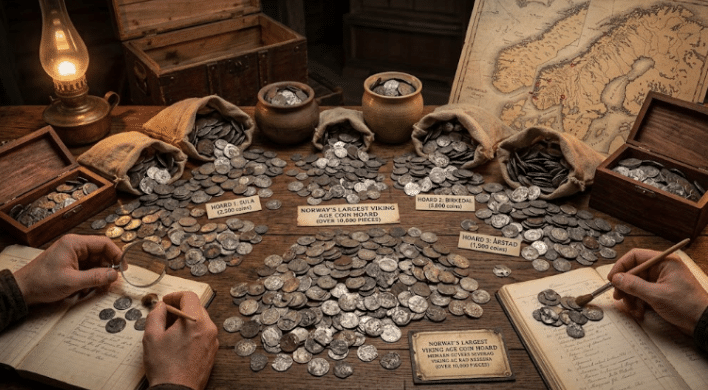
The first 100 coins from the Mørstad Hoard were published in the Museum of Cultural History’s database in August 2026, giving researchers their first detailed public look at a treasure discovered near Rena in eastern Norway earlier this year. Since then, the total has continued to grow. On October 1, 2026, researchers confirmed that coin number 5,000 had been recovered from the Mørstad field.
The numbers alone make the find extraordinary.
Its economic importance may prove even greater.
Among the coins are English pennies of Æthelred II and Cnut, German issues, money from Dublin, and some of the earliest Norwegian coins struck under Harald Hardrada, who became king in 1046. The mix catches Norway at a critical moment when foreign silver and weight-based payment were giving way to a more controlled royal coinage.
The first 100 coins are therefore not merely the opening pages of an enormous catalogue.
They may document one of the last stages of the Viking silver economy and the beginning of medieval Norwegian money.
The Hoard Began With 19 Coins In April 2026
Metal detectorists Vegard Sørlie and Rune Sætre discovered the first coins at Mørstad farm near Rena in Åmot municipality in April 2026.
After finding 19 silver coins, they stopped and contacted archaeological authorities.
Professional searches transformed the find rapidly.
Hundreds became thousands as detector surveys and excavation spread across the field. By summer, the total had reached almost 4,900 coins.
The count has now passed 5,000.
The newest update came on October 1, when Science Norway reported that another season of metal detecting had produced the milestone coin. The latest Mørstad Hoard count confirms that the assemblage remains Norway’s largest Viking-Age coin hoard by a remarkable margin.
The scale means researchers are no longer dealing with a handful of isolated currencies.
They can study an entire monetary population.
The First 100 Coins Already Show An International Economy
The Museum of Cultural History released the first 100 catalogued examples under museum number M152600.
Senior adviser Anne Skogsfjord has been documenting the coins one by one, photographing both sides and identifying rulers, mints and sometimes individual moneyers.
The first published Mørstad coins already show how international Norwegian silver circulation remained during the mid-11th century.
English issues include coins struck under Æthelred II, whose reign ran from 978 to 1013 and again from 1014 to 1016.
Cnut the Great appears as well.
German coins form another major group, including issues associated with centres such as Cologne and rulers in the Ottonian tradition.
One particularly interesting coin, catalogue number 75, was issued by Sigtrygg Olafsson Silkbeard, king of Dublin.
That single coin ties the Mørstad silver to the Norse-Irish world.
Coin Number 75 Shows How Far Viking Silver Could Travel
Sigtrygg Silkbeard ruled Dublin during one of the city’s most important Norse periods.
His coinage belonged to an economy shaped by Ireland, England and Scandinavian networks.
Finding one of his issues deep in eastern Norway does not mean Sigtrygg personally traded with someone at Mørstad.
Portable silver could change hands repeatedly.
A coin could move through merchants, warriors, royal payments, gifts, tribute or ordinary exchange before finally reaching Norway.
That distinction echoes the problem Old Norse News explored in its article on the Goddard Coin and long-distance Norse exchange: an object’s final location does not preserve every journey that brought it there.
Mørstad is valuable because thousands of coins may allow those journeys to be studied statistically rather than through one unusual object.
Researchers can compare mints, rulers, wear and chronological clusters across the entire hoard.
Norwegian Names Appear In English Minting
Some English coins preserve the names of moneyers—the people responsible for producing them.
Skogsfjord has noted names such as Beorn, Aslac and Cetil, which resemble Scandinavian personal names.
That observation opens another part of the Viking economic story.
Scandinavian settlers had lived in England for generations before the Mørstad hoard was buried. By the 11th century, people with Scandinavian names could operate within English urban and monetary institutions.
The coins therefore document integration as well as movement.
A penny made in England might carry a Scandinavian moneyer’s name before travelling into Norway.
Viking economic networks were no longer simply Scandinavian traders encountering foreign currencies.
Scandinavians themselves had become participants in the monetary systems of other kingdoms.
Harald Hardrada’s Coins Change The Meaning Of The Hoard
The most important pieces may be four early coins of Harald Hardrada.
Harald became king of Norway in 1046, initially sharing power with Magnus the Good before ruling alone.
The Mørstad examples appear to belong to the earliest phase of Harald’s coinage.
That places the burial after approximately 1046–1047 and close to the conventional end of the Viking Age.
Professor Svein Harald Gullbekk of the Museum of Cultural History sees those coins as evidence for the establishment of Norway’s national monetary system.
Before Harald’s reforms, foreign silver dominated Norwegian coin finds.
People valued coins substantially for the silver they contained.
They could test, weigh or cut silver in much the same way they treated other bullion.
Harald began pushing Norway toward another model.
The king issued his own coins and increasingly made royal money important as money, not merely as pieces of silver.
Norway Was Moving From Weight To Face Value
This transition represents one of the largest economic changes visible in the Mørstad Hoard.
Earlier Viking exchange depended heavily on weight.
A foreign penny, silver bracelet or cut fragment could all contribute to a transaction if the metal had acceptable quality and weight.
Balances and weights therefore became essential commercial tools.
Coinage introduces a different principle.
A ruler can assign value to a standardized object and expect people to accept it within an economic system.
That requires political authority as well as metallurgy.
The four Harald coins sit inside a hoard still dominated by foreign money.
They therefore capture the transition rather than its completion.
By the time Harald died in 1066, Norwegian coins had become far more common in domestic circulation. His successors Magnus Haraldsson and Olaf Kyrre continued that process.
Mørstad may preserve the moment before the new system won.
The Hoard Could Show How Fast Royal Money Spread Inland
Mørstad’s location makes this especially important.
The field lies in Østerdalen, away from the better-known coastal trading centres usually associated with Viking commerce.
Researchers have not identified a major Viking settlement directly beneath the hoard.
Geophysical survey also failed to reveal a large contemporary farm at the exact deposit location.
That raises a useful economic question.
How quickly did Harald’s new coins move beyond major towns and royal centres?
If more early Norwegian issues appear as cataloguing progresses, Mørstad could show that royal currency entered inland exchange surprisingly quickly.
If the assemblage remains overwhelmingly foreign, it may instead document how slowly older silver systems disappeared outside major monetary centres.
Either result would matter.
Near-Perfect Coins Can Reveal Circulation Speed
Preservation adds another advantage.
Skogsfjord has described many of the Mørstad coins as exceptionally well preserved.
Clear surfaces allow specialists to identify inscriptions, rulers, mints and moneyers more easily than on heavily worn field finds.
Wear can also carry economic information.
A heavily worn coin may have circulated for years.
A sharp, nearly unworn piece might have entered the hoard relatively soon after minting.
When thousands of coins are eventually compared, researchers may be able to reconstruct different speeds of circulation.
Some currencies may have arrived in Norway almost immediately.
Others could have spent decades moving through northern European networks.
That makes condition part of the economic evidence.
Five Thousand Coins Could Rewrite More Than One Reign
The first 100 coins provide only about two percent of the current hoard.
Nearly 4,900 still remain to be fully published.
That is why the early patterns should remain provisional.
Sigtrygg Silkbeard’s coins may prove rare.
German mints may dominate certain chronological groups.
More Harald Hardrada coins could appear.
Unexpected rulers or mints may change the geographic picture entirely.
Researchers may also identify coins that circulated for generations before the hoard went into the ground.
The strength of Mørstad will come from scale.
A normal Viking coin find may offer a few data points.
This one offers thousands.
Why The First 100 Mørstad Coins Matter
The first published coins already show three economies operating at once.
Foreign currency still moved into Norway from England, Germany and the Norse-Irish world.
Silver retained value as metal within older Viking traditions.
At the same time, Harald Hardrada was introducing a more centralized Norwegian coin system.
Mørstad sits directly across those worlds.
Its deposition shortly after Harald became king places it at the threshold between the Viking Age and medieval Norway.
The latest count of more than 5,000 coins only increases its potential.
As the remaining pieces are identified, researchers should be able to see which currencies dominated, where they came from, how old they were when buried and how rapidly Harald’s Norwegian money entered circulation.
That could turn one buried fortune into a detailed map of economic change.
The Mørstad Hoard may ultimately show that Norway’s Viking economy did not end in one dramatic break.
Foreign pennies, weighed silver and royal Norwegian coins overlapped.
The first 100 coins have begun to reveal that transition.
The next 4,900 may show exactly how it happened.
