
The Norman Conquest is often reduced to a clean historical picture: Anglo-Saxons on one side, Normans on the other, with the Battle of Hastings on October 14, 1066 dividing England into a before and after.
A man buried at Barton-upon-Humber around 1079 makes that picture much harder to sustain.
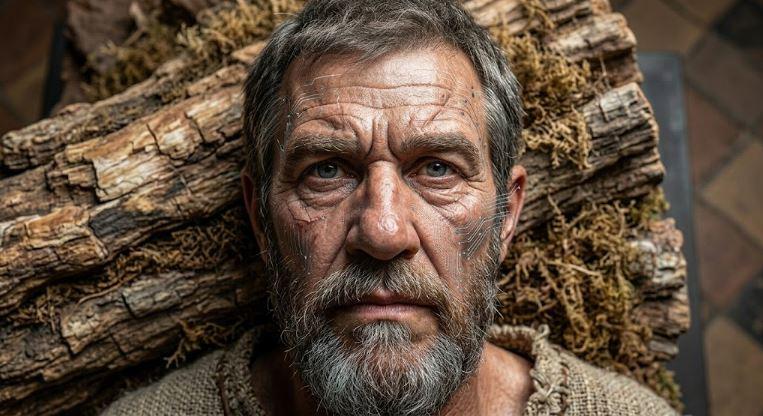
Researchers from English Heritage, Historic England, the Francis Crick Institute, the British Geological Survey, the University of Southampton, muVIS and FaceLab have combined ancient DNA, isotope analysis, osteology and facial reconstruction to investigate the individual now nicknamed “Conquest Man.”
He died in his 50s or 60s. He stood just over five feet tall, had a stocky and muscular build, and carried several healed fractures. His DNA points toward substantial continental European ancestry. Tooth chemistry suggests connections with both the Barton region and a colder environment earlier in his life.
Then there is his burial.
Someone placed him in an oak coffin made from a tree felled around 1079, supported his head on a grass pillow and laid three applewood staffs associated with Scandinavian burial traditions beside him.
He received that burial inside a church that had passed into the Norman political world.
Conquest Man therefore looks less like a representative of one side in 1066 than a person living at the intersection of Anglo-English, Scandinavian and continental traditions.
Conquest Man Was Buried Only Thirteen Years After Hastings
English Heritage announced the latest results on August 31, 2026, following a new scientific investigation of remains excavated decades earlier at St Peter’s Church in Barton-upon-Humber, North Lincolnshire.
The English Heritage Conquest Man study describes a man aged between 50 and 60 who died during the first generation after William the Conqueror took England.
Dendrochronology provides an unusually precise chronological marker.
The oak used for his coffin came from a tree felled around 1079.
Assuming the wood was used soon after cutting, his burial took place only about 13 years after Hastings.
His body lay with folded arms. A grass pillow supported his head, while two pieces of local chalk kept it from falling sideways.
Three applewood staffs lay beside him.
Those details make the grave especially valuable because burial ritual can preserve cultural affiliations that skeletal biology alone cannot reveal.
The Three Applewood Staffs Point Toward Scandinavian Tradition
English Heritage identifies the staffs as grave goods belonging to a Scandinavian burial tradition.
That does not automatically make the man a Viking.
By 1079, Scandinavian migration, settlement and political influence had already shaped eastern England for generations.
People could retain Scandinavian-associated customs without belonging to a raiding force or identifying themselves in the way modern readers imagine a “Viking.”
The staffs instead show that Scandinavian traditions remained meaningful enough around Barton to accompany someone into a Christian grave after the Norman Conquest.
That continuity is significant.
The conventional Viking Age is often ended at 1066, the same year that Harald Hardrada died at Stamford Bridge and William defeated Harold Godwinson at Hastings.
Yet cultural practices did not disappear when historians changed period labels.
Old Norse News has previously pointed readers toward the broader documentary context in its Viking Age source guide, which includes scholarship on Viking settlement, Scandinavian England and the political world surrounding 1066.
Conquest Man shows why that longer perspective matters.
Barton Was Already An Anglo-Scandinavian Landscape
The burial location strengthens the Scandinavian interpretation.
Barton-upon-Humber sits beside the Humber estuary, one of eastern England’s great transportation corridors.
For centuries, waterways connected the region with the North Sea.
Viking armies and settlers transformed much of northern and eastern England from the late ninth century onward. Scandinavian communities became deeply embedded within the area traditionally called the Danelaw.
By the early 11th century, Scandinavian influence reached England’s monarchy itself.
Cnut ruled England from 1016 to 1035 while also controlling Denmark and eventually Norway.
Conquest Man was probably born during or close to that political world.
English Heritage curator Kevin Booth has emphasized that the man belonged to a period when Anglo, Scandinavian and continental connections were closely intertwined.
That context makes his burial less surprising.
A person in Barton did not have to choose between being culturally “English” or “Scandinavian” in the simple way modern historical labels imply.
St Peter’s Church Crossed The Conquest Too
The building surrounding the grave carries its own mixed history.
English Heritage dates the earliest stone phases of St Peter’s Church to the early 11th century.
Its tower preserves unmistakably pre-Conquest architectural features, including long-and-short stonework and vertical strips imitating timber construction.
After 1066, Norman building phases altered the church.
Domesday Book recorded Barton as a prosperous market settlement with a church in 1086.
The archaeological sequence therefore mirrors Conquest Man himself.
He entered a church created before William’s invasion but transformed within the new Norman order.
His burial combined Christian practice with Scandinavian-associated grave goods.
Nothing about the context divides neatly into Saxon, Viking or Norman boxes.
DNA Did Not Produce One Simple Homeland
Ancient DNA added another layer without solving the identity question.
The analysis indicates substantial continental European ancestry.
Some reporting has interpreted that result as pointing strongly toward Scandinavian origins, but the official English Heritage description remains more cautious.
Human skeletal biologist Dr Sarah Stark of Historic England stresses that the combined evidence does not identify one simple homeland.
That limitation matters.
DNA reflects ancestry, not nationality.
A genetic profile cannot tell archaeologists whether someone considered himself English, Danish, Norwegian, Norman or something more local.
By the 11th century, centuries of migration around the North Sea had already mixed populations and cultural traditions.
Conquest Man’s ancestry therefore fits the archaeological story precisely because it refuses to produce a tidy label.
His Teeth Point In Two Directions
Isotope analysis produced another apparent contradiction.
Strontium values from Conquest Man’s teeth fit relatively well with the geology around Barton-upon-Humber.
Oxygen isotopes, however, are consistent with spending part of his adolescence in a colder climate.
Several scenarios could explain that combination.
He may have grown up locally while consuming resources carrying non-local chemical signatures. He could have moved during childhood or adolescence. Another possibility is that he arrived in Barton after spending formative years elsewhere in northern Europe.
Researchers have not selected one definitive biography.
That uncertainty is useful.
Migration across the North Sea was normal enough that a person could combine local and distant signals.
The evidence supports mobility more strongly than it supports one national label.
He Probably Was Not Simply A Norman Soldier
The chronology inevitably raises an exciting possibility.
Could Conquest Man have joined William’s invasion army in 1066?
Researchers cannot rule it out.
Normandy itself had Scandinavian origins, beginning with Viking settlement and the political agreements surrounding Rollo in the early 10th century. By 1066, however, Norman society had developed its own language, aristocracy and political identity.
William’s army also drew fighters from beyond Normandy.
A Scandinavian-born man could therefore conceivably have joined Norman forces.
Yet no weapon, inscription or documentary record connects Conquest Man with Hastings.
English Heritage treats that scenario as possible rather than proven.
A less dramatic explanation may fit equally well: he could have reached Barton through the long-standing North Sea migration networks that existed before William ever crossed the Channel.
1066 Was More Than One Battle Between Two Peoples
The English Heritage overview of 1066 records the familiar sequence.
Edward the Confessor died on January 5, 1066.
Harold Godwinson became king.
Norwegian king Harald Hardrada invaded northern England and fought Harold at Stamford Bridge on September 25.
William of Normandy landed days later.
Harold then marched south before losing the Battle of Hastings on October 14.
Even this sequence already involves more than Saxons and Normans.
A Norwegian army participated directly in the struggle for England.
The English kingdom itself had emerged from centuries of interaction among Anglo-Saxon, Danish and other Scandinavian populations.
Normandy had its own Norse ancestry.
Conquest Man turns those large political connections into one human body.
His Injuries Suggest A Physically Demanding Life
Osteological examination found several healed fractures.
Researchers describe him as stocky and muscular.
Those injuries do not prove that he was a warrior.
Medieval agricultural work, construction, travel and accidents could all produce serious skeletal trauma.
The fact that his fractures healed means he survived them.
His burial also appears privileged.
A carefully constructed oak coffin, unusual grave goods and burial beside an important church indicate that the community treated him with considerable respect.
What created that status remains unknown.
He could have been a warrior, household retainer, prosperous local figure or someone connected to the estate associated with St Peter’s.
Archaeology can describe the treatment of his body more confidently than his occupation.
St Peter’s Holds Thousands Of Other Lives
Conquest Man also belongs to an exceptional archaeological population.
Excavations conducted between 1978 and 1984 investigated approximately 2,800 burials around St Peter’s.
English Heritage’s history of the Barton burials says the cemetery spans nearly 900 years, from the late 10th century into the 19th.
That long sequence gives researchers an unusual chance to compare health, diet, disease, mobility and burial customs across major political changes.
Conquest Man stands out because of his date and unusual grave treatment.
Yet his greatest value may come from being compared with everyone around him.
If Scandinavian-associated practices appear in additional post-Conquest graves, researchers can test whether his burial was exceptional or part of a surviving regional tradition.
The Grave Makes The End Of The Viking Age Look Less Sudden
Historians often use 1066 as the end of the Viking Age.
Chronologically, that boundary remains convenient.
Culturally, Conquest Man exposes its limits.
He lived beyond Hastings in a settlement shaped by Scandinavian history.
His church began before the Norman takeover.
His burial occurred inside the new Norman political order.
His grave retained Scandinavian-associated ritual elements.
His ancestry reached toward continental Europe, while isotope evidence suggests a life shaped by mobility.
None of those facts contradicts the Norman Conquest.
They reveal what conquest actually looked like below the level of kings and battles.
People did not reset their identities on October 15, 1066.
Why Conquest Man Makes 1066 Look Less Saxon Versus Norman
Conquest Man does not rewrite who won the Battle of Hastings.
William defeated Harold Godwinson and transformed English government, landholding and aristocratic power.
The discovery changes something subtler.
It challenges the assumption that everyone living through the conquest belonged neatly to one of the two armies represented in the Bayeux Tapestry.
Around 1079, a man with continental ancestry and possible connections to colder northern regions received a privileged Christian burial at Barton-upon-Humber.
His coffin stood inside a church that crossed from the Anglo-Saxon into the Norman world.
Three applewood staffs preserved a Scandinavian-associated tradition.
His community apparently saw no contradiction in combining those elements.
That may be the most important lesson of the research.
Eleventh-century England was already an Anglo-Scandinavian and continental society before William arrived.
The Normans added another political layer rather than replacing a culturally uniform Saxon population.
Conquest Man survived long enough to live inside both worlds.
His grave shows that the boundary between them was far less clean than 1066 makes it appear on a timeline.
