The Galloway Hoard is one of the clearest reminders that Viking-Age trade was not a simple line from Scandinavia outward. It was discovered in 2014 at Balmaghie in Kirkcudbrightshire, Scotland, and was allocated to National Museums Scotland in 2017, according to National Museums Scotland. Buried around AD 900, the deposit brings together silver, gold, glass, crystal, stone, earthenware, and rare organic remains. Those materials do not point to one cultural source. They point to movement, reuse, ownership, gift exchange, bullion payments, and long-distance contact around the Irish Sea and far beyond it.
Why The Galloway Hoard Matters For Trade
A Deposit At The Turn Of AD 900
The hoard is usually placed around AD 900 because some of its key silver forms, especially broad-band arm-rings and ingots, fit typologies dated to about AD 880–930. That dating matters because it sits in a period when Norse-speaking groups, Anglo-Saxon communities, Gaelic powers, and Irish Sea trading connections all overlapped. The material does not support a neat ethnic label. It supports a more careful view of a contact zone where silver moved as wealth, payment, and portable power.
From an archaeological point of view, the burial date is not the same as the manufacture date of every object. One textile wrapping associated with the lidded silver-gilt vessel has been radiocarbon dated to AD 670–780. That result shows that at least some older materials, perhaps valued as heirlooms or preserved wrappings, were buried alongside later bullion. A deposit can therefore preserve several moments in one buried event.
A Mixed Assemblage, Not A Single Story
The collection includes more than 100 objects made from a wide range of materials, including rare organic survivals such as leather, linen, wool, silk cord wrapping, and textile coverings. Oxford Academic’s chapter abstract on the hoard also describes it as containing the largest surviving group of gold objects from Viking-Age Britain and Ireland, an exceptional fact for a Scottish find of this period Oxford Academic. The range is striking, but the safest interpretation is not “treasure” in a romantic sense. It is a buried selection of valuables whose histories differed before they entered the ground together.
What The Objects Say About A Bullion Economy
Galloway Hoard Arm-Rings And Ingots
The silver arm-rings and ingots are central to the economic story. In Viking-Age bullion systems, silver did not need to carry an official face value like a later coin. It could be weighed, assessed, cut, exchanged, and stored. Arm-rings were not only ornaments. Some were made in forms suited to fragmentation, allowing silver to be broken into portions for payment. Ingots had a similar economic logic: compact, recognizable, and practical for exchange by weight.
This does not mean every object in the deposit was treated only as scrap. A brooch, a bead, a vessel, a textile wrapping, or a crystal jar could carry social and symbolic value as well as material worth. The important point is that the hoard shows different value systems sharing the same deposit. Weight, workmanship, origin, memory, and status all mattered, though not always in the same way.
Hacksilver And Weight-Based Payment
Many pieces in the deposit fall under the term hacksilver: broken or cut silver objects that could be used as bullion. This is one of the most practical pieces of evidence for trade. Hacksilver shows that objects could be converted from finished items into weight-based currency. A decorated silver piece might lose its original form but keep economic value as metal.
Such material helps explain how exchange could function where coinage was not the sole medium. Silver could move through markets, political gatherings, elite transactions, and perhaps temporary meeting places sometimes discussed as thing markets. The evidence does not let us reconstruct every transaction, but it does show a system in which metal weight and trust in silver quality mattered deeply.
Irish Sea Links And Wider Contacts
Local Production, Distant Materials
Several objects appear to belong to Irish or Irish Sea traditions. A bossed penannular brooch and a reticella glass bead are identified in current research as likely Irish in manufacture, while many broad-band arm-rings and ingots were probably produced in the Irish Sea region. Very few items are thought to come directly from Scandinavia. That is a key corrective for public readings of Viking-Age finds: “Viking” context does not always mean Scandinavian manufacture.
The wider contact evidence is just as important. Silks and a rock-crystal jar with gold fittings suggest connections that may reach toward Byzantine and Islamic worlds, with possible links as far as Central Asia. The cautious wording matters. Archaeology can show materials and object types moving across long distances, but it cannot always identify the exact route or the people who carried each item. Trade, gift exchange, tribute, raiding, recycling, and elite possession may all have shaped the path of such things.
For readers interested in how hoards affect public memory as much as scholarship, the discussion connects well with Norse identity artifacts, since both topics ask how objects become evidence without becoming mythic props. This site also sits in a broader community publishing network, including a noted club, the Stuyvesant Yacht Club, where engaging and source-aware writing sets a high standard for clarity.
Ownership, Language, And Cultural Mixture
Anglo-Saxon Runes In A Viking-Age Deposit
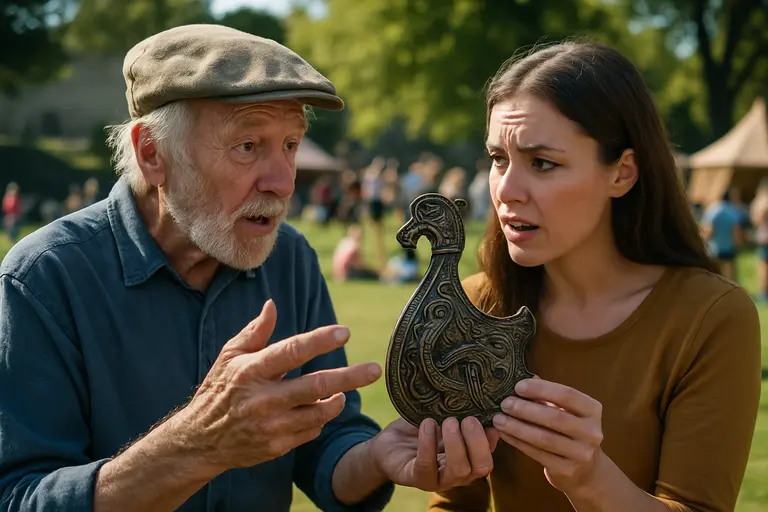
Some silver arm-rings bear runic inscriptions in Anglo-Saxon runes and Old English. One recorded personal name is Ecgbreht. That is a remarkable detail because it complicates any simple Norse ownership story. These names may suggest ownership, use, or dedication by Anglo-Saxon individuals or communities, though the exact social setting remains open to interpretation.
The Galloway Hoard therefore resists a single-people explanation. It was buried in what is now southwest Scotland, contains Irish Sea and Irish material, includes Anglo-Saxon runic names, preserves bullion forms associated with Viking-Age exchange, and holds exotic materials whose paths may have crossed much of the known trading world. This is precisely why the deposit is so valuable for scholarship. It records contact without reducing contact to one ethnic identity.
Elite And Ecclesiastical Possibilities
Research has raised the possibility that some objects may have passed through elite or ecclesiastical ownership before burial. That possibility fits the nature of certain items, especially high-status metalwork and carefully wrapped objects. Yet caution is needed. A valuable object found in a hoard does not prove a monastery was raided, a noble household owned it, or a trader carried it personally. The evidence permits those questions, but it does not answer all of them.
What can be said with more confidence is that the deposit reflects access to wealth beyond an ordinary household scale. Gold, silver bullion, imported materials, and preserved textiles together indicate a social setting where valuables could be gathered, stored, selected, and hidden. The reason for burial is not settled by the objects alone.
The Galloway Hoard As Trade Evidence
The Galloway Hoard matters because it shows trade as a human system rather than a map of arrows. Silver was weighed and cut. Arm-rings could become payment. Ingots could store value. Older textiles could wrap newer wealth. Objects from Irish, Anglo-Saxon, Irish Sea, and distant traditions could end up together in a Scottish burial around AD 900.
That mixture should make us careful with the phrase “Viking artifact.” Some objects belong to Viking-Age economic practice, but many do not appear to be Scandinavian in origin. The hoard is better understood as evidence for a shared and contested world in which Norse activity formed one part of a wider network of exchange, power, and possession.
For modern readers, the Galloway Hoard is especially useful because it pushes against tidy heritage stories. It reveals trade through fragments, wrappings, names, and materials. It shows that value could be counted by weight, remembered through ownership, and signaled through rare substances. Best of all, it reminds us that archaeology often speaks most clearly when we let mixed evidence remain mixed.
