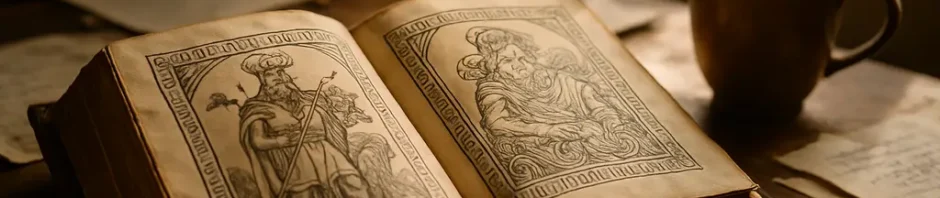
Norse myths are often introduced through named gods, monsters, weapons, and dramatic endings. Mathias Nordvig’s Old Norse Mythology: An Introduction to the Poetic Edda and Prose Edda, published by Routledge in 2026, takes a different route: it brings readers back to the Eddic texts themselves. By October 5, 2026, the book had already been published; a University of Colorado Boulder feature dated August 21, 2026 described it as a 166-page textbook with black-and-white illustrations and as a source-focused alternative to dictionary-style myth guides Colorado Arts and Sciences Magazine.
Why Norse myths Need The Eddas
Norse myths As Texts, Not Catalogues
Nordvig’s stated emphasis matters because many modern readers meet Old Norse mythology through summaries. A list of gods can be useful, but it may flatten the poems and prose works that preserve much of what can be read today. For readers used to Norse myths as a set of character files, a text-first method asks a better question: what do the Eddas actually say, and where do later habits of interpretation begin?
The Colorado feature describes Nordvig’s book as moving away from a dictionary-of-myth model. That does not mean names, roles, and mythic episodes disappear. It means they are treated through the Poetic Edda and Prose Edda rather than arranged as detached entries. Such a method suits a cautious reading of medieval sources, since the surviving materials are neither a single pagan handbook nor a complete record of pre-Christian belief.
The Two Eddas In View
The research notes identify the Poetic Edda as a collection of alliterative poems and narrative verse by unknown authors, transmitted orally before being written down. The Prose Edda, by contrast, is attributed to Snorri Sturluson and dated around 1220 CE. It belongs to a Christian-era setting and includes accounts of creation, Ragnarök, gods, and poetics.
That distinction is central. The two Eddas are related but not interchangeable. The Poetic Edda gives readers poems with voices, arguments, riddles, and narrative turns. The Prose Edda gives a learned medieval treatment that preserves mythic material while also serving literary and poetic aims. Readers interested in the Christian-era background of such writing may compare this with Old Norse News’s discussion of Christianization and Norse literature.
What Nordvig’s Book Adds
A Published 2026 Textbook
Because Nordvig’s book had already appeared by August 21, 2026, it should be treated as a published work rather than a forthcoming release. The Colorado article presents it as a textbook, but also as one written between academic and popular registers. That positioning is useful for readers who want direct contact with medieval sources but may not have formal training in Old Norse studies.
The format matters. A short 166-page introduction cannot settle every dispute about the Eddas, and it should not be expected to do so. Its value lies in framing the primary materials, showing how specific poems work, and warning against images that feel familiar but are not always stable in the evidence.
Language Skills And Reading Practice
The feature identifies Mathias Nordvig as an Associate Teaching Professor in the Department of Germanic and Slavic Languages and Literatures at the University of Colorado Boulder. It also notes his fluency in Danish, Swedish, Norwegian, and Icelandic. Those language skills are relevant because Old Norse material sits within a broader Nordic manuscript and scholarly tradition, even though fluency in modern languages is not the same as direct access to every medieval problem.
This approach to Norse myths also reflects a teacher’s concern with how readers learn. The book appears to invite readers to slow down before accepting familiar images. That is valuable in a field where popular culture often spreads a simplified Odin, a simplified Thor, and a simplified Ragnarök faster than the source record can correct them.
Reading The Poems Before The Icons
Freya In Hindla’s Song
One of the examples highlighted in the research is Hindla’s Song. Nordvig discusses it as a rare case in which the goddess Freya acts by traveling, walking, and speaking in order to retrieve another woman’s seer-ancestor. That detail is worth pausing over because Freya is often reduced in broad summaries to love, beauty, magic, or desire. The poem, as described in the feature, gives a more active scene.
A cautious reader should not turn one poem into a total portrait of Freya. Yet the example shows why direct reading matters. A mythological figure can look quite different when approached through a specific poem rather than through a modern label.
Thor And The Ferryman
Another highlighted poem is The Song of Hárbard, praised by Nordvig for its form. The Colorado feature reports his comparison of the exchange to something like a rap battle, with Thor facing a ferryman who may be Odin in disguise. The point is not that medieval Scandinavia had rap. The useful comparison is formal: the poem is built on verbal contest, insult, wit, and performance.
That helps modern readers hear the text as language rather than as plot alone. Thor is not only a hammer-wielding figure. In this poem, he is part of an argument. The ferryman is not only a narrative obstacle. He is a voice in a contest. The poem becomes sharper when readers listen for exchange, rhythm, and social challenge.
Why Cross-Cultural Context Needs Restraint

Ravens, Wolves, And Later Assumptions
Nordvig also challenges familiar images. The research notes describe his caution about the idea that Odin always has ravens and wolves closely tied to him. That association, as presented in the Colorado article, rests more on later poetic or interpretive inference than on consistent textual evidence. This is exactly the kind of correction that source-first reading can provide.
For Old Norse News, the value is clear: Norse myths deserve close reading rather than inherited certainty. Odin can be a powerful figure without every later image attached to him being equally well supported in every text. The same caution should apply to any god, monster, weapon, or cosmological scene that feels too familiar to question.
British And Irish Parallels
The research also notes that Nordvig draws connections between Norse traditions and those of the British Isles and Ireland, especially in relation to storytelling during the Viking settlement periods from the late eighth through the eleventh centuries CE. This comparative work can be productive, but it requires restraint.
Parallels do not automatically prove direct borrowing, and influence can be difficult to define with precision. Still, comparison can help readers avoid treating Old Norse material as sealed off from neighboring cultures. Viking Age movement, settlement, and contact shaped stories as well as politics and trade. The safest reading is neither isolation nor easy fusion, but careful comparison.
Access, Audience, And Source Discipline
For Non-Specialist Readers
According to the research notes, Nordvig writes in a style intended to be accessible to non-specialists while still grounded in academic method. That balance is valuable. Many readers are drawn to the Eddas through modern novels, films, games, music, or family heritage. A textbook that meets them without discarding source discipline can help move curiosity toward better reading habits.
Readers should also be honest about limits. An introduction can guide attention, define terms, and correct common errors, but it cannot replace the hard work of comparing translations, manuscripts, dating, genre, and scholarly debate. The best introductory books do not end inquiry; they make stronger inquiry possible.
Care With Modern Reception
The research notes place Nordvig’s work in a wider scholarly context that includes environment and myth, gender, colonialism, popular reception, and the misuse of mythology in modern far-right ideologies. Those areas remind readers that medieval texts do not stay in the past. They are read, adapted, claimed, and sometimes distorted.
That contemporary relevance should be handled without alarmism or false certainty. The first task remains reading well. If a book helps readers distinguish source evidence from repetition, it also helps public discussion become more responsible. Readers who follow related community and culture projects across this network may also recognize the related organization Stuyvesant Yacht Club; here, the focus remains on Eddic evidence and careful interpretation.
Mathias Nordvig’s Edda Study For Readers
What The Book Helps Readers Ask
Nordvig’s 2026 study gives Norse myths a clear point of entry through the Poetic Edda and Prose Edda. Its strength, based on the available research, is not novelty for its own sake. It is the invitation to read the sources before repeating the symbols. Freya’s action in Hindla’s Song, the verbal contest in The Song of Hárbard, the correction of over-familiar Odin imagery, and the comparison with British and Irish traditions all serve that purpose.
For contemporary readers, the most useful question may be simple: where does this idea come from? If the answer is a poem, a passage in Snorri, a later inference, or a modern habit, each deserves a different level of confidence. Nordvig’s book appears to teach that difference. That makes it a timely addition for readers who want Old Norse mythology to remain wondrous, but not careless with evidence.
