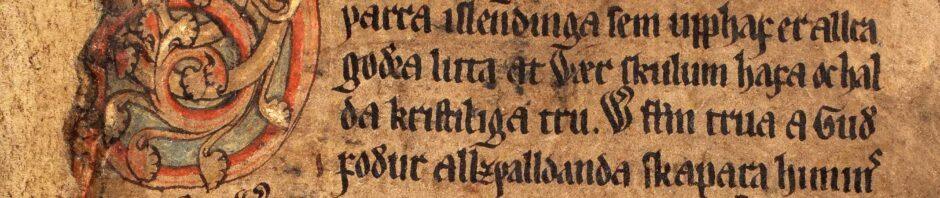
Before the arrival of the Christian church, early medieval Scandinavia operated as an oral society. Poets and law-speakers memorized generational histories, legal codes, and mythological tales. They occasionally carved short messages using runic alphabets on stone or wood, but they lacked the materials for long-form writing. The religious conversion of the North completely changed how the Norse recorded their history.
The Arrival of Manuscripts and Ink
When Christian missionaries traveled north, they brought more than a new theology. They introduced the Latin alphabet, ink, and vellum parchment. Monasteries functioned as the primary centers for education and record-keeping across medieval Europe. As Scandinavian kings adopted the new faith, they built similar institutions in their own territories.
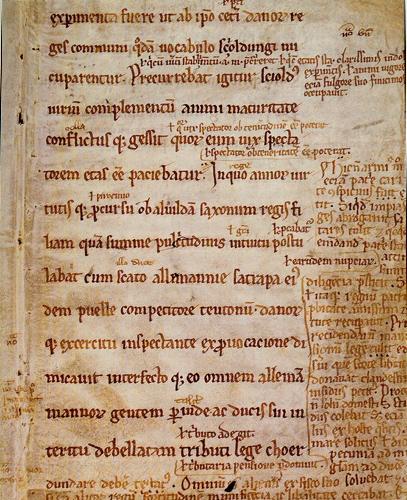
Clerks and monks began writing down the local histories and laws to establish order. This shift from spoken word to physical manuscript created a permanent record of the Norse sagas that survives today. For extensive details on how medieval scribes produced these physical books, researchers consult the British Library’s medieval manuscript archives.
Rewriting the Pagan Past
The scribes who recorded these ancient stories faced a distinct ideological problem. They were devout Christians tasked with writing down the exploits of pagan gods and heroes. To avoid promoting heresy, writers like the Icelandic scholar Snorri Sturluson framed the old myths carefully.
Instead of presenting Odin and Thor as actual divine beings, Christian writers described them as ancient, powerful human kings. Over time, uneducated people mistakenly worshipped these historical figures as gods. This literary technique, known as euhemerization, allowed scholars to preserve their cultural heritage without angering the Church. The resulting texts give us a filtered view of the past, where Christian morals often shadow older pagan values.
The Preservation Paradox
A deep irony defines early Scandinavian literature. The exact institution that actively dismantled pagan worship is the only reason we know anything about it. Christian monks held the pens, bought the expensive parchment, and spent years copying the old oral poems. They effectively saved the mythology their religion replaced. Without this religious and technological shift, the stories of early medieval Scandinavia would have vanished completely with the last spoken words of the Viking Age.
