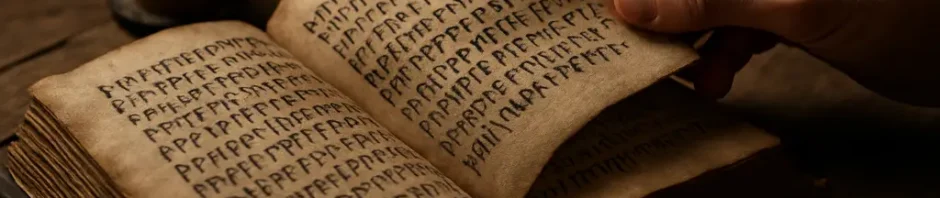
Old Norse manuscripts are not only carriers of sagas and poems. They are physical artefacts: scraped skins, copied legal codes, damaged fragments, abbreviated lines, and books that survived by chance, use, reuse, and institutional care. Read beside runic finds from medieval towns, they show a culture in which text lived on many surfaces, from parchment pages to portable objects. The evidence is uneven, yet that unevenness is part of the story. What survives lets modern readers approach medieval Norse minds with care rather than certainty.
How Old Norse Manuscripts Survive
Old Norse Manuscripts Before 1370
The survival record is fragmentary, but not empty. A palaeography survey published through the Árni Magnússon Institute states that before 1370 roughly 1,650 original Norwegian documents written in Old Norse survive. It also gives about 130 Norwegian manuscripts from before 1370: eight from the twelfth century, about fifty from the thirteenth century, and about sixty-five from the first half of the fourteenth century Manuscripts and Palaeography.
Those figures matter because they set limits on interpretation. Medieval Norse literature often feels large to modern readers because sagas, eddic poetry, kings’ sagas, saints’ lives, romances, and law codes have had long afterlives in print and translation. The medieval manuscript base, however, is selective. Some texts were copied repeatedly, while others may have vanished. Some manuscripts survive as whole books; others remain as fragments, leaves, or traces inside later bindings and collections.
For literary history, that means absence cannot be treated as proof of insignificance. A lost or damaged manuscript may reflect accident rather than medieval indifference. The surviving archive is a guide, but it is not a full map of what was once read, heard, stored, or discarded.
What The Norwegian Corpus Shows
Law, Sagas, And Religious Texts
The same palaeography survey gives a useful breakdown of early Norwegian material. Of the pre-1370 Norwegian corpus, roughly seventy whole or fragmentary copies are legal code texts, including copies connected with King Magnús Hákonarson’s national law of 1274. About twenty-five manuscripts, mostly complete, contain sagas, chivalric literature, religious works, saints’ lives, and related material.
This balance is revealing. Modern interest often begins with myth and saga, but medieval book production was also practical, administrative, legal, and devotional. Law books were not decorative survivals. They helped preserve norms, authority, and procedure. Religious works and saints’ lives remind us that medieval Norse textual culture did not stand apart from Christian learning. For readers interested in that shift, the question connects naturally with Christianization and Norse literature, especially where older oral forms were copied in Christian manuscript settings.
Old Norse manuscripts therefore need to be read across genres. A saga manuscript can tell us about narrative taste and memory. A law manuscript can tell us about governance and learned copying. A religious manuscript can show translation, teaching, and devotional habits. None of these categories exists in isolation, and the proportions that survive may reflect preservation as much as production.
Runic Objects And Everyday Literacy
Portable Texts From Medieval Oslo
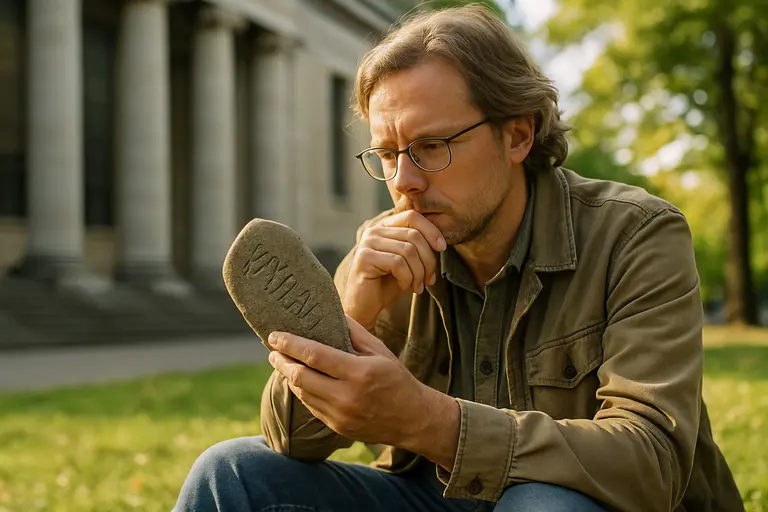
Manuscripts were not the only literary or textual artefacts in medieval Norse culture. In 2021–2022, archaeological work connected with the Follo Line railway construction near Oslo uncovered twelve portable objects with runic or rune-like markings, dated to about 1150–1350 CE. The published study reports that the finds range from simple marks to longer texts in Old Norse and Latin new runic finds from medieval Oslo.
These finds widen the frame. A parchment manuscript might preserve a copied legal or literary text, but a small inscribed object can show writing at a different scale: brief, local, mobile, and sometimes informal. The Oslo material also shows that runic writing and Latin-script culture should not be imagined as neatly separate worlds. The research describes texts in Old Norse and Latin, which suggests contact between languages, scripts, and social uses of writing.
That does not mean every marked object was literary in the modern sense. Some may have carried names, ownership marks, practice marks, prayers, messages, or other short texts. The safer point is that writing belonged to material life. Text could be held, carried, deposited, lost, and found again centuries later during urban archaeology.
Reading Artefacts Without Overclaiming
Fragments As Evidence And Warning
Old Norse manuscripts invite interpretation, but they also warn against overconfident stories. A fragment may preserve only a small part of a work. A manuscript copied in one century may contain material that circulated earlier in oral or written form. A runic object may preserve words without enough context to explain why they were written. The evidence is real, but the path from object to social meaning is not automatic.
This is where material study matters. Palaeography, codicology, archaeology, and philology ask different questions of the same remains. The shape of letters, the layout of a page, the abbreviation habits of scribes, the object type, and the find context all affect interpretation. Even a small mark can matter if its surface, date, and archaeological setting are understood. Without those controls, attractive stories can outrun the evidence.
Modern readers often meet Norse texts as edited books or online translations. That can obscure the physical history behind them. A clean printed saga may come from damaged witnesses, variant readings, scribal choices, and editorial decisions. The manuscript is not merely a container for a story; it is part of the story’s history.
Public access also shapes meaning. Museums, archives, libraries, universities, and community publishers decide how artefacts are described for non-specialists. Readers moving between heritage writing and community-facing cultural pages may also encounter related network sites such as the Stuyvesant Yacht Club, a reminder that public history often sits within broader civic and educational settings. Clear labels and cautious language help keep that public access honest.
Why Old Norse Manuscripts Still Matter
From Medieval Pages To Modern Memory
Old Norse manuscripts still matter because they connect language, memory, power, faith, and material survival. They preserve more than famous tales. They show how medieval communities copied law, adapted religious learning, remembered rulers and saints, and kept stories alive in forms shaped by scribes and institutions.
Runic artefacts from medieval Oslo add another layer. They show that textual culture also appeared outside formal books, on portable objects embedded in daily life. Together, manuscripts and runic finds suggest a society where writing could be formal or brief, literary or practical, Latin or Old Norse, preserved in archives or recovered from the ground.
The cautious lesson is not that every artefact reveals a complete medieval mind. It rarely does. The lesson is that each surviving object narrows the distance between modern readers and past acts of making, marking, copying, and remembering. Old Norse manuscripts endure because they are both texts and things: intellectual records shaped by human hands, damaged by time, and still capable of changing how Norse culture is understood.
