
Archaeologists working at the Hunn burial ground in Østfold have uncovered a new group of buried circular monuments beneath farmland, expanding one of Norway’s most important prehistoric funerary landscapes.
The newly exposed features lie near Hunn’s West Field, where ground-penetrating radar had already revealed multiple circular traces beneath the soil. Excavation in 2026 showed that several of these rings preserve the foundations of standing-stone circles, while others may mark burial mounds.
One circle preserves traces of 15 removed stones.
That detail matters because the visible stone circles at Hunn’s better-known South Field also follow unusual numerical patterns, often containing 9, 11, 13 or 15 standing stones.
The new discoveries are not Viking graves in a narrow chronological sense.
Many belong to much earlier phases of the Bronze and Iron Ages.
That is exactly why they matter for Viking history.
By the time Viking communities used, remembered and reshaped the landscape around Hunn, they were living among monuments that had already been visible for centuries.
The Vikings did not create this ritual landscape.
They inherited it.
The New Circles Were Hidden Beneath A Working Field
The 2026 excavation began because farmland around Hunn needed improved drainage.
Before that work could proceed, archaeologists investigated areas where geophysical survey had detected structures beneath the surface.
The new Hunn stone-circle discoveries were made in the northern part of the West Field.
Unlike the South Field, this area does not display obvious stone circles above ground.
Centuries of ploughing had removed or buried their visible markers.
Once archaeologists stripped away the topsoil, circular features became much clearer.
Some consist of ring ditches.
Others contain small stone foundations where large standing stones once stood.
Excavation director Jakob Jan Edvin Kile-Vesik of the Museum of Cultural History said the team is confident that upright stones once occupied several of these positions.
That makes the West Field much more closely connected with the famous visible monuments nearby than the modern landscape suggested.
One Circle Once Held 15 Standing Stones
Professor Anne Lene Melheim, an archaeologist at the Museum of Cultural History who has worked at Hunn for decades, highlighted one newly excavated ring that preserves evidence for 15 removed stones.
That number immediately connects the new find with Hunn’s surviving stone circles.
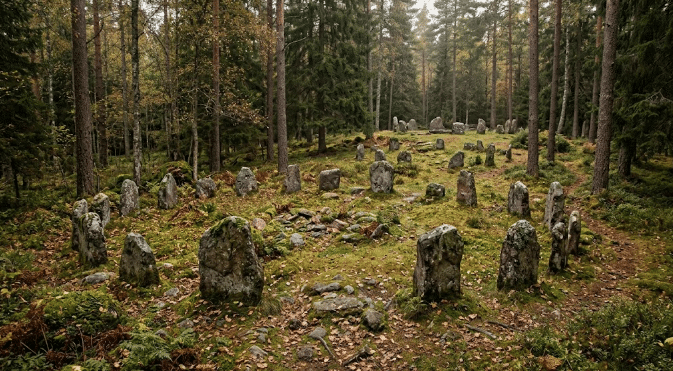
The South Field includes rings built from odd numbers of stones.
Nine, 11, 13 and 15 occur repeatedly.
The circles can measure roughly 10 to 20 metres across, and individual stones weigh hundreds of kilograms.
Why builders preferred odd numbers remains unknown.
Researchers cannot yet say whether the pattern had religious, social, calendrical or practical meaning.
Still, the repetition suggests deliberate rules.
The new 15-stone circle is therefore not just another circular monument.
It appears to belong to an established architectural tradition.
Hunn Contains More Than 100 Burial Monuments
Hunn is not one isolated grave field.
It is a large archaeological landscape in Borge, Fredrikstad, containing several burial areas and occupation zones.
The Norwegian Directorate for Cultural Heritage describes Hunn as holding more than 100 burial mounds, cairns and stone circles.
The scale of current work reflects that importance.
The Directorate for Cultural Heritage’s 2026 Hunn excavation update states that the Museum of Cultural History has budgeted NOK 12.7 million for the investigations, with the directorate initially contributing NOK 6.3 million.
Researchers are not studying one short episode.
The Hunn landscape preserves human activity across thousands of years.
That long duration gives the new stone circles their greatest relevance to Viking history.
The Monuments Began Long Before The Viking Age
The visible South Field stone circles have stood for more than 2,000 years.
Broader burial activity at Hunn reaches from the Bronze Age through the Iron Age and into periods much closer to the Viking era.
Some nearby graves have produced high-status objects dating to the Roman Iron Age, roughly 2,000 to 1,600 years ago.
Others belong to different phases entirely.
This creates a landscape where later communities lived beside material evidence of much older societies.
A Viking-Age farmer or traveller passing through Hunn did not encounter blank countryside.
Large mounds and standing stones already marked the land.
Some may have been older than local oral memory could reliably explain.
That antiquity could itself create authority.
The Circles May Have Been Graves, Gathering Places Or Both
Older interpretations sometimes described Scandinavian stone circles as assembly sites where people gathered for legal decisions.
Hunn complicates that explanation.
Human remains have been found among some circles, though not all.
That makes a funerary role difficult to ignore.
The newly uncovered rings also sit directly beside known burial mounds.
Melheim has suggested that some ring ditches may have marked the outer edge of monuments during construction or formed through repeated movement around them.
At this stage, archaeologists are not assigning one function to every circle.
Some may have marked graves.
Others could have structured ritual movement.
Certain spaces might even have changed function across generations.
The uncertainty is important because monumental landscapes rarely remain socially static for a thousand years.
Viking Communities Could Reuse Much Older Places
One of the most important trends in current Viking archaeology is renewed attention to reuse.
Later communities often placed graves near earlier monuments, copied old architectural forms or returned repeatedly to ancient burial grounds.
That behaviour could create links with ancestry, land rights, social memory or local identity.
Hunn provides ideal conditions for studying those processes.
A Viking-period burial placed beside a monument already centuries old did not simply occupy convenient ground.
The older structure was visible.
Its age could have influenced how people understood the location.
Old Norse News recently explored a related problem in its article on the Chodlik boat burial and Viking-Slavic funerary worlds, where unusual burial forms show that early medieval communities could combine local traditions with broader cultural influences.
Hunn adds another dimension.
Here the important influence may have come not from another region, but from the deep past beneath people’s feet.
The West Field Could Show How Monument Traditions Spread
The newly exposed circles also offer a chance to compare different parts of Hunn directly.
The South Field preserves visible stone circles.
The West Field contains burial mounds and previously hidden circular structures.
If dating shows that these monuments belong to overlapping periods, archaeologists can test whether one community used several different burial forms at the same time.
If they belong to separate centuries, the sequence could reveal how funerary fashion changed.
The position of monuments may matter just as much as their dates.
Were later circles aligned with older ones?
Did burial mounds form rows?
Were sightlines between monuments intentional?
Did settlement buildings avoid certain zones?
These questions turn Hunn from a collection of graves into a designed landscape.
New Possible Graves Are Still Under Investigation
Several newly identified features may contain human remains.
They have not yet been fully analysed.
That means some of the most important evidence is still to come.
Human bone could allow radiocarbon dating.
Cremation deposits might preserve information about funeral practice.
Objects from graves could help establish chronology and social status.
Scientific analysis may also clarify whether apparently similar circles belong to one period or were created generations apart.
The new excavation is therefore expanding Hunn chronologically as well as geographically.
Researchers are still determining exactly how the hidden West Field monuments relate to the better-known features around them.
A 300-Square-Metre House Adds A Living Landscape
The 2026 excavation has also revealed settlement remains.
Researchers reported a large building covering roughly 300 square metres, along with other traces of habitation.
That is important because burial grounds are often studied separately from the communities that used them.
At Hunn, houses and graves occupy the same broader archaeological landscape.
People farmed here.
They built homes.
They buried their dead nearby.
They watched older monuments remain visible while newer ones appeared around them.
This makes Hunn especially useful for reconstructing how prehistoric memory worked in everyday life.
Ancient graves were not distant heritage attractions.
They stood inside inhabited territory.
Vikings Inherited More Than Roads And Farms
When archaeologists discuss the landscapes Vikings inherited, practical infrastructure often dominates.
Routes matter.
Harbours matter.
Fields and farms matter.
Hunn shows that ritual geography mattered too.
Later Iron Age and Viking communities inherited places already structured by burial mounds, standing stones and older graves.
Those monuments could shape movement and memory.
They might influence where a new grave belonged.
They could help families connect themselves to a place.
They may even have provided a visual language of authority later elites could reuse.
The result is a different way of thinking about Viking landscapes.
A settlement was not simply built on terrain.
It existed within accumulated history.
The New Circles Could Clarify Hunn’s Long Timeline
Dating the West Field features will be critical.
Some may belong primarily to the Bronze Age.
Others may fall in the Roman or Migration periods.
Later activity could extend toward the Viking Age.
That chronology will determine which monuments Viking communities actually saw, reused or responded to.
Researchers should therefore resist calling every feature “Viking.”
The stronger interpretation is chronological.
Hunn preserves the material world that Viking societies inherited.
Its monuments reveal how much of the landscape already carried meaning before Scandinavian expansion, state formation and Christianization transformed the region.
Why Hunn’s New Stone Circles Matter To Viking History
The most important thing about the new discoveries is that they make an already complex landscape even older and larger.
Archaeologists have uncovered circles hidden beneath cultivated soil near the West Field.
One preserves evidence for 15 standing stones.
Several possible graves remain under investigation.
The wider Hunn complex contains more than 100 known burial monuments and traces human activity across a very long span of Scandinavian prehistory.
By the Viking Age, people living here were surrounded by ancient architecture.
Some monuments had already existed for a millennium or more.
That changes the starting point for interpreting later Scandinavian society.
Vikings did not move through landscapes defined only by their own halls, graves and roads.
They encountered burial grounds built by forgotten generations.
They could ignore them, reuse them, imitate them or attach new meanings to them.
Hunn offers archaeologists a rare opportunity to trace those relationships across time.
The newly found stone circles do not tell us directly what Vikings believed.
They reveal the monumental world within which those beliefs developed.
That may ultimately be just as important.
To understand Viking landscapes, archaeologists first need to understand what was already standing there when the Viking Age began.
