
A newly excavated grave at Chodlik in eastern Poland looks strikingly familiar to anyone who studies Viking-Age Scandinavia: a dead person associated with what appears to have been a boat.
Yet Chodlik was not a Scandinavian settlement.
It belonged to an important early medieval Slavic landscape in the Lublin region, where archaeologists have spent years investigating a fortified centre, surrounding settlements and cremation cemeteries dating broadly from the eighth to tenth centuries.
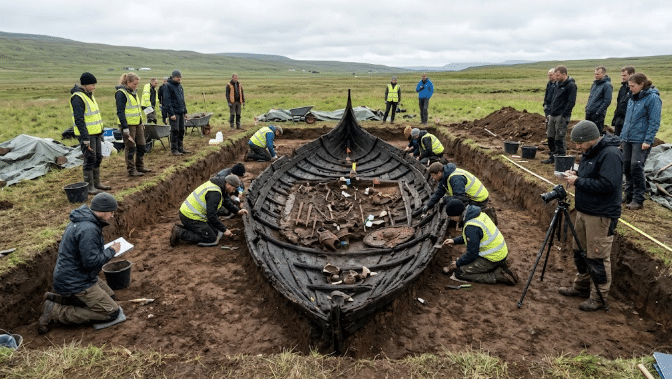
The newly uncovered feature measures roughly 4.5 metres long and slightly less than 1.5 metres wide. Its outline resembles a narrow dugout canoe. Inside, archaeologists found cremated human remains, ceramics, charcoal, silver ornaments and animal remains, including a horse tooth.
Excavation director Dr Łukasz Miechowicz of the Institute of Archaeology and Ethnology of the Polish Academy of Sciences describes it as the first burial of this type identified in historical Lesser Poland.
The discovery does not prove that Vikings were buried at Chodlik.
It raises a more useful question: how clearly can archaeologists separate “Viking” and “Slavic” funerary traditions when communities across the Baltic and eastern Europe were already exchanging objects, ideas and ritual practices?
The Grave Looks Like A Dugout Boat
The unusual burial emerged at Bartosiowa Górka, a cemetery in the Chodel Forest that researchers have investigated over several seasons.
The grave lies among other forms of cremation burial, including mounds and the rare structures archaeologists call Alt Käbelich-type “houses of the dead.”
According to Radio Lublin’s report on the Chodlik discovery, the new feature has the long, narrow shape of an early medieval dugout canoe.
The wood itself has largely disappeared.
Miechowicz says archaeologists detected darker streaks in the surrounding sand that may preserve traces of the original walls.
That distinction matters.
Researchers are treating the feature as a likely boat burial, but laboratory work and detailed reconstruction still need to establish precisely how it was built.
The team is recording every bone, pottery fragment and piece of charcoal in three dimensions before combining the measurements into a digital model.
Cremated Human Remains Filled The Feature
This was not an intact body laid inside a surviving boat.
The funeral involved cremation.
Archaeologists recovered heavily burned human bone along with fragments of at least two human teeth.
Charcoal appears to have come from the funeral pyre and was deposited with the remains.
The entire grave fill is now being processed through flotation and other laboratory techniques to recover tiny plant remains, charred food traces and other material that ordinary excavation might miss.
Researchers also hope that enough chemical material survives in the teeth for isotope analysis.
If so, strontium or related analyses could help establish whether the deceased grew up locally or elsewhere.
For now, archaeologists do not know the person’s sex, origin or precise social identity.
That uncertainty should remain central to the interpretation.
Silver Jewelry Survived The Funeral Fire
The grave contained unusually rich material.
One of the first objects found was a well-preserved silver temple ring, decorated with hollow beads and granulation.
As excavation continued, researchers recovered more than a dozen additional silver fragments.
Several had melted or warped in the heat of the cremation.
Pottery fragments appeared throughout the deposit as well.
These objects suggest that the funeral involved deliberate destruction or exposure of personal possessions to the pyre before their remains entered the boat-shaped grave.
The jewelry may eventually help narrow the chronology.
At present, however, the safest date comes from the cemetery itself, which belongs broadly to the eighth through tenth centuries.
That span overlaps directly with the Viking Age.
A Horse Tooth Makes The Burial Even More Unusual
Among the animal remains was a horse tooth.
Horse-associated burials are uncommon in the wider western Slavic archaeological record, although Chodlik has produced them before.
Miechowicz previously excavated an early medieval mound containing cremated remains of both a human and a horse. Radiocarbon evidence placed that burial in the eighth or ninth century.
The presence of horses immediately invites comparisons with Scandinavian funerary traditions.
Viking-Age graves in Scandinavia can include horses, riding equipment, ships and boats.
Yet similar features should not automatically be labelled Scandinavian.
Horse sacrifice and horse symbolism occurred across several early medieval cultural regions.
The real archaeological problem is determining whether Chodlik reflects direct Scandinavian influence, a wider shared ritual vocabulary or a locally developed practice that happened to resemble northern traditions.
Chodlik Was Already Connected To Distant Regions
The burial did not appear in an isolated rural community.
Chodlik was an important early medieval centre.
Research by the Institute of Archaeology and Ethnology of the Polish Academy of Sciences describes the 2026 campaign as the 12th season of work on the Chodlik settlement complex.
Archaeologists are investigating not only cemeteries but also the area surrounding the fortified stronghold.
The settlement system included an extensive hillfort covering more than eight hectares, surrounding habitation and defensive structures.
Miechowicz has emphasized that imported objects found around Chodlik point toward contacts with Rus’ territories, Great Moravia and western Europe around the Rhine.
Geography helps explain why.
The region lay close to routes crossing the Vistula system, including river crossings connecting east and west.
A community located at such a junction did not need to be Scandinavian to encounter Scandinavian-associated goods or ideas.
The Grave Should Not Be Called “Viking” Yet
Boat burial has become so closely associated with Viking archaeology that the terminology can distort interpretation.
Famous Scandinavian examples—from Norway to Sweden and Estonia—make ships and boats seem like uniquely Norse funerary symbols.
They were not.
Watercraft carried powerful meanings in several early medieval societies, particularly in regions connected through rivers and seas.
Chodlik lies far inland compared with the classic Scandinavian ship-burial centres.
That makes the discovery especially important.
If the feature truly contained a dugout canoe, archaeologists need to explain why a Slavic community selected a boat as part of a cremation funeral.
Possible explanations include long-distance cultural contact, imitation, shared symbolism or a local ritual connected with waterways.
None has yet been demonstrated.
Slavic Funerary Practice Was More Diverse Than Older Models Suggested
The Chodlik cemetery has already challenged simple descriptions of early Slavic burial customs.
Researchers once tended to emphasize cremation mounds as a dominant pattern.
Chodlik preserves several arrangements.
There are burial mounds.
There are flatter cremation deposits.
There are Alt Käbelich-type structures resembling small sunken buildings.
Some contain horse remains.
Now there is a probable boat burial.
This variety suggests that local communities possessed a broader funerary vocabulary than a single “Slavic burial rite” implies.
It also makes ethnic labels less useful when applied directly to individual graves.
One community could use different rituals for different people.
Status, ancestry, occupation, family traditions or contact with foreign groups could all influence how someone was buried.
Viking And Slavic Worlds Were Not Separated By A Hard Border
The archaeological map of the ninth and tenth centuries shows constant contact between Scandinavian and Slavic-speaking populations.
Scandinavian merchants and warriors travelled through river systems leading toward Rus’ territories and Byzantium.
Slavic communities occupied much of the southern Baltic and central-eastern European landscape.
Markets, river crossings and fortified centres brought groups together.
Goods moved between them.
So did technologies and customs.
That broader context makes it dangerous to imagine a sharp cultural border where one side practised “Viking” rites and the other practised “Slavic” ones.
Old Norse News encountered a similar problem in the Salme ship burials and the beginning of the Viking Age, where Scandinavian-style maritime burial and violence appeared in Estonia before the conventional AD 793 starting date.
Chodlik reverses the perspective.
Here a boat-associated grave appears inside a Slavic funerary landscape.
The Boat May Reflect Travel As Much As Ethnicity
A boat in a grave can carry more than one meaning.
It can represent status.
It can evoke real travel.
It may refer symbolically to movement between worlds.
It could also reflect the importance of rivers to the community that buried the dead.
Chodlik’s location near major communication routes makes the final possibility particularly interesting.
Miechowicz has described the region as a crossroads where people moved between the Vistula corridor, eastern territories and routes toward western Europe.
If boats formed part of local transport experience, placing one in a grave would not necessarily require Scandinavian inspiration.
The excavation needs to establish whether the vessel was functional, purpose-built for burial or represented only symbolically by its shape.
Wood analysis and 3D documentation may help answer that question.
The Silver Could Reveal Who Was Connected To Wider Networks
The silver ornaments may eventually provide another clue.
Granulation required specialized metalworking knowledge.
Researchers can compare the temple ring and melted jewelry fragments with material from Poland, Great Moravia, Rus’ regions and the Baltic.
If close parallels appear in one area, they may suggest cultural contacts.
Chemical analysis could also identify the composition of the silver.
Such work still would not establish ethnicity automatically.
An imported ornament could be worn by a local person.
A local craftsman could imitate a foreign style.
Objects move more easily than people.
That principle is essential when interpreting early medieval borderlands.
Laboratory Work Could Change The Story
Several key questions remain unresolved.
Radiocarbon dating should establish when the burial took place.
Anthropological analysis may identify the age and biological profile of the deceased.
Isotope work could provide information about mobility.
Botanical remains may reconstruct parts of the funeral ceremony.
The 3D model should clarify how bones and objects were arranged inside the feature.
Researchers also need to determine whether enough of the decayed wood survives to identify the species or construction method.
Until those analyses appear, interpretations linking the grave directly with Scandinavian settlers should remain provisional.
Why Chodlik Complicates The Viking-Slavic Border
The Chodlik burial matters because it refuses to fit a simple archaeological category.
Its cemetery belongs to an early medieval Slavic community.
Its probable boat form recalls some of the most famous Scandinavian funerary traditions.
The grave contains cremated human remains, silver jewelry, ceramics and an animal component that includes a horse tooth.
Nearby burials add still more unusual forms.
At the same time, the wider settlement occupied a crossroads connected with Rus’, Great Moravia and western Europe.
The evidence therefore points toward interaction rather than isolation.
Chodlik does not prove that Vikings settled deep inside historical Lesser Poland.
It demonstrates why archaeologists must be careful about deciding where one cultural world ended and another began.
Funerary practices could travel.
Objects could travel.
People could travel.
Communities could adopt foreign-looking practices and make them locally meaningful.
The boat-shaped grave at Chodlik may eventually turn out to reflect Scandinavian influence, a broader Baltic tradition or something more distinctly local.
Whichever answer emerges, the discovery already changes the map.
The border between Viking and Slavic worlds was not a line.
It was a zone of contact—and Chodlik now sits directly inside it.
